
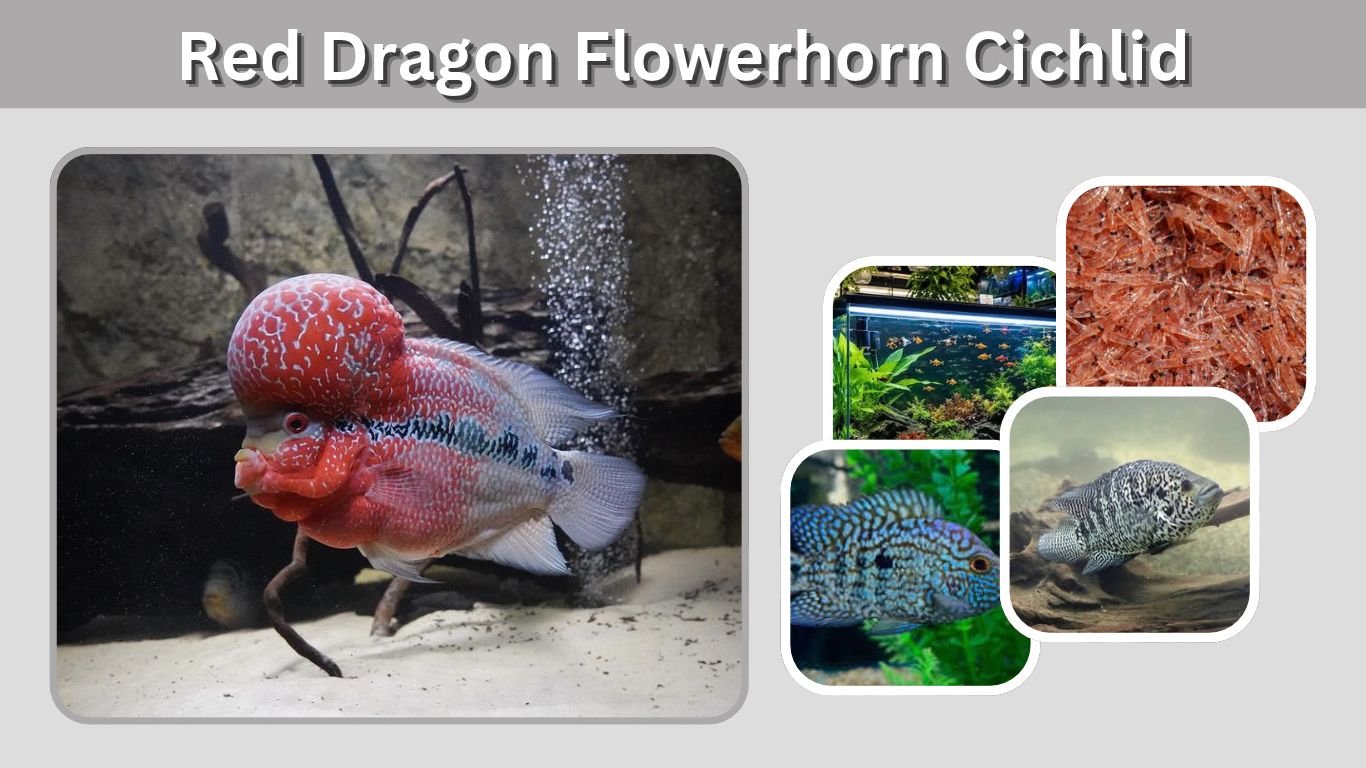
The Red Dragon Flowerhorn Cichlid is a colorful freshwater aquarium fish known for its bright red body, prominent forehead hump, and attractive pearly markings. This ornamental fish is a selectively bred variety of Flowerhorn Cichlid, developed for its striking appearance and interactive personality. Its combination of red coloration, black patterns, and shimmering scales makes it especially popular among aquarium enthusiasts.
Red Dragon Flowerhorns are intelligent fish that often recognize their owners and respond to movement outside the aquarium. However, their aggressive temperament and large adult size require careful aquarium planning. Understanding their appearance, feeding requirements, tank size, water conditions, and behavior is important for maintaining a healthy Red Dragon Flowerhorn.
What Is a Red Dragon Flowerhorn Cichlid?
The Red Dragon Flowerhorn Cichlid is a selectively bred variety of the hybrid Flowerhorn Cichlid. Flowerhorns were developed in Asia during the 1990s through crossbreeding involving several Central American cichlid species.
Red Dragon varieties are especially valued for their red coloration, distinctive body patterns, and large forehead humps.
Many Red Dragons are associated with Zhen Zhu Flowerhorn breeding lines, which are recognized for their elongated bodies, reflective pearling, and prominent heads.
Unlike naturally occurring fish species, Red Dragon Flowerhorns do not have a separate scientific species name.
| Characteristics | Red Dragon Flowerhorn Cichlid |
| Common Name | Red Dragon Flowerhorn |
| Scientific Classification | Hybrid cichlid |
| Family | Cichlidae |
| Origin | Selective breeding in Asia |
| Adult Size | Commonly 10–14 inches |
| Lifespan | Approximately 8–12 years |
| Minimum Tank Size | 75 gallons |
| Temperature | 78–84°F |
| pH Range | Approximately 6.5–8.0 |
| Diet | Omnivorous |
| Temperament | Aggressive and territorial |
| Care Level | Intermediate |
Red Dragon Flowerhorn Cichlid Appearance
The Red Dragon Flowerhorn is recognized by its muscular body, large head, and attractive red coloration. Its appearance varies depending on genetics, age, and breeding quality.
Bright Red Body Color
Red Dragon Flowerhorns typically develop red or orange coloration around their faces, heads, and front portions of their bodies.
Some individuals display red coloration across much of the body, while others retain lighter colors toward the tail.
Their color intensity depends heavily on genetics and may change as the fish matures.
Large Forehead Hump
One of the most distinctive characteristics is the large forehead hump, commonly called the kok.
This hump consists of specialized tissue and varies considerably between individual fish.
Male Flowerhorns are generally more likely to develop prominent humps, although females may also have visible forehead growth.
Pearly Scales and Black Markings
Many Red Dragon Flowerhorns have reflective white, blue, or silver spots across their bodies and fins.
These markings are commonly called pearling.
Some also display irregular black markings along the middle of their bodies, forming what aquarium enthusiasts call a flower line.
Red Dragon Flowerhorn Cichlid Size and Growth
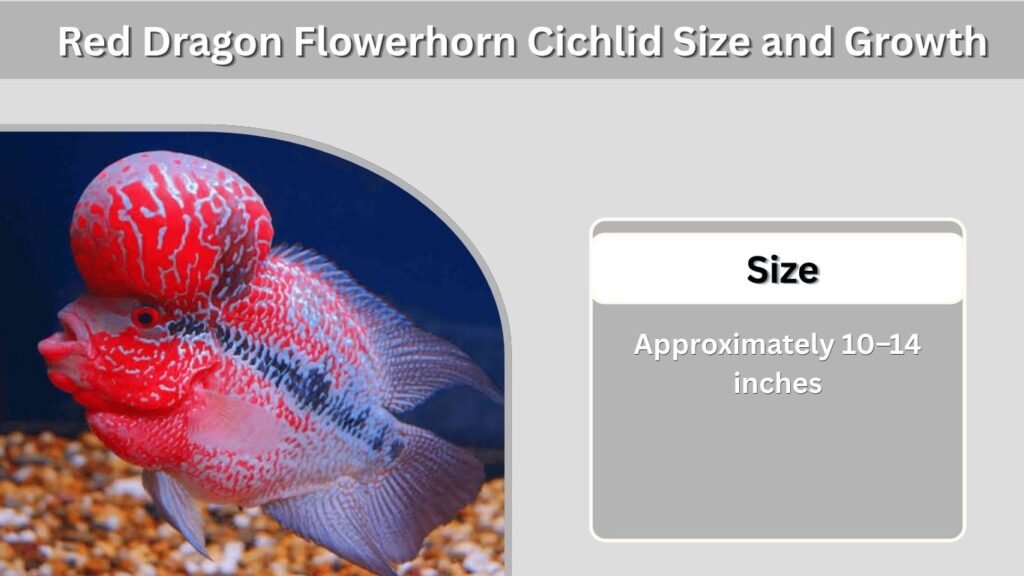
Adult Red Dragon Flowerhorns commonly reach approximately 10–14 inches in length.
Males usually grow larger than females, although size differences depend on genetics.
Young Flowerhorns may grow rapidly when provided with sufficient aquarium space, balanced food, and clean water.
Growth is generally faster during the juvenile stage and gradually slows as the fish approaches maturity.
A small juvenile should not be expected to remain suitable for a compact aquarium throughout its life.
Super Red Dragon Flowerhorn Cichlid
The Super Red Dragon Flowerhorn, often abbreviated as SRD, is a selectively bred form of the Red Dragon variety.
These fish are especially prized for their intense red coloration, attractive pearling, and prominent forehead development.
The term Super Red Dragon is commonly used in the ornamental fish trade, but grading standards are not completely uniform among breeders.
Red Dragon vs. Super Red Dragon Flowerhorn
| Feature | Red Dragon | Super Red Dragon |
| Red Coloration | Red to orange-red | Often deeper and more extensive |
| Forehead Hump | Varies by genetics | Frequently selected for prominence |
| Pearling | Common | Often pronounced |
| Body Pattern | Variable black markings | Often selected for balanced markings |
| Availability | Relatively common | Depends on breeding quality |
| Price | Generally less expensive | Premium specimens may cost more |
Both varieties require essentially the same aquarium conditions and maintenance.
A Super Red Dragon is not automatically healthier, larger, or longer-lived than a regular Red Dragon.
Red Dragon Flowerhorn Cichlid Tank Size
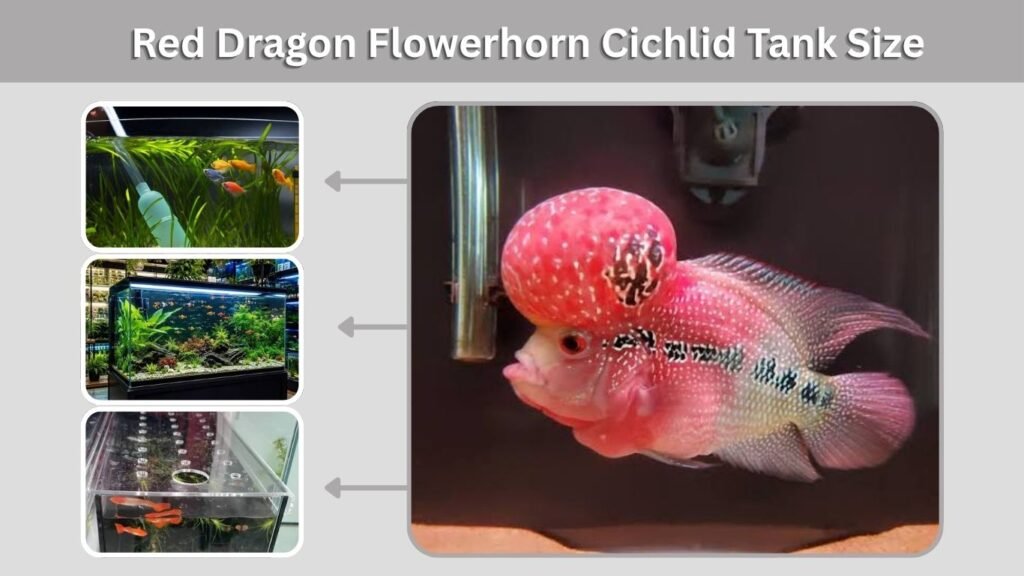
Red Dragon Flowerhorns require spacious aquariums because of their size, activity level, and territorial behavior.
A 75-gallon aquarium is a practical minimum for one adult, while a 90–125-gallon tank provides more comfortable swimming space for larger individuals.
Smaller aquariums may temporarily accommodate juveniles, but upgrading becomes necessary as they grow.
How to Set Up a Red Dragon Flowerhorn Tank
An appropriate aquarium should include:
- Strong filtration: Helps remove waste and maintain stable water quality.
- Reliable aquarium heater: Keeps water temperature consistent.
- Open swimming space: Allows comfortable movement.
- Smooth decorations: Helps prevent injuries.
- Secure aquarium lid: Prevents accidental jumping.
- Easy-to-clean substrate: Makes routine maintenance simpler.
Flowerhorns frequently move gravel and rearrange aquarium decorations.
Avoid sharp rocks, unstable ornaments, and exposed equipment that could injure the fish.
Red Dragon Flowerhorn Water Temperature and pH
Maintaining stable water conditions is essential for Red Dragon Flowerhorn health.
| Water Parameter | Recommended Level |
| Temperature | 78–84°F (26–29°C) |
| pH | Approximately 6.5–8.0 |
| Ammonia | 0 ppm |
| Nitrite | 0 ppm |
| Nitrate | Keep low |
| Water Changes | Around 25–30% weekly, adjusted to water tests |
The aquarium should be fully cycled before introducing the fish.
Sudden changes in temperature or water chemistry can cause stress, reduced appetite, and increased susceptibility to disease.
Regular water testing and proper filtration are important for long-term care.
What Do Red Dragon Flowerhorn Cichlids Eat?
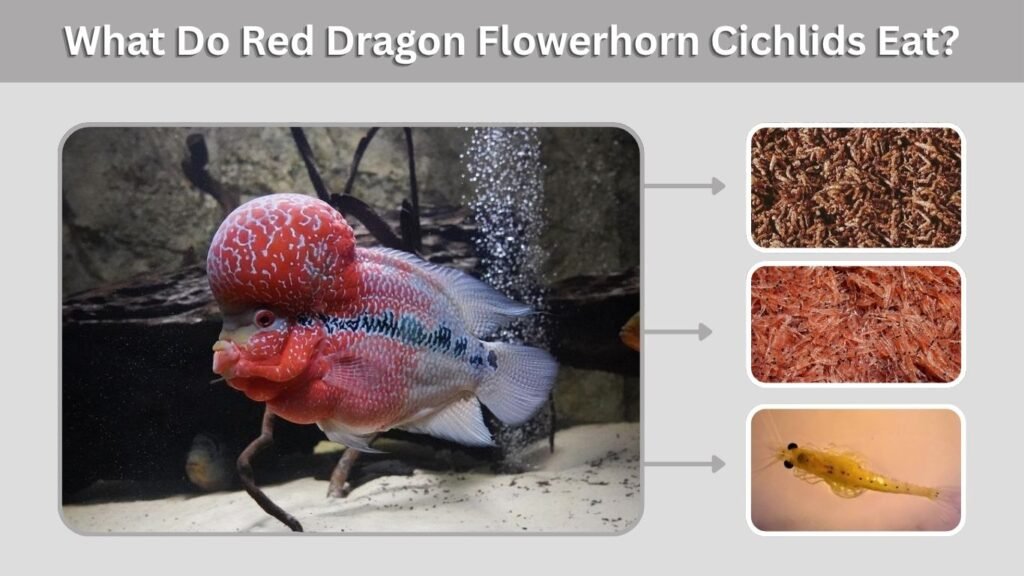
Red Dragon Flowerhorns are omnivorous fish that require balanced nutrition.
High-quality cichlid pellets should form the foundation of their diet because they provide essential nutrients needed for growth and maintenance.
Suitable foods include:
- Premium Flowerhorn pellets
- High-quality cichlid pellets
- Frozen shrimp
- Krill
- Mysis shrimp
- Bloodworms as occasional treats
- Appropriate insect-based aquarium foods
A varied diet helps maintain good health and supports normal coloration.
Best Food for Red Dragon Flowerhorn Color
Many Red Dragon Flowerhorn foods contain carotenoids, including astaxanthin, which can help support red pigmentation.
However, food cannot completely change a fish’s genetic coloration.
A Flowerhorn with naturally limited red pigmentation will not necessarily become bright red simply by eating color-enhancing pellets.
Avoid excessive supplements, artificial coloring treatments, and unnecessary overfeeding.
How Often Should You Feed a Red Dragon Flowerhorn?
Adult Red Dragon Flowerhorns generally require one or two modest meals daily.
Juveniles may benefit from smaller, more frequent feedings.
Offer only the amount of food the fish can consume promptly.
Overfeeding may contribute to digestive problems, excess waste, and declining aquarium water quality.
Red Dragon Flowerhorn Cichlid Tank Mates
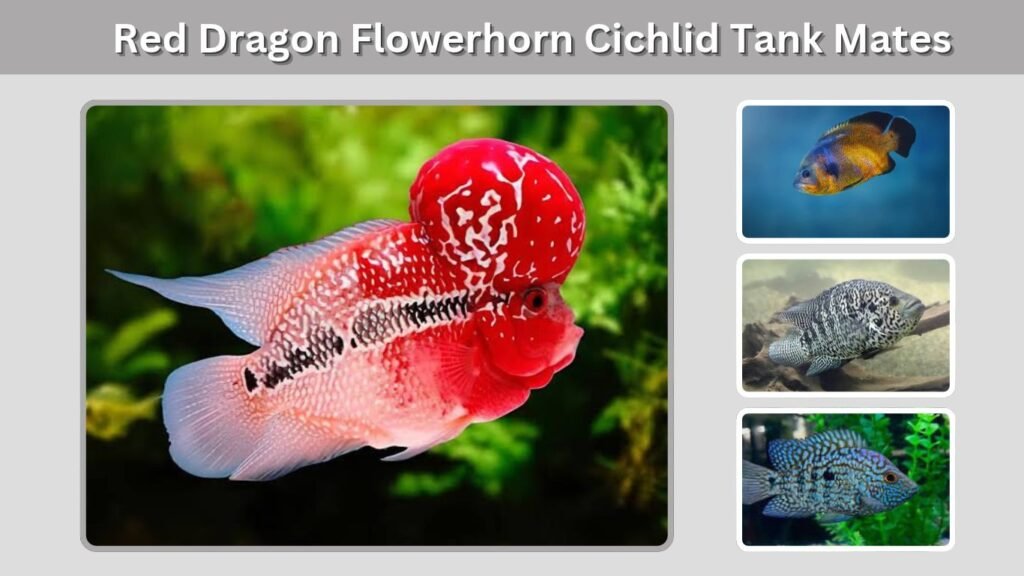
Red Dragon Flowerhorns are aggressive and territorial fish.
They may chase, bite, or seriously injure other aquarium inhabitants, particularly in confined spaces.
For this reason, keeping a Red Dragon Flowerhorn alone is generally the safest arrangement.
Can Red Dragon Flowerhorns Live With Other Fish?
Some experienced aquarists attempt to keep Flowerhorns with other large cichlids, including:
- Oscar Cichlids
- Texas Cichlids
- Jaguar Cichlids
- Red Devil Cichlids
However, these are not reliably compatible tank mates.
All four species can become aggressive, and serious fighting may occur even in large aquariums.
Any attempt at cohabitation requires considerable space, close monitoring, and a separate aquarium available immediately.
Small community fish should not be kept with Red Dragon Flowerhorns.
Red Dragon Flowerhorn Male vs. Female
Male and female Red Dragon Flowerhorns may display noticeable physical differences after reaching maturity.
Males are typically larger and frequently develop more prominent forehead humps.
Females often have smaller humps and comparatively rounded bodies.
However, these characteristics vary among individuals and cannot always determine sex accurately.
Examining the reproductive organs of mature fish provides a more dependable identification method.
How to Improve Red Dragon Flowerhorn Color
Red coloration is one of the most attractive characteristics of this Flowerhorn variety.
Several factors can influence its appearance.
1. Provide Balanced Nutrition
High-quality pellets containing appropriate vitamins and carotenoids support normal pigmentation.
2. Maintain Clean Water
Poor water quality can cause stress and affect a fish’s overall appearance.
Regular maintenance helps preserve healthy skin and scales.
3. Reduce Aquarium Stress
Aggressive tank mates, excessive disturbances, and unstable water conditions can cause stress-related color changes.
4. Use Suitable Aquarium Lighting
Moderate lighting can make red coloration and pearling easier to appreciate.
Avoid excessively intense lighting or sudden changes in the lighting schedule.
5. Understand Genetic Limitations
Genetics plays the greatest role in determining how much red coloration a Flowerhorn develops.
Some juveniles become noticeably redder as they mature, while others retain lighter coloration.
Red Dragon Flowerhorn Cichlid Lifespan
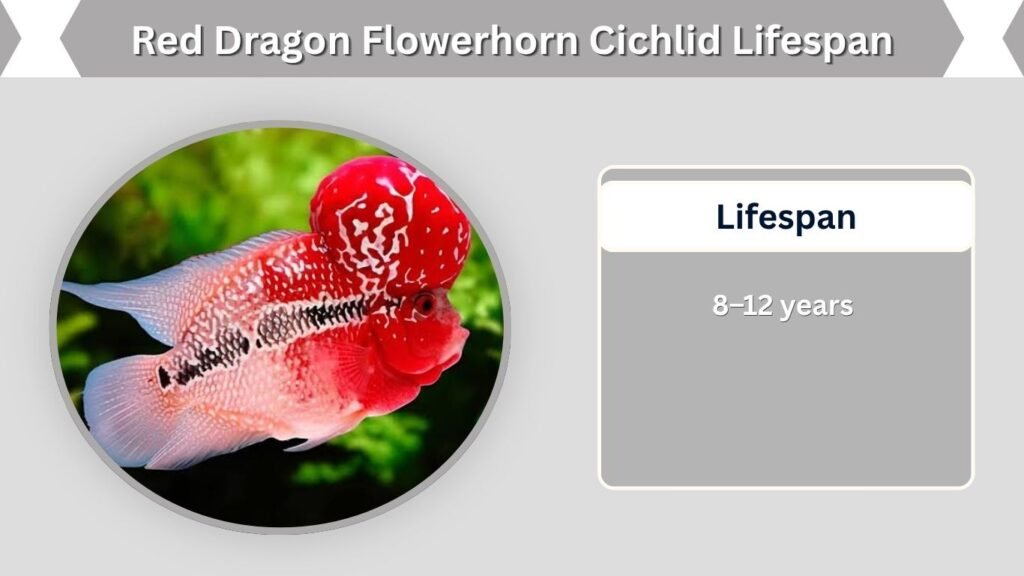
Red Dragon Flowerhorn Cichlids commonly live approximately 8–12 years under suitable aquarium conditions.
Their lifespan depends on genetics, nutrition, water quality, disease prevention, and overall husbandry.
Regular water changes, balanced feeding, and adequate aquarium space help support long-term health.
Fish exposed to persistent stress or unsuitable environmental conditions may experience a shorter lifespan.
Common Red Dragon Flowerhorn Health Problems
Like other ornamental cichlids, Red Dragon Flowerhorns can develop several health conditions.
Hole-in-the-Head Disease
This condition causes pits or lesions around the head.
Poor environmental conditions, nutritional problems, and certain infections may contribute to its development.
Bloating and Digestive Problems
An unusually swollen abdomen may indicate overfeeding, constipation, infection, or another internal disorder.
Reduced appetite, abnormal swimming, and persistent swelling require attention.
White Spot Disease
White spot disease, also called ich, is a parasitic infection that causes small white spots on the body and fins.
Affected fish may rub against decorations or show signs of irritation.
Stress and Color Loss
Sudden color changes may occur because of environmental stress, illness, or natural developmental processes.
Check water parameters and observe the fish’s behavior whenever unusual changes appear.
Red Devil Cichlid vs Red Dragon Flowerhorn
Red Devil Cichlids and Red Dragon Flowerhorns are sometimes confused because both can display red or orange coloration and aggressive behavior.
However, they are different fish.
The Red Devil Cichlid (Amphilophus labiatus) is a naturally occurring species native to Central America.
The Red Dragon Flowerhorn is a selectively bred hybrid produced through the ornamental aquarium trade.
Red Devils typically have a more natural cichlid body shape, while Red Dragon Flowerhorns are bred for prominent forehead humps, pearling, and distinctive body patterns.
Both require large aquariums and careful handling because of their territorial behavior.
Red Dragon Flowerhorn Cichlid Price and Buying Guide
Red Dragon Flowerhorn prices vary depending on size, age, coloration, head development, and breeding quality.
Juveniles generally cost less than mature fish with well-developed colors and forehead humps.
Super Red Dragon specimens with desirable characteristics may command higher prices.
Before purchasing, inspect the fish for:
- Clear, healthy eyes
- Smooth and intact scales
- Normal swimming behavior
- Healthy fins
- Regular breathing
- Good feeding response
- No obvious wounds or abnormal swelling
Purchase from a reputable aquarium breeder or retailer who can explain the fish’s feeding history and care requirements.
Remember that a juvenile’s final coloration and forehead size cannot be guaranteed.
FAQs
1. How Big Does a Red Dragon Flowerhorn Get?
Red Dragon Flowerhorns commonly grow between 10 and 14 inches long. Their final size depends on genetics, sex, nutrition, and aquarium conditions.
2. Is a Super Red Dragon Flowerhorn Rare?
High-quality Super Red Dragon specimens with extensive red coloration and attractive pearling may be less common than standard Red Dragons. However, availability varies among breeders and aquarium markets.
3. Can a Red Dragon Flowerhorn Live Alone?
Yes. Red Dragon Flowerhorns are highly territorial and generally do well in individual aquariums. Keeping one alone also reduces the risk of injuries caused by aggressive interactions.
4. Why Is My Red Dragon Flowerhorn Not Turning Red?
A young Flowerhorn may develop stronger coloration as it matures. Genetics, age, nutrition, and stress influence color development. Some individuals naturally remain orange or partially red.
5. Are Red Dragon Flowerhorn Cichlids Good for Beginners?
Red Dragon Flowerhorns are better suited to aquarists with some experience caring for large cichlids. Their aggressive behavior, substantial tank requirements, and need for consistent water maintenance can be challenging for beginners.