
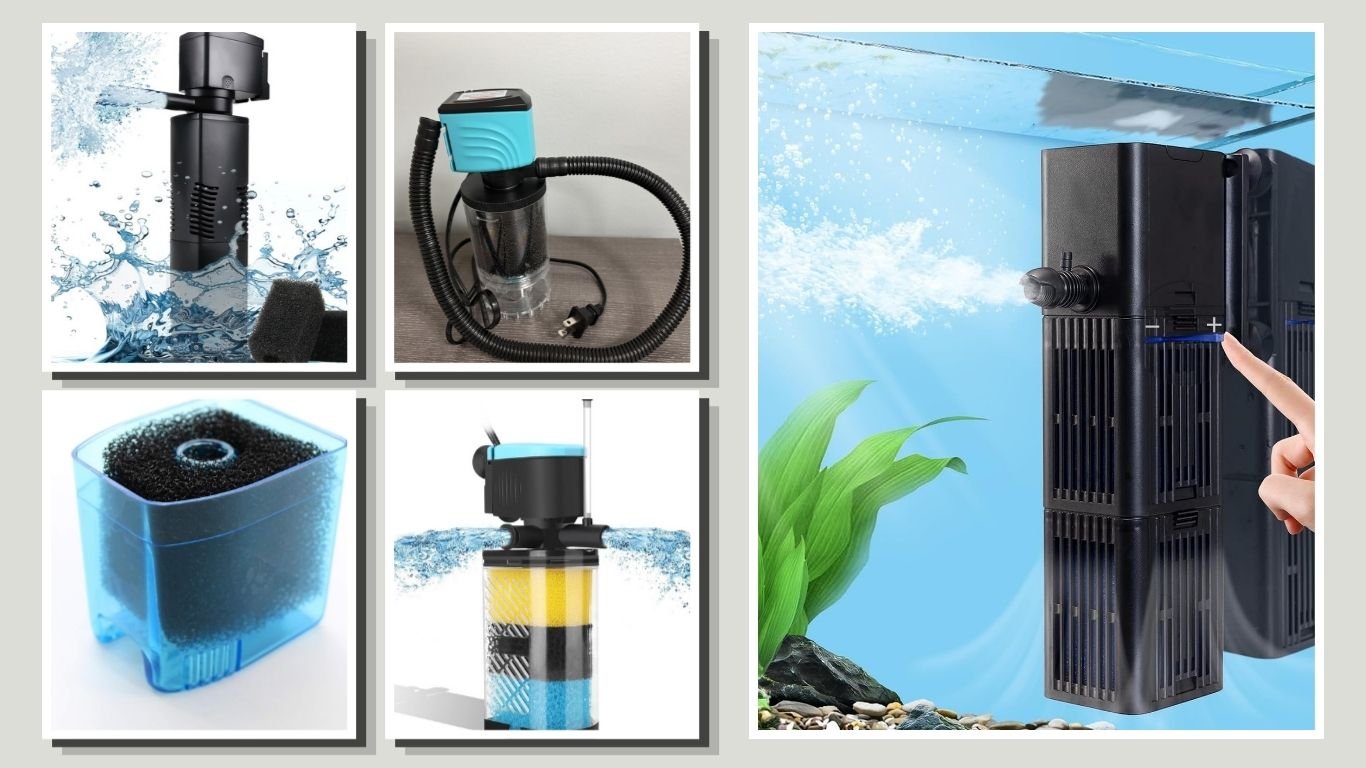
Keeping aquarium water clean, clear, and properly circulated is essential for the health of fish, plants, and other aquatic life. The best internal aquarium filter can remove debris, support biological filtration, improve oxygenation, and maintain steady water movement without taking up space outside the tank. Internal filters are especially convenient for freshwater tanks, turtle setups, and smaller aquariums. In this guide, we review nine reliable internal aquarium filters with different flow rates, filtration stages, and tank capacities to help you choose the right option for your aquarium.
1. Aulofee Submersible Internal Aquarium Filter
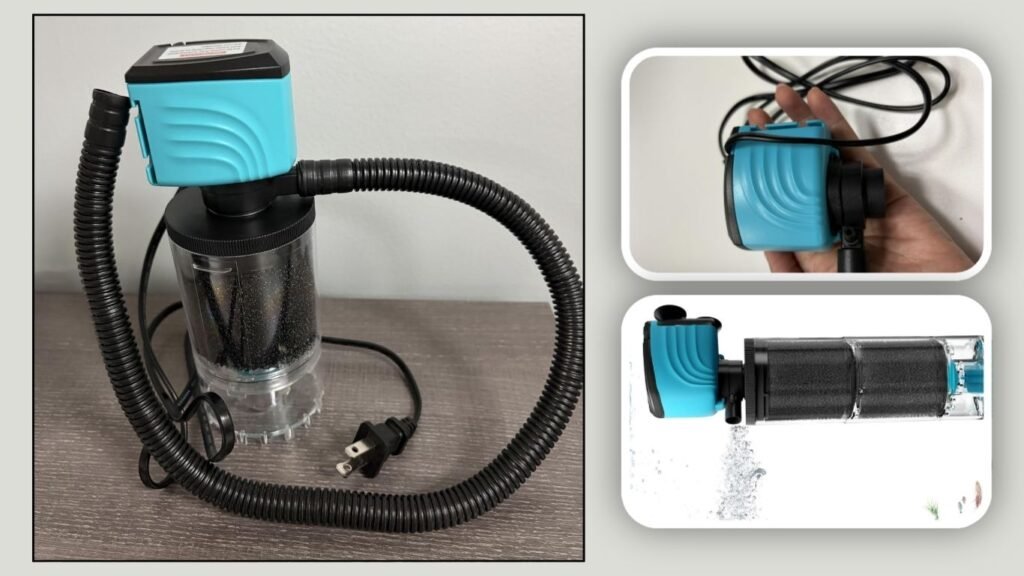
The Aulofee Submersible Aquarium Filter is designed for aquarists who need strong internal filtration without installing a bulky external system. Its fully submerged design combines filtration, circulation, and water movement inside the aquarium. It is especially suitable for larger freshwater or saltwater setups where fish waste and suspended debris can quickly affect water clarity.
Key Features
- Designed for approximately 50–150 gallon aquariums
- Fully submersible internal design
- Suitable for freshwater and saltwater tanks
- Can be positioned horizontally or vertically
- Integrated water pump for circulation
- Bottom guard helps protect smaller fish
- Compact design for its filtration capacity
Why It Stands Out for Larger Aquariums
One of the strongest advantages of the Aulofee filter is its ability to provide filtration and circulation from a single underwater unit. Larger tanks often develop areas where debris settles because water movement is insufficient. Positioning an internal filter closer to these problem areas can improve circulation and help direct suspended waste toward the filtration media.
Its ability to operate vertically or horizontally also makes installation more flexible. This can be particularly useful in turtle tanks, deeper aquariums, or setups where decorations limit available mounting space.
Filtration Performance and Water Circulation
The filter is intended to continually draw aquarium water through its filtration area while its pump returns cleaner water to the tank. That constant circulation can help reduce visible debris and improve overall water movement.
The protective bottom design is another useful consideration for tanks containing smaller aquatic animals. It helps reduce the chance of fish being pulled directly toward the intake while still allowing the filter to process tank water efficiently.
Best Use and Overall Verdict
This model makes the most sense for aquarists wanting substantial internal filtration in medium-to-large tanks. Its submersible construction keeps most equipment inside the aquarium and avoids the plumbing associated with external canister filters.
For fish or turtle setups where strong circulation, flexible placement, and straightforward maintenance matter, the Aulofee provides a practical combination of filtration and water movement.
2. Tetra Whisper 40i Internal Power Filter
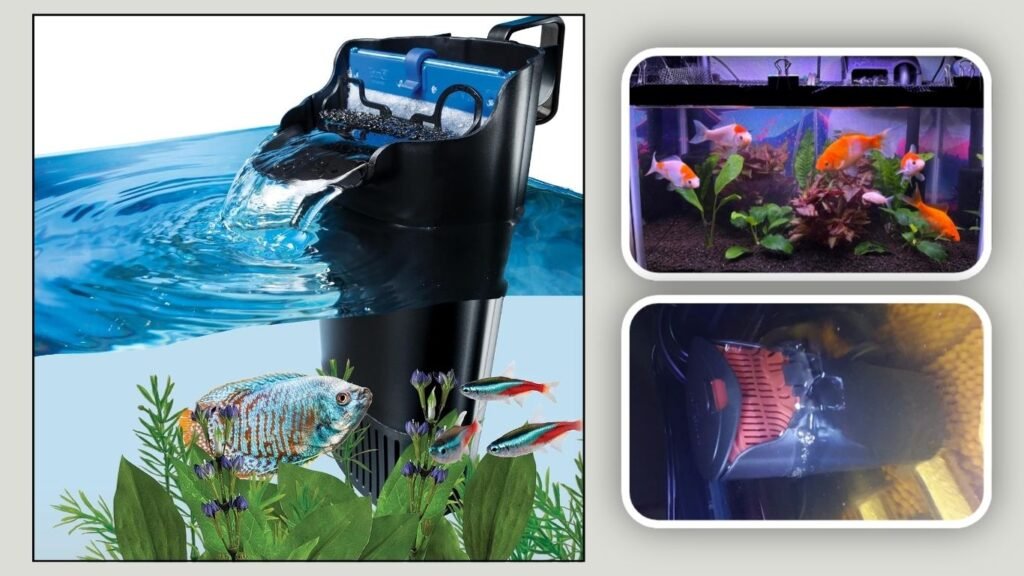
The Tetra Whisper 40i is a well-established internal filter designed for aquariums up to approximately 40 gallons. It combines mechanical filtration with a reusable biological filtration surface while maintaining continuous water circulation. Its relatively simple cartridge-based design makes routine maintenance straightforward, making it particularly appealing for beginner and intermediate aquarium keepers.
Key Features
- Designed for aquariums up to 40 gallons
- Flow rate of up to approximately 170 GPH
- Uses replaceable Tetra Bio-Bag cartridges
- Includes a Bio-Scrubber for biological filtration
- Internal aquarium installation
- Adjustable mounting height
- Continuous filtration and oxygenation
Why It Works Well for Everyday Aquariums
The Whisper 40i focuses on simplicity rather than complicated media chambers. Water passes through the replaceable cartridge, where suspended particles and waste can be captured before the water returns to the aquarium.
Its Bio-Scrubber provides additional surface area where beneficial bacteria can establish. These bacteria play an important role in biological filtration by helping process waste compounds produced by fish.
This combination makes the filter particularly useful for community aquariums requiring dependable everyday filtration.
Filtration Performance and Maintenance
The filter can move up to approximately 170 gallons of water per hour, providing substantial circulation for tanks within its intended size range.
Maintenance is also uncomplicated. Tetra recommends replacing the Bio-Bag cartridge periodically, while the Bio-Scrubber generally remains in place unless damaged. If excessive debris accumulates, the biological surface can be gently rinsed with dechlorinated water rather than completely replaced.
Best Use and Overall Verdict
The Tetra Whisper 40i is especially practical for aquarists who prioritize straightforward maintenance and easily replaceable filter media. It fits community tanks, beginner aquariums, and everyday freshwater setups without requiring complicated installation.
Its combination of cartridge filtration, biological support, and steady circulation makes it a balanced internal filtering option for tanks approaching the 40-gallon range.
3. TARARIUM 300 GPH Internal Aquarium Filter
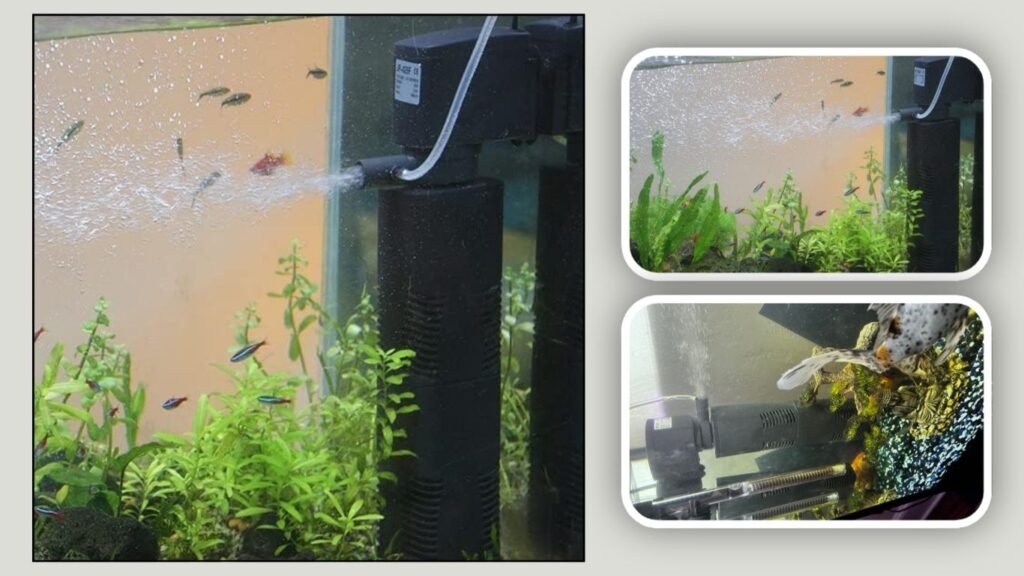
The TARARIUM Internal Aquarium Filter is built for aquariums that require stronger water movement and filtration than small internal filters typically provide. With a rated flow of about 300 GPH, it can help circulate substantial volumes of aquarium water while collecting suspended waste. Its tall, fully submersible construction makes it useful for larger fish and turtle environments.
Key Features
- Approximately 300 GPH flow rate
- Designed for larger aquarium setups
- Fully submersible construction
- Integrated filtration and circulation
- Suitable for fish and turtle tanks
- Compact vertical footprint
- Corded electric operation
Why It Is Best for High-Waste Tanks
Larger fish and turtles can produce considerable waste, meaning weak water circulation may allow debris to accumulate quickly. The TARARIUM filter’s higher flow rate helps move more water through the filtration system and keeps particles suspended long enough for them to reach the intake.
Its internal positioning also allows the filter to be placed strategically near areas where waste commonly settles. That flexibility can be particularly valuable in tanks containing large decorations, rocks, driftwood, or basking structures.
Water Movement and Filtration Performance
A rated flow of approximately 300 GPH gives this TARARIUM model enough circulation capacity for medium and larger aquariums.
Strong circulation can also improve water distribution throughout the tank. Instead of allowing filtered water to remain concentrated around one area, the output helps mix aquarium water and reduces stagnant sections.
The filter therefore serves multiple purposes: capturing suspended debris, moving water, and creating additional circulation around the aquarium.
Best Use and Overall Verdict
This TARARIUM model is best suited to aquarium keepers who specifically want stronger internal circulation. It can be particularly attractive for turtle tanks, heavily stocked aquariums, and setups where visible debris accumulates quickly.
Its 300 GPH output provides noticeably more water movement than many small internal filters, making it an appealing middle ground between compact filtration and larger external systems.
4. AquaMiracle 3-Stage Internal Aquarium Filter
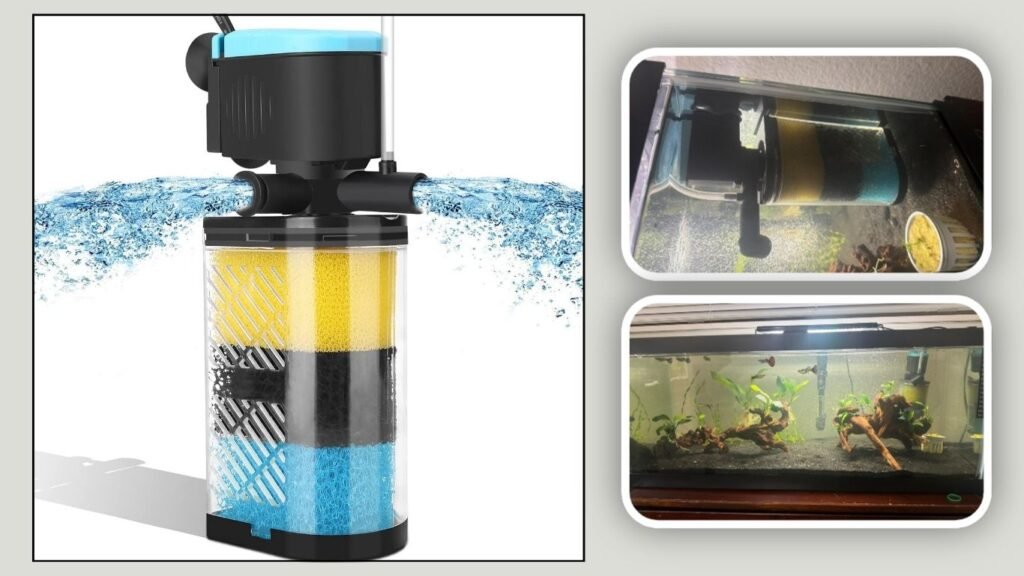
The AquaMiracle Internal Aquarium Filter offers a more structured filtration approach by combining several sponge stages with water circulation and aeration. Different versions are available for varying aquarium capacities, making the design adaptable to both smaller and larger tanks. Dual water outlets further help distribute filtered water more evenly around the aquarium.
Key Features
- Three-stage sponge filtration system
- Coarse, carbonized, and fine sponge media
- Multiple size and flow configurations
- Dual water outlets
- Integrated aeration function
- Fully submersible motor
- Suitable for fish and turtle tanks
Why Its Multi-Stage Design Is Useful
Aquarium debris varies considerably in size. Uneaten food and plant material may be relatively large, while tiny suspended particles can make otherwise healthy aquarium water look cloudy.
AquaMiracle addresses this by using different sponge densities. The coarse sponge targets larger waste, while progressively finer filtration helps catch smaller material. The carbonized sponge provides an additional filtration stage for improving overall water quality.
This layered approach makes the filter particularly appealing when water clarity is an important priority.
Filtration, Aeration, and Water Flow
Depending on the selected model, AquaMiracle offers versions with different flow rates and aquarium-size recommendations. Current product information lists configurations ranging from about 130 GPH to 300 GPH.
The dual outlets can distribute returning water more effectively than a single concentrated output. Integrated aeration is another practical feature because surface agitation and air introduction can support oxygen exchange.
These functions allow one compact device to handle filtration, circulation, and aeration simultaneously.
Best Use and Overall Verdict
The AquaMiracle is a strong choice for aquarists who want more than basic sponge filtration. Its layered media system is particularly useful when both larger debris and finer suspended particles need attention.
The combination of adjustable model sizes, multiple filtration stages, dual outlets, and aeration gives this filter considerable versatility for freshwater fish, turtles, and general community aquarium setups.
5. NO.17 Submersible Internal Aquarium Filter
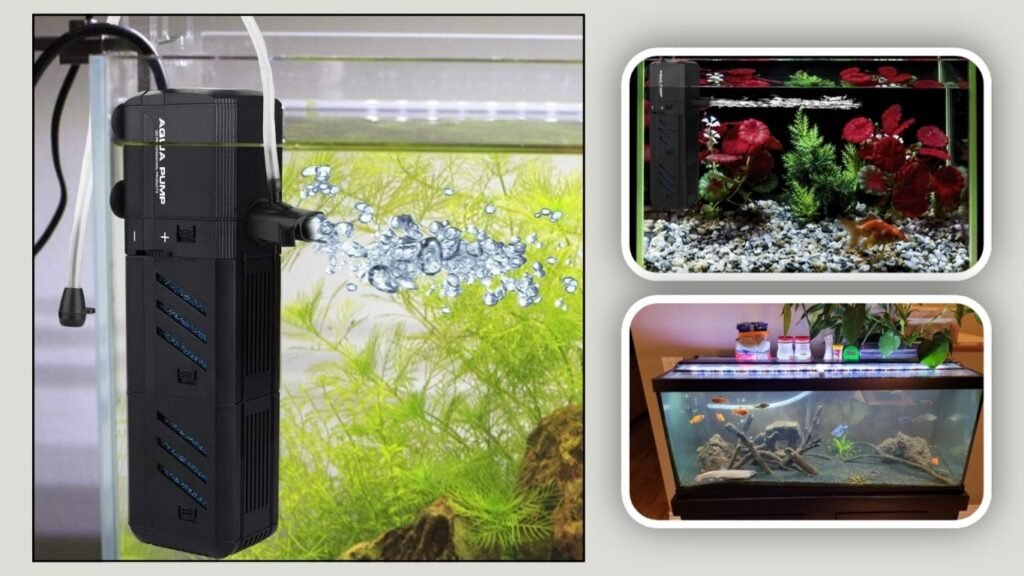
The NO.17 Submersible Aquarium Filter combines an adjustable water pump with internal filtration, giving aquarium owners greater control over circulation. The version associated with this model is commonly listed with an 8-watt motor and approximately 200 GPH maximum flow, making it suitable for small-to-medium aquariums where adjustable water movement is important.
Key Features
- Approximately 200 GPH maximum flow
- 8-watt submersible motor
- Adjustable water flow
- Designed for roughly 10–50 gallon tanks
- Multiple filtration media
- Compact internal construction
- Designed for quiet operation
Why Adjustable Flow Makes a Difference
Not every aquarium needs maximum water movement. Bettas and some other slower-swimming fish generally appreciate calmer sections, while community tanks may benefit from stronger circulation.
The adjustable pump gives aquarium keepers more flexibility to balance filtration performance with the needs of their livestock. This can be particularly useful when changing stocking levels, decorations, or aquarium layouts.
Rather than replacing the entire filtration system, users can modify the flow to better match changing tank conditions.
Filtration Performance and Everyday Operation
With a listed maximum output of around 200 GPH, this NO.17 model can circulate the water in many small and medium tanks several times per hour.
Multiple filtration media help trap debris as aquarium water passes through the unit. Because the pump and filter are integrated into a single submerged system, there is no need for external hoses or a separate pump.
Its compact footprint also allows it to fit into aquarium corners where it can remain relatively unobtrusive.
Best Use and Overall Verdict
The NO.17 filter is particularly attractive for aquarium owners who value flow control. Being able to increase or reduce water movement provides more flexibility than a fixed-output internal filter.
For small-to-medium community tanks, freshwater aquariums, and setups where a compact filtration system is preferred, its combination of adjustable circulation, internal media, and simple submerged installation makes it a practical everyday option.
6. Internal Aquarium Filter for 55–150 Gallon Tanks
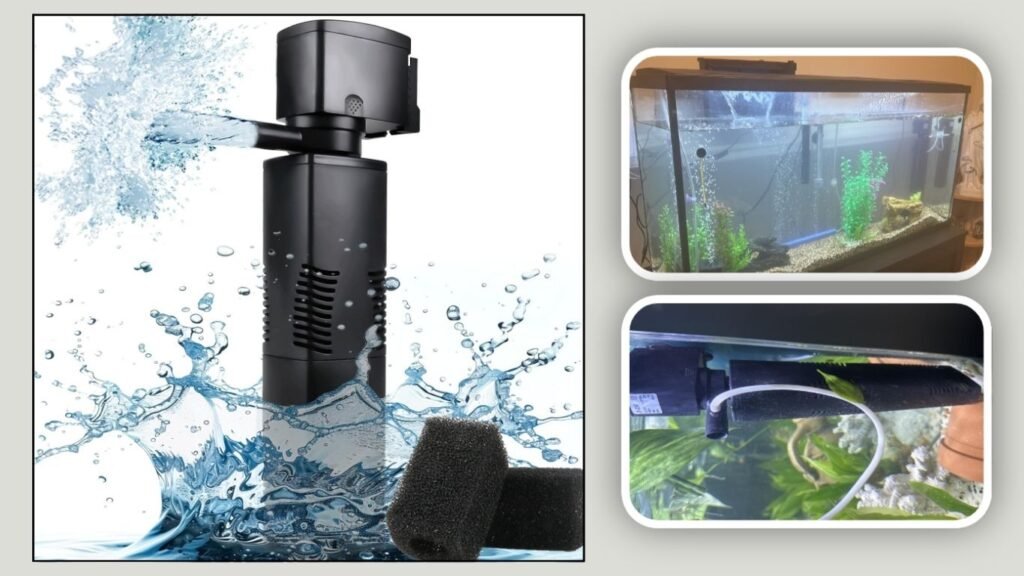
This internal aquarium filter is designed for larger tanks where stronger filtration and water circulation are necessary. It combines mechanical filtration, water movement, and aeration in one submerged unit, making it useful for fish tanks, turtle habitats, and heavily stocked aquariums. Its higher-capacity design can help manage visible debris while maintaining consistent circulation throughout the aquarium.
Key Features
- Designed for approximately 55–150 gallon tanks
- Fully submersible internal construction
- Powerful water circulation
- Integrated aeration function
- Suitable for fish and turtle tanks
- Multi-purpose filtration design
- Helps reduce suspended debris
Why It Is Best for Larger Tank Setups
Larger aquariums require more than basic filtration because waste can accumulate in corners and low-flow areas. This model provides stronger circulation that can help move debris toward the intake instead of allowing it to settle on the substrate.
Its internal placement can also be useful when the aquarium does not have enough space behind or underneath it for an external filter. Everything remains inside the tank, making installation relatively straightforward.
The design is particularly practical for turtle tanks and larger fish because these animals can generate considerable amounts of waste.
Filtration Power and Water Movement
The filter continuously pulls aquarium water through its filtration media while returning it with enough force to improve circulation. This process can help capture uneaten food, suspended waste, and other particles that affect water clarity.
The aeration function adds another benefit by increasing surface movement and improving gas exchange. Better circulation can also help distribute oxygen, heat, and nutrients more evenly throughout the aquarium.
For larger tanks, that combination of filtration and water movement can help create a more stable aquatic environment.
Best Use and Overall Verdict
This model is most appropriate for aquarium keepers who need stronger internal filtration without moving to a canister system. Its higher-capacity design works well for larger community tanks, turtle setups, and aquariums with moderate-to-heavy biological loads.
The combination of circulation, filtration, and aeration makes it a versatile option for maintaining clearer water while reducing the amount of separate equipment required.
7. Penn-Plax Cascade 600 Internal Aquarium Filter
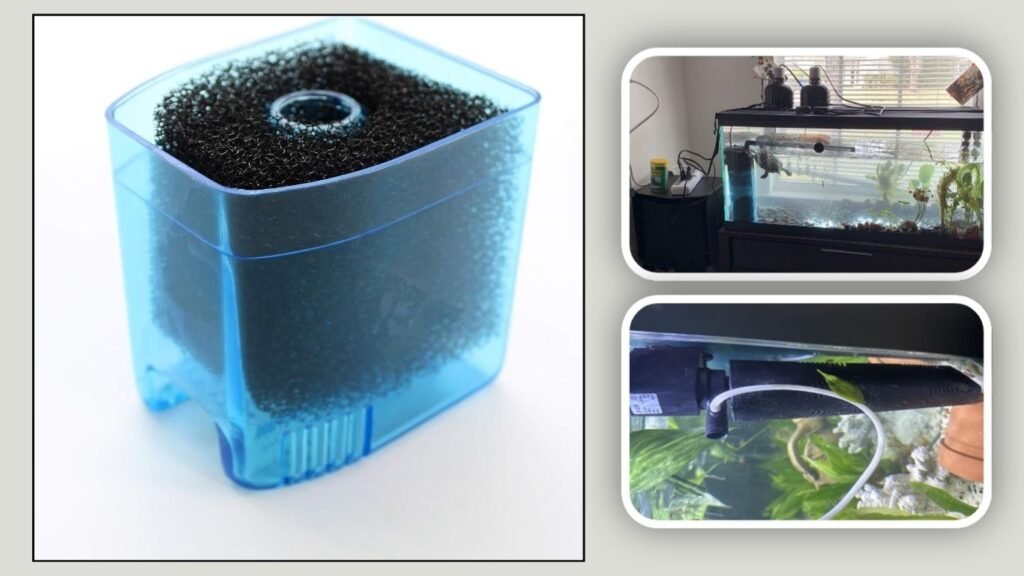
The Penn-Plax Cascade 600 is a compact fully submersible filter designed to provide mechanical, chemical, and biological filtration inside the aquarium. It is particularly useful for small and medium tanks where dependable filtration is needed without installing external hoses or equipment. Its recognizable internal design also offers adjustable positioning and convenient access to filtration media.
Key Features
- Fully submersible internal filter
- Designed for tanks up to approximately 50 gallons
- Multi-stage filtration
- Replaceable filter media
- Adjustable flow direction
- Suitable for freshwater and marine aquariums
- Compact vertical design
Why It Is Best for Reliable Everyday Filtration
Penn-Plax designed the Cascade series around straightforward aquarium maintenance. The internal filter can be installed directly inside the tank, which eliminates the need for priming external hoses or finding cabinet space for larger filtration systems.
Its multi-stage filtration approach is particularly useful for everyday aquarium maintenance. Mechanical media captures visible debris, while additional media can help manage dissolved impurities and provide space for beneficial bacteria.
This balanced filtration makes the unit suitable for community fish tanks where consistent water quality matters more than extremely powerful flow.
Performance and Maintenance
One of the practical advantages of the Cascade 600 is its accessible filtration chamber. The media can be removed and serviced without dismantling a complicated external system.
Regular cleaning of the sponge and other filter media can help maintain water flow and prevent debris buildup. The filter’s internal pump also keeps aquarium water circulating continuously, helping reduce stagnant areas.
Its relatively compact construction means it can fit into aquarium corners while still leaving room for plants, rocks, driftwood, and other decorations.
Best Use and Overall Verdict
The Penn-Plax Cascade 600 suits aquarium owners who want an established internal filtration design with flexible media options. It works particularly well in small-to-medium freshwater community tanks and similar aquarium setups.
Its combination of compact size, multi-stage filtration, and straightforward maintenance gives it strong everyday usability without the complexity associated with larger external filtration systems.
8. 660 GPH Internal Aquarium Filter for 100–300 Gallon Tanks
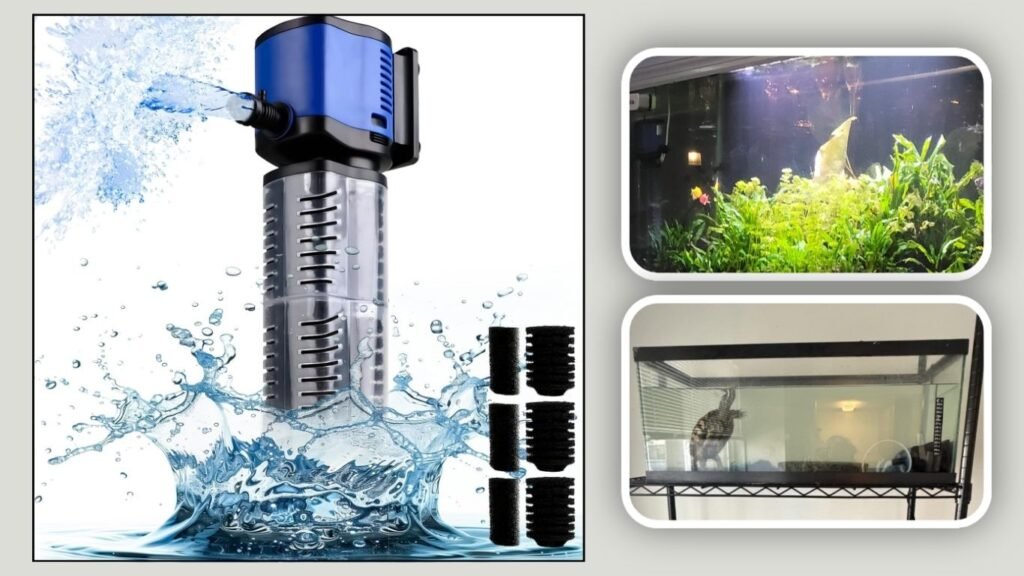
This high-capacity internal aquarium filter is designed for large aquariums where strong water movement is essential. With a powerful pump and submerged filtration system, it can process significant amounts of aquarium water while helping remove suspended debris. It is particularly suited to large fish tanks, turtle habitats, and other setups where smaller internal filters may struggle to keep up.
Key Features
- Designed for approximately 100–300 gallon tanks
- High-capacity internal filtration
- Powerful water circulation
- Fully submersible pump
- Suitable for large fish and turtle tanks
- Helps improve aeration and water movement
- Designed for high-waste environments
Why It Is Best for Very Large Aquariums
Large tanks can develop dead spots where water movement is weak and waste accumulates. A high-output internal filter can help reduce these areas by pushing water farther across the aquarium.
The stronger circulation is particularly useful in tanks containing large fish, turtles, or higher stocking levels. These setups typically create more solid waste and require faster water turnover than lightly stocked aquariums.
Because the filter operates entirely underwater, it can also simplify installation compared with larger external systems that require hoses and additional space.
Powerful Circulation and Filtration
Higher flow can help keep debris suspended long enough for the filter intake to capture it. Instead of allowing waste to settle quickly on the substrate, strong circulation encourages particles to move through the filtration system.
This water movement can also improve oxygen exchange at the surface. In long or deep tanks, proper circulation helps distribute oxygenated water throughout different areas of the aquarium.
However, high-output filters should be positioned carefully around slow-swimming species because excessively strong currents may cause unnecessary stress.
Best Use and Overall Verdict
This model is most suitable for large tanks where water volume and waste production require substantially stronger filtration.
It can be especially useful for turtle tanks, large community aquariums, and setups containing bigger fish. For aquarium owners who want powerful internal circulation while keeping external equipment to a minimum, this high-capacity design offers a practical solution.
9. TARARIUM Internal Aquarium Filter for 20–75 Gallon Tanks
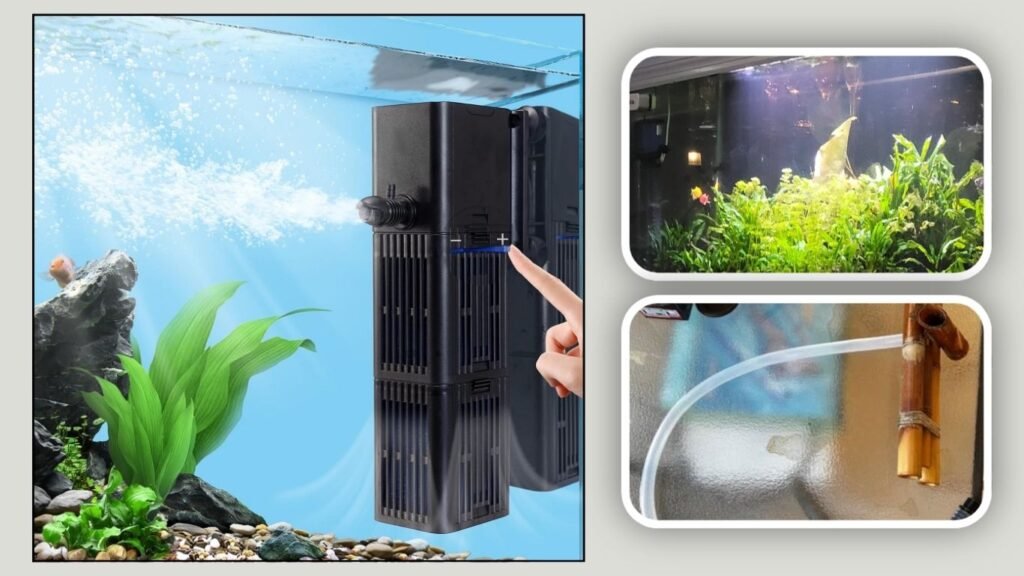
The TARARIUM internal aquarium filter for 20–75 gallon tanks offers a practical balance between compact size and effective water circulation. It is designed for aquarists who want filtration, circulation, and aeration from one underwater unit. Its adjustable design allows it to work across different aquarium sizes, including freshwater fish tanks and turtle environments.
Key Features
- Designed for approximately 20–75 gallon aquariums
- Fully submersible construction
- Adjustable water flow
- Integrated filtration and circulation
- Aeration capability
- Suitable for freshwater fish and turtles
- Compact internal design
Why It Is Best for Medium-Sized Tanks
Medium aquariums often need more circulation than nano filters can provide but do not necessarily require a large external canister system. This TARARIUM filter fits neatly between those two categories.
Its internal installation makes setup relatively simple, while adjustable flow gives aquarium owners more control over water movement.
That flexibility is particularly useful in community tanks containing fish with different swimming abilities. Stronger flow can be used when additional circulation is needed, while gentler settings may be better for calmer areas of the aquarium.
Filtration and Everyday Performance
The filter draws water through its filtration section, where suspended particles can be trapped before the water returns to the aquarium.
Continuous circulation can reduce visible debris while helping oxygenated water reach different parts of the tank. The aeration function can further improve surface agitation, which supports gas exchange.
Because filtration and circulation are combined in a single device, the aquarium setup can remain relatively simple and uncluttered.
Best Use and Overall Verdict
This TARARIUM filter is well suited to small-to-medium community aquariums, turtle tanks, and general freshwater setups.
Its main strengths are versatility and simplicity. Adjustable water movement allows the filter to adapt to different aquarium conditions, while the submerged design avoids the additional plumbing associated with external filters.
For aquarists who need an internal filter covering a broad range of medium tank sizes, it provides a useful combination of filtration, circulation, and aeration.
FAQs
1. What Is an Internal Aquarium Filter?
An internal aquarium filter is a filtration system installed directly inside the aquarium and submerged in the water. It typically uses a small electric pump to pull aquarium water through sponge, cartridge, or other filtration media before returning cleaner water to the tank. Many models also provide water circulation and aeration.
2. Are Internal Filters Good for Aquariums?
Yes. Internal filters can work very well in small and medium aquariums and can also supplement filtration in larger tanks. They are compact, relatively easy to install, and can provide mechanical and biological filtration. The key is choosing a model with sufficient filtration capacity and flow for the aquarium size and livestock.
3. How Often Should I Clean an Internal Aquarium Filter?
Most internal filters benefit from routine inspection every few weeks, although cleaning frequency depends on fish numbers, feeding, and waste production. Sponge media should generally be rinsed gently in removed aquarium water rather than untreated tap water so beneficial bacterial colonies are not unnecessarily disrupted.
4. Where Should an Internal Aquarium Filter Be Placed?
An internal filter should usually be positioned where it can create good circulation across the aquarium without producing excessive current for the fish. Placing the outlet near the water surface can increase surface agitation, while positioning the intake near areas where debris collects may improve mechanical filtration.
5. How Do I Choose the Best Internal Aquarium Filter?
Start by checking the filter’s recommended tank size and flow rate. You should also consider filtration media, adjustable flow, noise level, maintenance requirements, and the type of animals in the aquarium. Heavily stocked fish tanks and turtle setups generally require stronger filtration than lightly stocked community aquariums.