
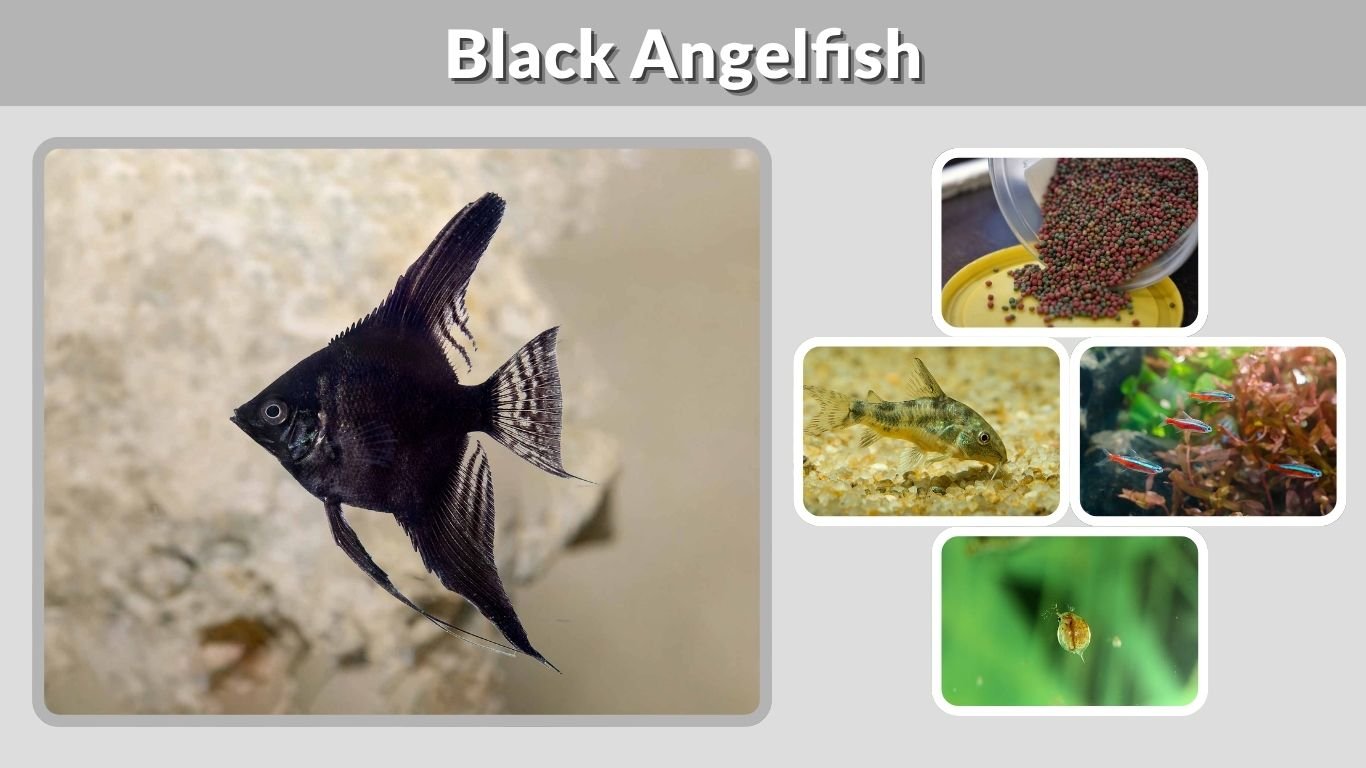
The black angelfish is a dark-colored variety of the freshwater angelfish, admired for its elegant body, flowing fins, and deep black coloration. Most black angelfish kept in home aquariums belong to the species Pterophyllum scalare, a South American cichlid available in many selectively bred colors and patterns. Although these fish are generally manageable for aquarists with some experience, they need a tall aquarium, stable warm water, a balanced diet, and carefully selected tank mates. With proper care, black angelfish can become impressive centerpiece fish and live for many years.
Black Angelfish Quick Facts
Black angelfish have essentially the same care requirements as silver, koi, marble, and other domestic freshwater angelfish. Their dark appearance comes from selective breeding rather than membership in a separate species. Most aquarium varieties are forms of Pterophyllum scalare.
| Feature | Information |
| Scientific name | Pterophyllum scalare |
| Family | Cichlidae |
| Water type | Freshwater |
| Adult body length | Up to about 6 inches |
| Total height | Up to about 8 inches with fins |
| Temperament | Semi-aggressive |
| Preferred temperature | Approximately 78–82°F |
| Recommended tank | Tall 30-gallon or larger aquarium |
| Diet | Omnivorous |
| Expected lifespan | About 8–12 years with excellent care |
Adult freshwater angelfish may reach approximately 6 inches in body length and around 8 inches in total height when their long dorsal and anal fins are included. Well-maintained fish can live for roughly 8–12 years.
What Is a Black Angelfish?
A black angelfish is a freshwater angelfish bred to display increased amounts of dark pigmentation. It has the same laterally compressed, triangular body and long fins seen in other domestic angelfish.
The term can describe several varieties rather than one fixed appearance. Some fish are almost completely black, while others have silver scales, stripes, lace-like patterns, or lighter sections.
Common Black Angelfish Varieties
Popular dark varieties include:
- Double-black angelfish: Usually displays very dark coloration across most of its body and fins.
- Black lace angelfish: Has dark pigmentation combined with delicate, lace-like fin markings.
- Half-black angelfish: Features a lighter front half and a dark rear portion.
- Black marble angelfish: Displays irregular black, silver, and sometimes white patches.
- Black veil angelfish: Combines dark coloration with especially long, flowing fins.
- Black zebra angelfish: Has multiple dark vertical bands over a lighter or smoky body.
Color may look slightly different depending on genetics, age, lighting, background, health, and stress. A temporarily pale fish is not necessarily changing varieties.
Freshwater vs. Saltwater Black Angelfish
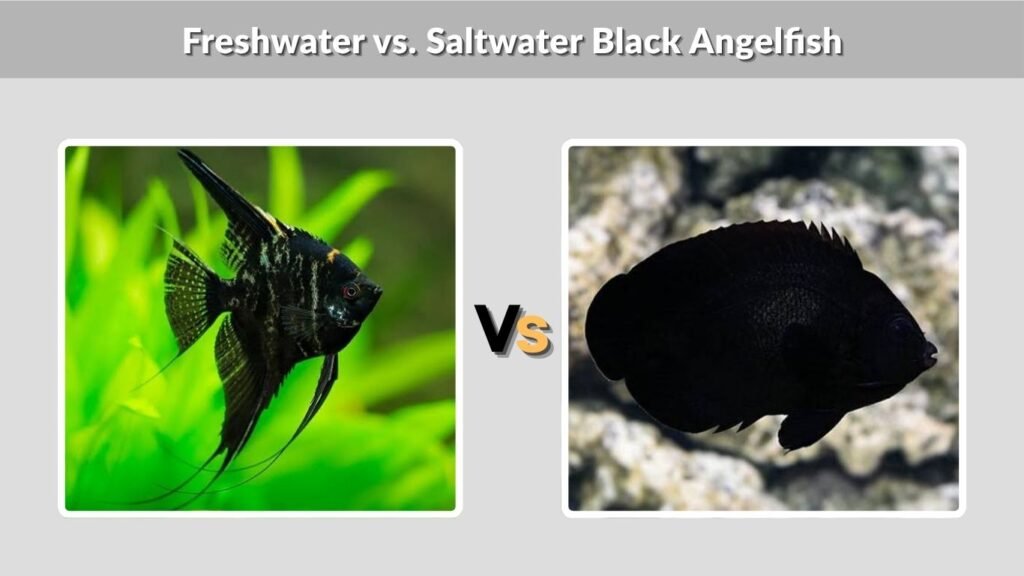
Freshwater and marine angelfish are very different fish that should never be placed in the same aquarium.
Freshwater black angelfish belong to the genus Pterophyllum and originate from South American freshwater habitats. Marine angelfish belong to several unrelated saltwater genera and require reef or marine aquarium conditions. The word “angelfish” is used for both groups because of their attractive shapes, not because they have identical care requirements.
| Feature | Freshwater black angelfish | Marine black angelfish |
| Water | Freshwater | Saltwater |
| Common aquarium species | Pterophyllum scalare | Several marine species |
| Tank setup | Planted tropical aquarium | Marine or reef-style aquarium |
| General difficulty | Moderate | Often moderate to advanced |
| Body shape | Tall and triangular | Varies by marine species |
Always confirm the scientific name before purchasing a fish described simply as a “black angelfish.”
Black Angelfish Tank Size and Setup
A tall aquarium is more suitable than a short tank because adult angelfish need vertical room for their extended fins. A practical minimum is approximately 30 gallons for a single adult or compatible pair, although a larger aquarium provides more stable water conditions and additional territory.
Groups need considerably more room. A 55-gallon tank is a more practical starting point for several juveniles, with a plan to separate fish if pairs become territorial. Aquarium Co-Op notes that stocking depends strongly on adult numbers, companions, territorial behavior, and maintenance.
Ideal Tank Features
A suitable setup should include:
- A tall aquarium with open swimming space
- Reliable heater and thermometer
- Appropriately sized biological filter
- Broad-leaved or tall aquarium plants
- Smooth driftwood and decorations
- A secure lid
- Moderate or gentle water movement
- No sharp objects that could tear long fins
Wild Pterophyllum scalare occupies vegetated, slow-moving or flooded freshwater habitats. Plants, driftwood, shaded areas, and vertical structures can therefore create a comfortable aquarium environment.
Water Conditions
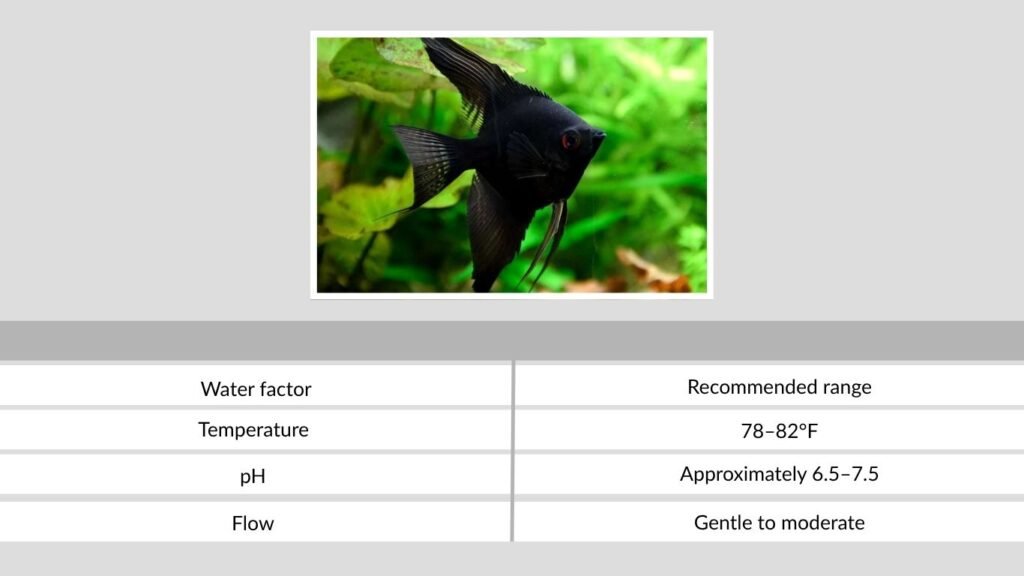
Captive-bred black angelfish can adapt to a reasonable range of water chemistry, but stability is more important than constantly adjusting the aquarium to reach an exact number.
Maintain the following general conditions:
| Water factor | Recommended range |
| Temperature | 78–82°F |
| pH | Approximately 6.5–7.5 |
| Flow | Gentle to moderate |
| Ammonia | 0 ppm |
| Nitrite | 0 ppm |
Freshwater angelfish can tolerate a broader temperature and pH range, but sudden changes can cause stress. Aquarium Co-Op reports successful maintenance at approximately 78–86°F and pH 6.0 — 8.0, depending on the fish’s breeding history and local water.
Cycle the aquarium fully before adding angelfish. Test the water regularly and perform partial water changes to control waste. Match the temperature of replacement water closely to avoid sudden shock.
What Do Black Angelfish Eat?
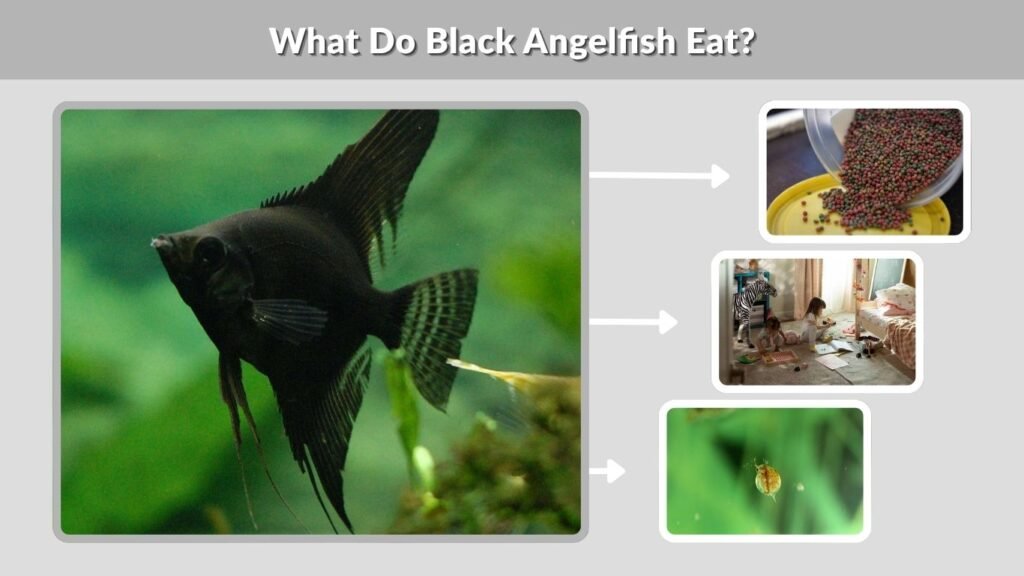
Black angelfish are omnivorous and readily accept many aquarium foods. A varied diet supports growth, immunity, breeding condition, and strong coloration.
Recommended Foods
Feed a rotation of:
- High-quality angelfish or cichlid pellets
- Tropical flakes
- Frozen or live brine shrimp
- Bloodworms as an occasional food
- Daphnia
- Mysis shrimp
- Insect-based fish foods
Aquarium angelfish accept both floating and sinking foods, while varied feeding helps provide a broader nutritional balance.
Offer an amount the fish can finish promptly once or twice daily. Remove uneaten food before it decomposes. Overfeeding can reduce water quality and contribute to digestive problems.
Are Black Angelfish Aggressive?
Black angelfish are not usually aggressive because of their color. Their behavior is similar to that of other freshwater angelfish.
As members of the cichlid family, they can become territorial when establishing dominance, forming pairs, spawning, or protecting eggs. Males may challenge one another, and breeding pairs may drive every other fish away from their chosen nesting area.
Aggression can be reduced by:
- Providing a spacious aquarium
- Creating visual barriers with plants and driftwood
- Avoiding overcrowding
- Keeping more than one feeding area
- Removing an excessively aggressive individual
- Separating breeding pairs when necessary
A black angelfish kept alone can work well as a centerpiece fish. Groups should be watched carefully as juveniles mature and begin forming pairs.
Suitable Tank Mates
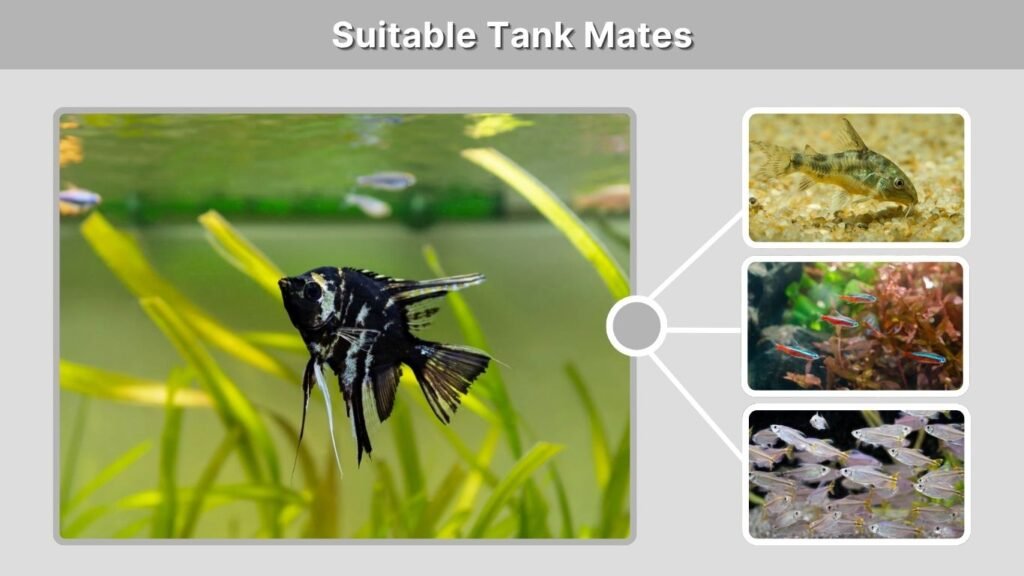
Good tank mates should tolerate warm water, avoid fin-nipping, and be too large for an adult angelfish to swallow.
Possible companions include:
- Corydoras catfish
- Peaceful plecos of an appropriate size
- Adult cardinal tetras
- Larger peaceful tetras
- Peaceful medium-sized community fish
- Other angelfish when adequate space is available
Aquarium Co-Op reports success with cory catfish, adult cardinal tetras, and black skirt tetras, while also warning against very small fish, fin-nippers, and fast feeders that may stress or outcompete angelfish.
Avoid tiny shrimp and very small fish because adult angelfish may view them as food. Aggressive cichlids and persistent fin-nipping species can damage the angelfish’s long fins.
Male vs. Female Black Angelfish
Males and females can be extremely difficult to distinguish by appearance alone. Features such as forehead shape, body size, and fin shape are not completely reliable.
The clearest differences become visible during spawning. The female develops a wider, blunt breeding tube and lays eggs, while the male has a smaller, more pointed tube and fertilizes them.
One reliable way to obtain a pair is to raise a group of juveniles and allow compatible adults to pair naturally.
Breeding Black Angelfish
A bonded pair usually cleans a vertical surface before spawning. Eggs may be deposited on a broad plant leaf, slate, filter tube, or aquarium wall.
Both parents may fan, clean, and guard the eggs. Freshwater angelfish are substrate-brooding cichlids that provide care to their embryos and larvae.
Eggs generally hatch within approximately two to three days under warm breeding conditions. Newly hatched fry initially remain attached near the spawning surface before becoming free-swimming. The parents may move them and defend the group, although inexperienced or stressed pairs sometimes eat their eggs.
Common Health Problems
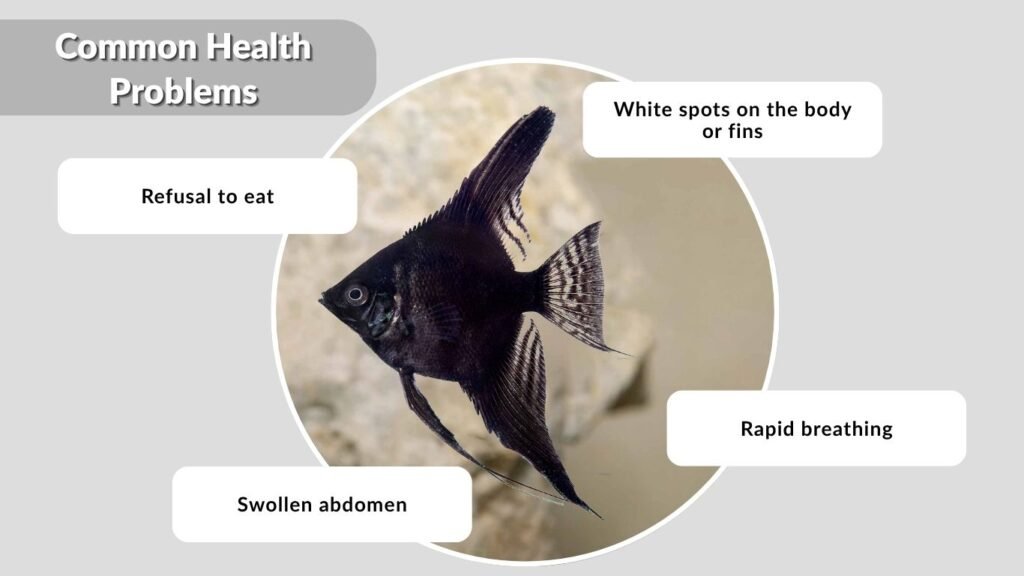
Black angelfish may develop health problems when water quality is poor, new fish introduce pathogens, or aggression creates chronic stress.
Watch for:
- White spots on the body or fins
- Clamped or damaged fins
- Rapid breathing
- Refusal to eat
- Swollen abdomen
- Stringy waste
- Cloudy eyes
- Open sores
- Unusual isolation
- Loss of dark coloration
Not every black mark indicates disease because naturally dark pigmentation can change with age and mood. However, newly developed spots combined with rubbing, breathing trouble, appetite loss, or abnormal swimming should be investigated.
Quarantine new fish before introducing them to the main aquarium. Test the water first whenever a fish behaves abnormally, since unstable temperature or toxic waste can produce symptoms resembling disease.
FAQs
Are black angelfish rare?
Some basic black angelfish are widely available, while high-quality double-black, black lace, veil, and specialty genetic lines may be less common. Availability depends on local breeders and aquarium stores.
How big does a black angelfish get?
A freshwater black angelfish can reach about 6 inches in body length and approximately 8 inches in total height, including its extended fins. This vertical growth makes a tall aquarium important.
How long do black angelfish live?
With clean water, minimal stress, suitable food, and enough space, freshwater angelfish may live approximately 8–12 years. Poor water quality and incompatible tank mates can shorten their lifespan.
Can black angelfish live with black skirt tetras?
They can sometimes live together in a sufficiently large aquarium, but individual behavior must be monitored. Black skirt tetras may nip fins if stressed, kept in an inadequate group, or housed in an overcrowded tank.
Do black angelfish need to live in pairs?
No. A single angelfish can live successfully as a centerpiece fish. A compatible pair can also be maintained, but it may become territorial during breeding and require more space or a separate aquarium.