
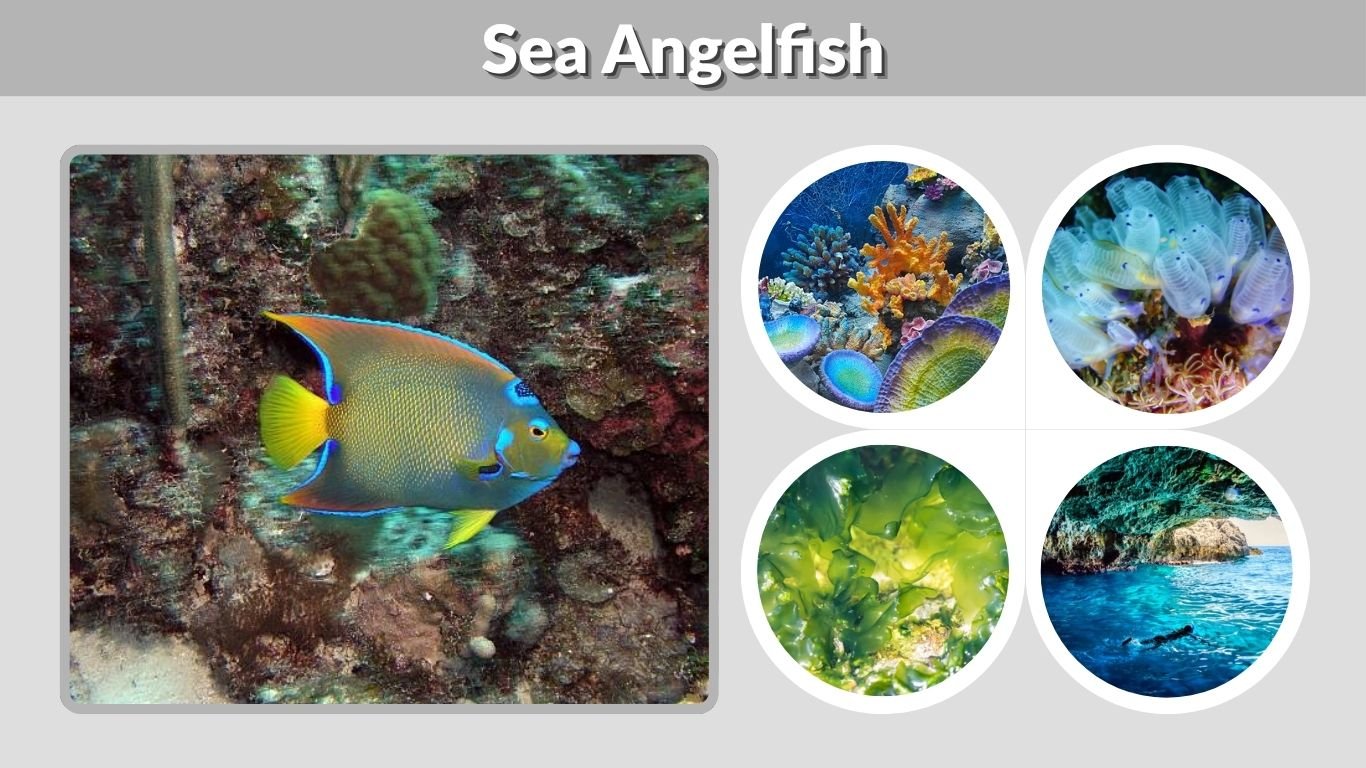
Sea angelfish are brightly colored marine fish commonly found around tropical coral and rocky reefs. Unlike freshwater angelfish, they belong to the family Pomacanthidae and require saltwater to survive. Popular species include the emperor, regal, queen, French, king, and Cortez angelfish. Most have flattened bodies, powerful fins, brilliant patterns, and a noticeable spine near the gill cover. They spend much of the day exploring reefs for sponges, algae, tunicates, and other food. This guide explains where sea angelfish live, what they eat, common Red Sea species, their aquarium requirements, and why they should not be confused with deep-sea anglerfish.
What Is a Sea Angelfish?
Sea angelfish, also called marine angelfish, are tropical saltwater fish belonging to the family Pomacanthidae. They are unrelated to the freshwater angelfish commonly kept in home aquariums. Marine angelfish occur around reefs in the Atlantic, Indian, and Pacific oceans.
Identification
- Deep, laterally flattened body
- Small mouth adapted for picking food from reefs
- Strong spine near the lower edge of each gill cover
- Long dorsal and anal fins
- Bright blue, yellow, orange, black, or white patterns
- Rounded or slightly extended tail fin
- Juveniles may look completely different from adults
- Adults range from about 6 inches to more than 16 inches, depending on species
The spine on the gill cover helps distinguish marine angelfish from similar-looking butterflyfish. Juvenile emperor angelfish, for example, have circular blue-and-white markings, while adults develop horizontal yellow and blue stripes.
Where Do Angelfish Live in the Sea?
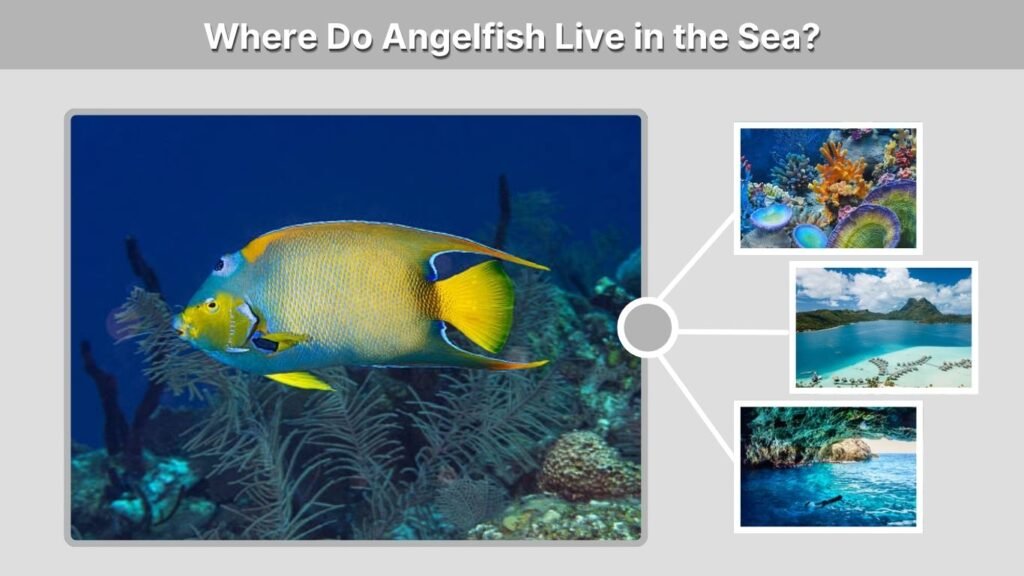
Marine angelfish are strongly associated with tropical reefs. These habitats provide food, shelter, breeding areas, and crevices where young or frightened fish can hide.
Ocean Regions
Different sea angelfish live in different parts of the world. Queen and French angelfish occur in the western Atlantic and Caribbean, while emperor and regal angelfish have broad Indo-Pacific ranges. King and Cortez angelfish inhabit the eastern Pacific, including the Gulf of California or Sea of Cortez.
Reef Habitat and Depth
Most species occupy coral reefs, rocky reefs, lagoons, channels, caves, and reef slopes. Emperor angelfish have been recorded from approximately 1 to 100 meters deep, while regal angelfish commonly occupy coral-rich lagoons and seaward reefs down to about 48 meters or more. These are reef fish rather than inhabitants of the ocean’s deepest zones.
Coral reefs support fish, sponges, corals, mollusks, crustaceans, and numerous other organisms. This diversity gives angelfish access to both food and protective cover.
Common Types of Sea Angelfish
Marine angelfish vary considerably in color, size, distribution, and aquarium difficulty. Some smaller species remain near 6 inches, while large Pomacanthus and Holacanthus species may grow beyond 15 inches.
| Sea angelfish | Scientific name | Natural region | Approximate maximum size |
| Emperor angelfish | Pomacanthus imperator | Red Sea and Indo-Pacific | 40 cm |
| Regal angelfish | Pygoplites diacanthus | Red Sea and Indo-Pacific | 25 cm |
| Queen angelfish | Holacanthus ciliaris | Caribbean and western Atlantic | 45 cm |
| French angelfish | Pomacanthus paru | Western Atlantic | Over 40 cm |
| King angelfish | Holacanthus passer | Eastern Pacific and Sea of Cortez | 35.6 cm |
| Cortez angelfish | Pomacanthus zonipectus | Eastern Pacific | 46 cm |
Recorded maximum sizes represent unusually large specimens; many individuals remain smaller. Aquarium size must nevertheless be selected according to the species’ potential adult size rather than its size when purchased.
Red Sea Angelfish
The warm, coral-rich Red Sea supports several spectacular angelfish. Emperor, regal, Arabian and yellowbar angelfish are among the best-known examples found in this region.
Red Sea Regal Angelfish
The regal angelfish has alternating yellow, white, blue and black bars, with variations in coloration across its range. It lives near coral-rich lagoons, outer reefs, and caves and primarily consumes sponges and tunicates. FishBase notes that this species frequently enters the aquarium trade but often survives poorly in captivity, making it unsuitable for inexperienced marine fish keepers.
Red Sea Emperor Angelfish
Adult emperor angelfish display bright yellow and blue horizontal lines, a dark facial mask, and a pale mouth. They occur from the Red Sea and East Africa across much of the Indo-Pacific. Adults favor coral-rich reef caves, ledges, channels, and protected areas, where they eat sponges, tunicates, and other encrusting organisms.
Arabian and Yellowbar Angelfish
The Arabian angelfish, also called the asfur angelfish, and the yellowbar angelfish are closely associated with the western Indian Ocean and Red Sea region. Both develop large yellow markings against dark blue or purplish bodies. The yellowbar angelfish occupies reef habitats at reported depths of about 4–60 meters.
What Do Angelfish Eat in the Sea?
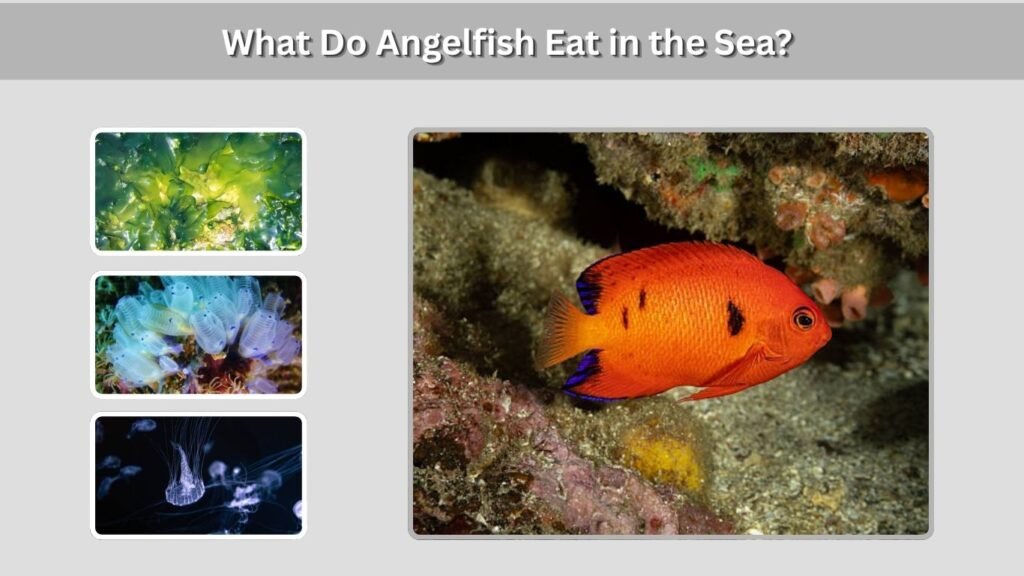
Most marine angelfish are omnivorous reef grazers, although the exact diet differs between species. Their narrow mouths help them remove food from coral surfaces, rock crevices, sponges, and other reef structures.
Natural Diet
Common foods include sponges, algae, tunicates, hydroids, bryozoans, plankton, and other attached organisms. Queen angelfish feed predominantly on sponges, supplemented by smaller amounts of algae and other invertebrates. Regal angelfish mainly consume sponges and tunicates, while king angelfish graze on sponges, algae, sessile invertebrates, and plankton.
Juveniles of some species also act as cleaner fish. Young queen, emperor, and king angelfish may remove parasites or unwanted material from larger fish.
Do Angelfish Eat Snails or Sea Urchins?
Sea snails and sea urchins are not the main foods of most angelfish. However, large individuals may investigate small invertebrates or pick at exposed tissue while grazing. Their typical natural diet is more strongly associated with sponges, tunicates, algae, plankton, and encrusting reef organisms.
Are Deep-Sea Angelfish Real?
The phrase “deep-sea angelfish” is often mistakenly used for the deep-sea anglerfish. Marine angelfish and anglerfish are entirely different groups.
Angelfish vs. Anglerfish
Sea angelfish are colorful reef fish that generally live in relatively shallow tropical waters. Deep-sea anglerfish are dark, unusual-looking predators adapted to deep ocean environments. Female deep-sea anglerfish commonly possess a fishing-rod-like structure tipped with a bioluminescent lure that attracts prey in darkness.
Therefore, a “deep-sea fish with a light” is an anglerfish, not an angelfish. The black seadevil is also a type of deep-sea anglerfish rather than a marine angelfish.
Sea Angelfish Aquarium Care
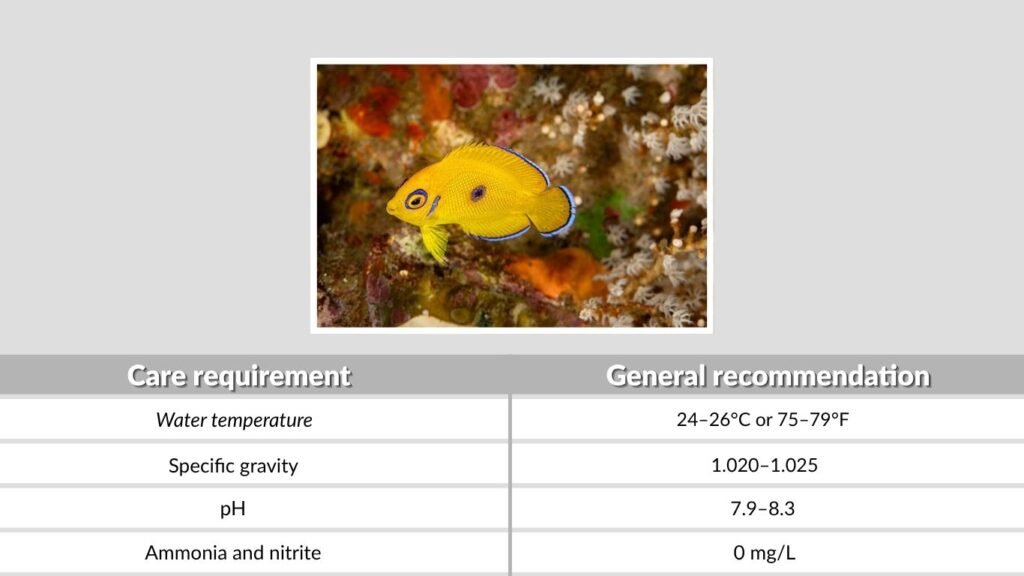
Marine angelfish can be impressive aquarium residents, but many require large, mature saltwater systems. Their size, diet, territorial behavior, and sensitivity make careful species selection essential.
| Care requirement | General recommendation |
| Water temperature | 24–26°C or 75–79°F |
| Specific gravity | 1.020–1.025 |
| pH | 7.9–8.3 |
| Ammonia and nitrite | 0 mg/L |
| Carbonate hardness | 8–12 dKH |
| Water movement | Moderate |
| Minimum tank for small species | About 300 liters or 79 gallons |
| Large species | Significantly larger aquarium |
These values are general guidelines; each species may have more specific needs. Large emperor, French, queen, and Cortez angelfish require considerably more space than dwarf or smaller angelfish.
Tank Setup
Provide mature biological filtration, strong oxygenation, moderate flow, stable temperature, and plenty of rockwork. Caves and openings allow the fish to hide, graze, and establish a territory. Regular testing is necessary because ammonia and nitrite must remain at zero.
Are Sea Angelfish Reef Safe?
Many species cannot be considered reliably reef safe. Because sponges, tunicates, hydroids, and other attached animals form part of their natural diets, they may nip corals, clam mantles, or other invertebrates. This risk varies by species and individual fish, so a marine angelfish should not be added to a reef aquarium without researching that exact species. This is a practical inference from their documented feeding ecology.
FAQs
Can sea angelfish live in freshwater?
No. Sea angelfish are marine fish requiring saltwater with appropriate salinity, pH, and mineral content. Freshwater angelfish belong to a completely different family and cannot be placed in a marine aquarium.
Are marine angelfish aggressive?
Many are territorial, particularly toward members of their own species or fish with similar body shapes and colors. Temperament varies, but spacious aquariums, hiding areas, and carefully selected tank mates can reduce conflict.
How large do sea angelfish grow?
Size depends on the species. Smaller angelfish may remain near 15 centimeters, while French, queen, emperor, and Cortez angelfish can reach approximately 40 centimeters or more.
What is the most popular Red Sea angelfish?
The emperor and regal angelfish are two of the most recognizable Red Sea species. Both display dramatic coloration, but the regal angelfish is particularly challenging to acclimate and maintain in captivity.
Do sea angelfish produce light?
No known reef angelfish has the glowing lure associated with deep-sea fish. The bioluminescent “light” belongs to deep-sea anglerfish, whose illuminated lure helps attract prey in dark water.