
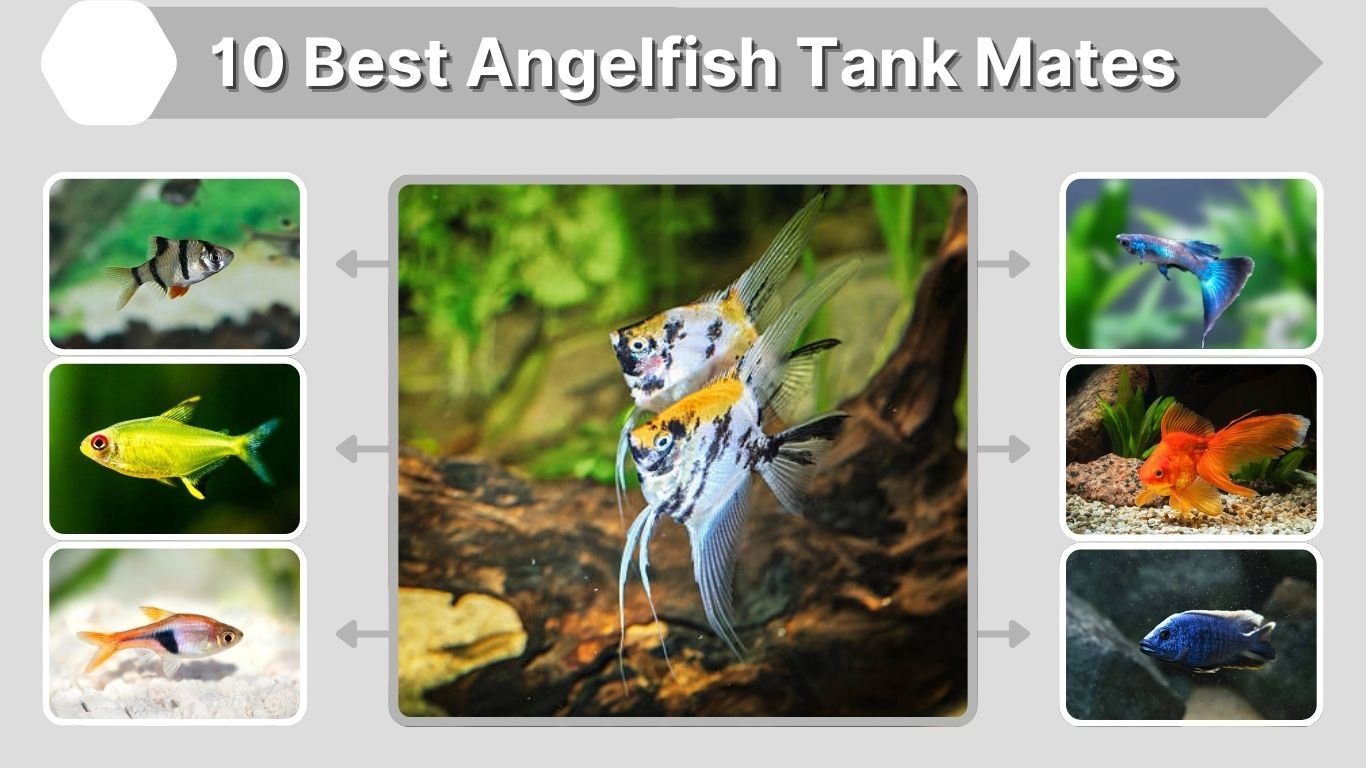
Freshwater angelfish are graceful community fish, but choosing suitable tank mates requires planning. Although generally calm, adult angelfish are cichlids and may become territorial when pairing or protecting eggs. They may also eat small fish that fit inside their mouths. The best angelfish tank mates are peaceful, warm-water species that are neither aggressive fin-nippers nor tiny enough to become prey. This guide covers compatible companions, fish to avoid and stocking ideas for different aquarium sizes.
Note: This guide covers freshwater angelfish, mainly Pterophyllum scalare. Coral beauty, flame, emperor, bicolor and other marine angelfish require saltwater aquariums and completely different companions.
What Makes a Good Angelfish Tank Mate?
A suitable companion should tolerate warm water, avoid biting the angelfish’s long fins and be large enough not to be swallowed. It should also occupy a compatible area of the aquarium without constantly competing for territory or food.
Freshwater angelfish can reach about 6 inches in body length and approximately 8 inches in total height when their fins are included. They are relatively peaceful compared with many cichlids, but aggression may increase when adults form breeding pairs.
Ideal Tank-Mate Characteristics
- Peaceful or mildly territorial temperament
- Adult size larger than the angelfish’s mouth
- Comfortable at approximately 78–84°F
- Not known for persistent fin-nipping
- Able to compete for food without bullying
- Suitable for a tall, planted community aquarium
Large tetras, peaceful rasboras, Corydoras and medium-sized catfish are among the commonly recommended choices.
10 Best Tank Mates for Angelfish
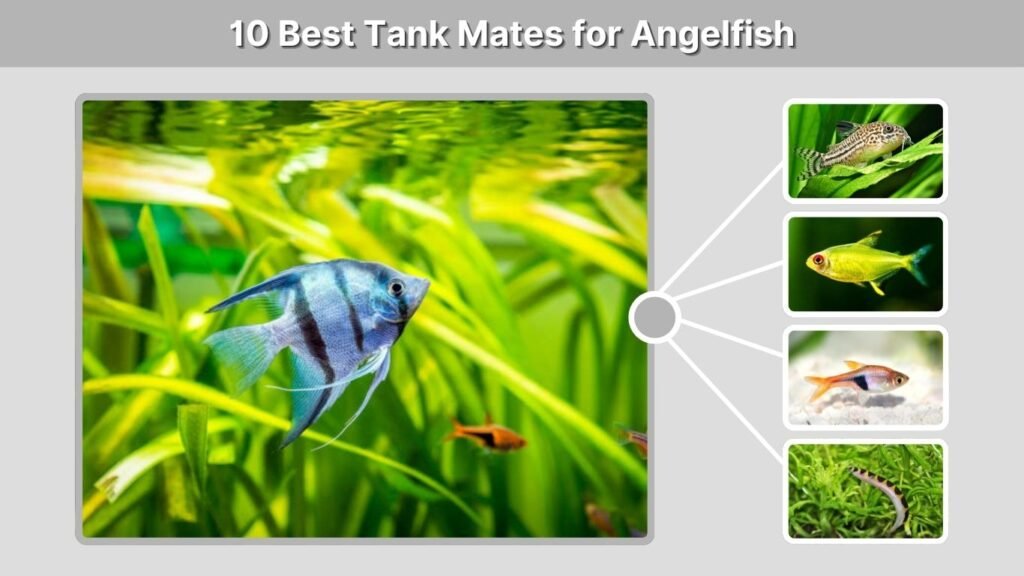
Compatibility always depends on aquarium size, individual temperament and whether the angelfish are breeding. A fish that works with one angelfish may be chased by another.
1. Corydoras Catfish
Corydoras are among the safest freshwater angelfish tank mates. They remain near the bottom while angelfish normally occupy the middle and upper parts of the aquarium.
Keep Corydoras in a group of at least six. Warm-water species such as Sterbai Corydoras are particularly suitable because they tolerate temperatures commonly maintained for angelfish.
2. Bristlenose Pleco
Bristlenose plecos are peaceful bottom-dwellers that usually ignore angelfish. They grow smaller than common plecos and can help consume some algae and leftover plant matter.
Provide caves, driftwood and proper sinking food. A pleco should not be expected to survive only by cleaning the aquarium.
3. Rummy-Nose Tetras
Rummy-nose tetras make attractive companions in a large planted tank. Their active schooling behavior creates movement beneath and around the slower-swimming angelfish.
Keep at least eight to ten adults. Very young or undersized individuals could be viewed as food by a mature angelfish.
4. Bleeding Heart Tetras
Bleeding heart tetras have deeper bodies than many smaller tetra species, making adults more difficult for angelfish to swallow. They are generally peaceful when maintained in an adequate school.
A group of eight or more works best because isolated individuals may become nervous or begin bothering other fish.
5. Lemon Tetras
Adult lemon tetras are colorful, active and usually peaceful. Their yellow bodies also stand out beautifully in planted angelfish aquariums.
Maintain a proper group and watch for occasional fin-nipping. This behavior is more likely when the school is too small or the tank is overcrowded.
6. Black Skirt Tetras
Black skirt tetras are commonly kept with angelfish because their deep bodies make them less vulnerable to predation. However, they can sometimes nip long fins.
Keep at least eight in a spacious aquarium. A larger school usually keeps their attention focused on one another rather than on the angelfish.
7. Harlequin Rasboras
Adult harlequin rasboras can live with calm angelfish, particularly when both species are introduced while young. They prefer living in groups and appreciate plants, shaded areas and open swimming space.
Avoid adding very small juveniles to an aquarium containing fully grown angelfish.
8. Bolivian Rams
Bolivian rams are relatively peaceful South American cichlids that spend much of their time near the bottom. They can share a large planted aquarium with angelfish when each fish has adequate territory.
Provide caves, wood and visual barriers. Aggression may increase if either species begins breeding.
9. Keyhole Cichlids
Keyhole cichlids are calmer than many other cichlid species and can work in a spacious community aquarium. They are large enough to avoid being eaten but are not normally aggressive enough to dominate adult angelfish.
Keep the tank well decorated so each cichlid can establish a separate area.
10. Kuhli Loaches
Kuhli loaches are shy, nocturnal bottom-dwellers that rarely compete directly with angelfish. Keep them in a group of at least six and provide sand, caves, driftwood and shaded hiding places.
Because they are most active after dark, make sure some sinking food reaches the bottom before the angelfish consume everything.
Angelfish Tank Mates Chart
| Tank mate | Compatibility | Main consideration |
| Corydoras catfish | Excellent | Keep six or more |
| Bristlenose pleco | Excellent | Needs caves and sinking food |
| Rummy-nose tetra | Good | Use adult fish in a large school |
| Bleeding heart tetra | Good | Needs a group of eight or more |
| Lemon tetra | Good | Monitor occasional fin-nipping |
| Black skirt tetra | Moderate to good | Large school reduces nipping |
| Harlequin rasbora | Moderate | Small individuals may be eaten |
| Bolivian ram | Good | Needs separate bottom territory |
| Keyhole cichlid | Good | Best in a spacious tank |
| Kuhli loach | Good | Requires hiding places |
Bad Tank Mates for Angelfish
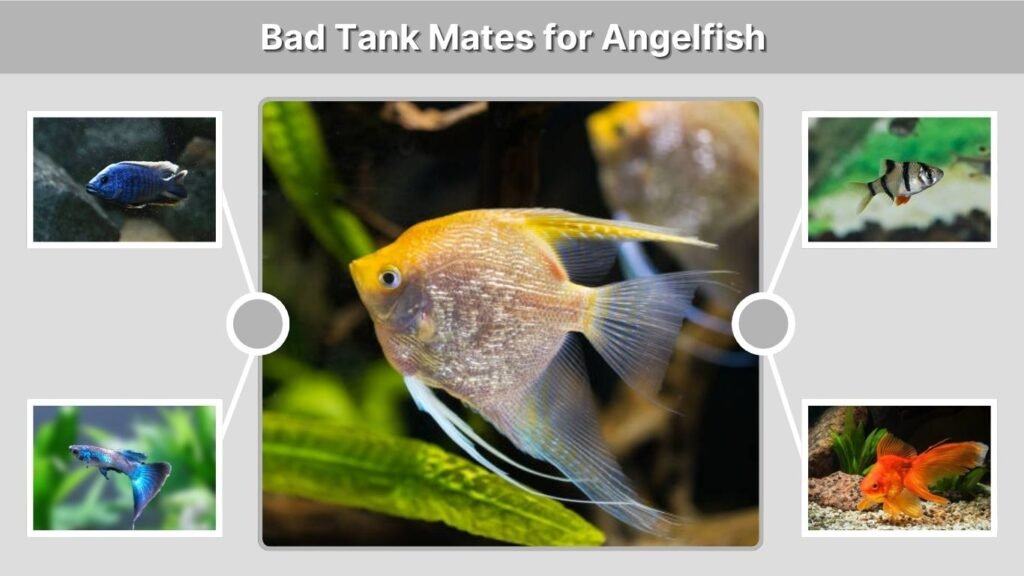
Some fish are unsuitable because of aggression, temperature differences, fin-nipping or predatory behavior.
Tiger Barbs
Tiger barbs frequently nip long fins, making veil and standard angelfish easy targets. Even a large tiger barb school can create unnecessary stress.
Goldfish
Goldfish prefer cooler water, while angelfish need tropical temperatures. Goldfish also produce considerable waste and have different feeding and environmental requirements.
African Cichlids
Most African rift-lake cichlids are too aggressive and require harder, more alkaline water than freshwater angelfish. Johanni, mbuna and similar species should not share an angelfish community tank.
Very Small Tetras and Rasboras
Adult angelfish may eat neon tetras, ember tetras, chili rasboras and other nano fish. Even peaceful species are unsafe when they fit inside the angelfish’s mouth.
Bettas
Bettas and angelfish are an unpredictable combination. Both may attack the other’s long fins, especially in a small aquarium. A large tank does not guarantee compatibility.
Guppies
Adult guppies may survive with a calm angelfish, but their flowing tails can attract aggression. Guppy fry will probably be eaten, and guppies generally prefer harder water than angelfish.
Aggressive Gouramis
Peaceful gourami species sometimes work, but large or territorial gouramis may fight with angelfish because both occupy similar areas of the aquarium.
Rainbow Sharks
Rainbow sharks can become highly territorial around the bottom and may chase angelfish or their other companions. They should only be considered in a large tank with several separated territories.
Can Discus Live With Angelfish?
Discus and angelfish can sometimes live together in a large, warm aquarium, but this is better suited to experienced keepers. Both species require excellent water quality, but angelfish may eat faster and prevent discus from receiving enough food.
There is also a risk of territorial conflict and disease transmission when fish from different sources are combined. Aqueon notes that they may be housed together in larger aquariums maintained above 82°F.
Tank Mates by Aquarium Size
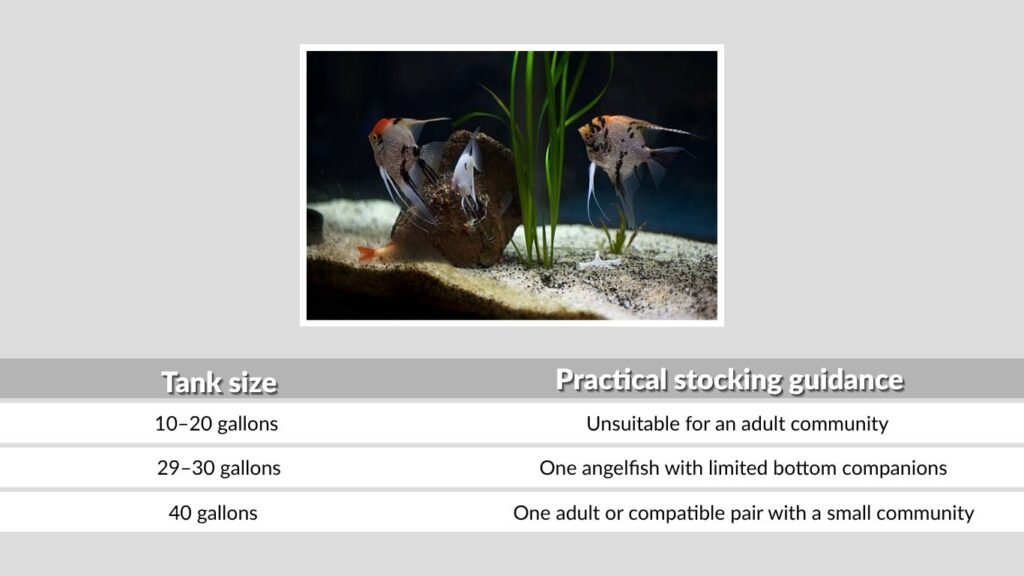
Angelfish need a vertical swimming room because of their tall bodies and extended fins. Aqueon recommends a tall aquarium of at least 55 gallons for fully grown fish, while smaller tanks are sometimes used for a single specimen or breeding pair.
| Tank size | Practical stocking guidance |
| 10–20 gallons | Unsuitable for an adult community |
| 29–30 gallons | One angelfish with limited bottom companions |
| 40 gallons | One adult or compatible pair with a small community |
| 55 gallons | Pair or small group with schooling and bottom fish |
| 75 gallons | Better for several angelfish and multiple companion groups |
| 125 gallons | Suitable for a larger community with separated territories |
Angelfish Tank Mates in a 20-Gallon Tank
A 20-gallon aquarium is too restrictive for a permanent adult angelfish community. A tall 20-gallon tank may be used temporarily for juveniles or as a dedicated breeding tank, but it leaves little room for companions.
Angelfish Tank Mates in a 29- or 30-Gallon Tank
A 29-gallon tank may hold one adult angelfish with a small group of Corydoras or another carefully selected bottom species. Avoid adding multiple adult angelfish, large schools and territorial cichlids together.
Angelfish Tank Mates in a 55-Gallon Tank
A 55-gallon tank provides enough space for a pair or small group of angelfish, a school of medium-sized tetras and a group of Corydoras. Plants and driftwood should divide the aquarium into separate visual territories.
Angelfish Tank Mates in a 75-Gallon Tank
A 75-gallon tank offers more flexibility for several angelfish, larger tetra schools, bottom-dwellers and peaceful dwarf cichlids. However, a newly formed breeding pair may still attack other angelfish and require separation.
Creating a Peaceful Angelfish Community
Introduce peaceful schooling and bottom-dwelling fish before adding the angelfish. This reduces the chance that an established angelfish will view every new arrival as an intruder.
Use tall plants, driftwood and decorations to break lines of sight. Feed floating, slow-sinking and bottom foods so every species receives enough nutrition. Keep a backup aquarium or divider available because individual behavior can change once angelfish mature or begin breeding.
FAQs
What are the best tank mates for angelfish?
Corydoras, bristlenose plecos, rummy-nose tetras, bleeding heart tetras and Bolivian rams are among the better choices. The aquarium must provide warm water, adequate space and hiding places.
Can angelfish live with gouramis?
Some peaceful gouramis may live with angelfish in a large tank, but territorial species can become aggressive. Watch for chasing, biting and competition near the surface.
Can angelfish live with tetras?
Yes, but choose medium-sized, deep-bodied tetras maintained in proper schools. Tiny tetras may be eaten, while known fin-nippers can damage an angelfish’s long fins.
Can koi and veil angelfish have the same tank mates?
Yes. Koi and veil angelfish are color or fin varieties of freshwater angelfish. However, veil angelfish are especially vulnerable to fin-nipping because of their longer, slower-moving fins.
Should angelfish be kept alone or in groups?
A single angelfish can live successfully as a community centerpiece. Groups require considerably more room because adults may form pairs, establish territories and attack weaker individuals.