
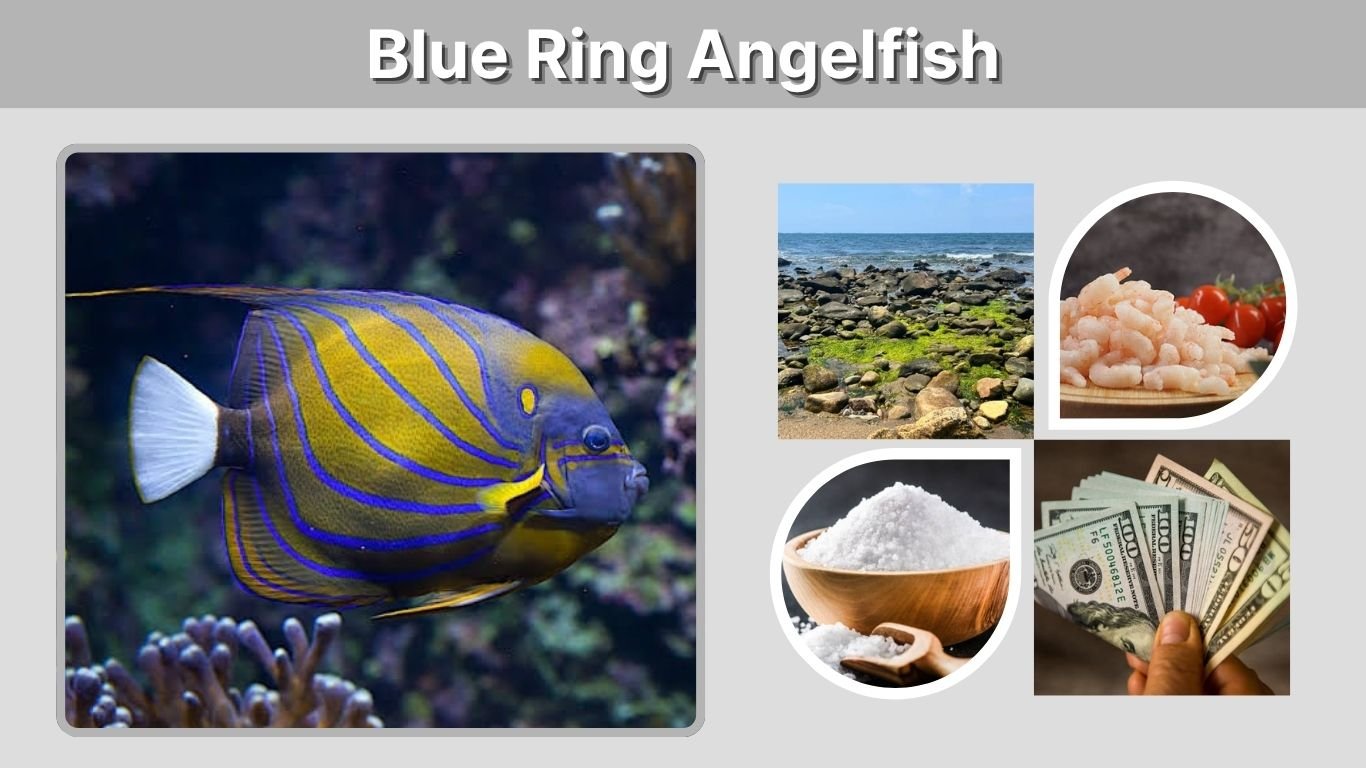
The blue ring angelfish is a large marine fish known for its golden-brown body, electric-blue curved stripes, and distinctive blue ring near the gill cover. Juveniles look completely different, displaying narrow blue and white bands over a dark body. Native to the Indo-West Pacific, this species lives around coastal reefs and is also sold for large saltwater aquariums. Although beautiful and relatively hardy after acclimation, it requires an established tank, varied food, careful tankmate selection, and a long-term commitment.
What Is a Blue Ring Angelfish?
The blue ring angelfish belongs to the marine angelfish family Pomacanthidae. Its accepted scientific name is Pomacanthus annularis. Other common names include blue-ringed angelfish, annularis angelfish, ringed angelfish, and blue king angelfish.
It is a tropical, nonmigratory reef fish found from the eastern coast of Africa through Indonesia and New Guinea to New Caledonia and north to southern Japan.
Blue Ring Angelfish Identification
An adult has a deep, laterally compressed body with a golden-brown, orange-brown, or dark brown background. Several brilliant blue lines curve backward from the area near the pectoral fin toward the dorsal and rear portions of the body.
Important identification features include:
- Golden-brown or orange-brown adult body
- Curved sapphire-blue lines across the sides
- Blue stripes across the face and eye
- Distinctive blue ring above the gill cover
- Whitish tail with a yellow margin
- Extended dorsal and anal fins
- Strong spine near the rear edge of the gill cover
Adults may be confused with other large Pomacanthus angelfish, but the blue ring near the gill cover and widely spaced curved body lines provide useful clues.
Juvenile vs Adult Blue Ring Angelfish
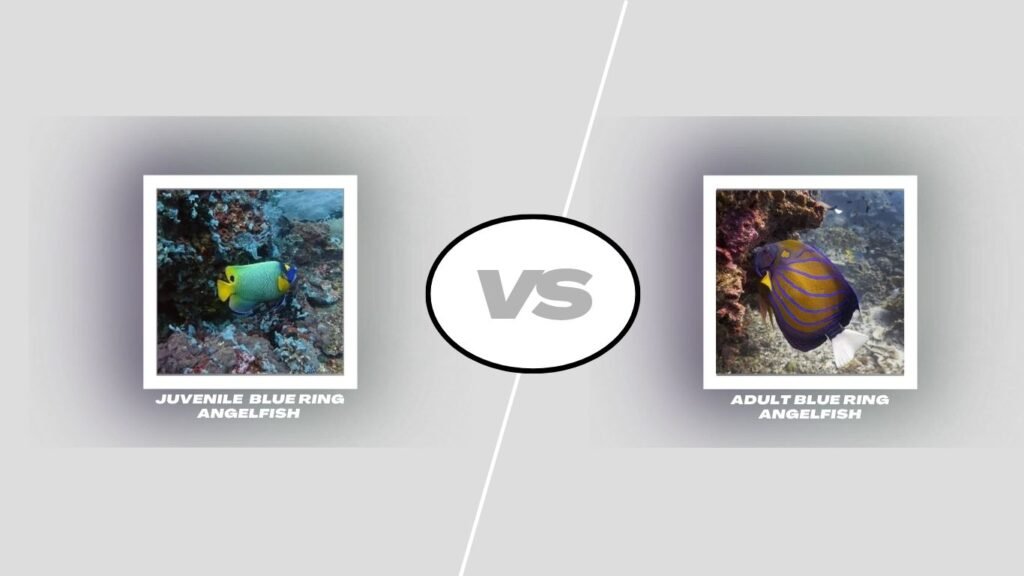
A juvenile looks dramatically different from an adult. Young fish are dark blue or almost black, with alternating pale-blue and white curved vertical stripes. Their tail is mostly transparent.
As the fish matures, its background changes from black to brown or orange-brown. The narrow vertical bands gradually disappear and are replaced by the wider, curved blue lines seen on adults. The tail also becomes whitish.
| Feature | Juvenile | Adult |
| Background color | Dark blue to black | Golden to dark brown |
| Body markings | Narrow vertical curved bands | Widely spaced blue lines |
| Tail | Mostly transparent | Whitish with yellow edge |
| Blue gill ring | Not strongly developed | Clearly visible |
| General appearance | Similar to other juvenile angels | Distinctive annularis pattern |
The complete color transformation is normal and does not indicate illness or poor water quality.
Blue Ring Angelfish Size and Lifespan
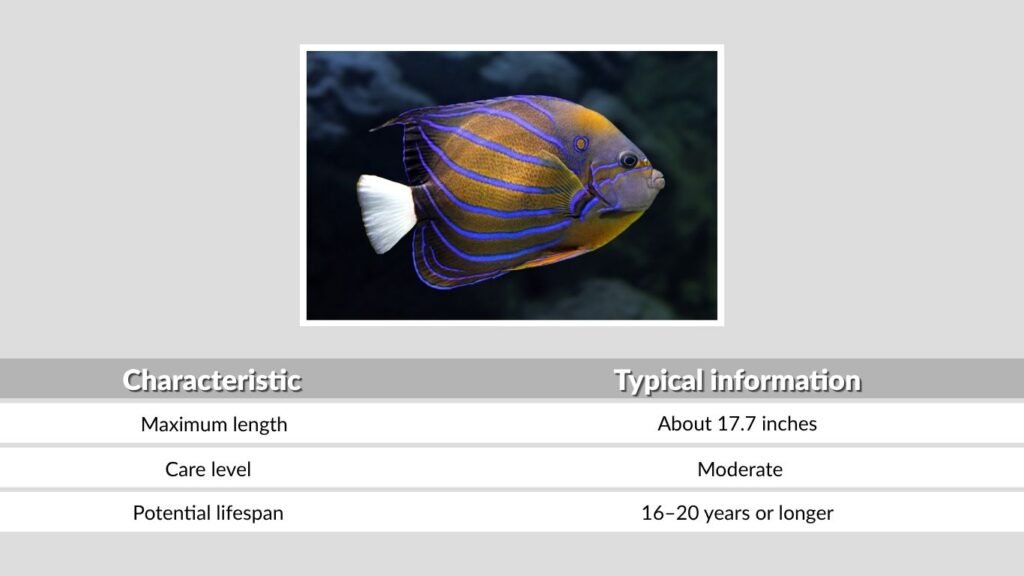
Wild blue ring angelfish can reach approximately 45 centimeters, or 17.7 inches, in total length. Many aquarium specimens remain somewhat smaller, but owners should prepare for a large, deep-bodied adult rather than judging space requirements from a small juvenile.
| Characteristic | Typical information |
| Maximum length | About 17.7 inches |
| Recommended minimum tank | Approximately 220 gallons |
| Care level | Moderate |
| Temperament | Semi-aggressive |
| Diet | Omnivorous |
| Reef suitability | With caution |
| Potential lifespan | 16–20 years or longer |
The species is long-lived. The St. Louis Aquarium gives a lifespan of approximately 16–20 years, while older aquarium records cited by Animal Diversity Web report individuals reaching as much as 25 years in managed care.
Blue Ring Angelfish Habitat
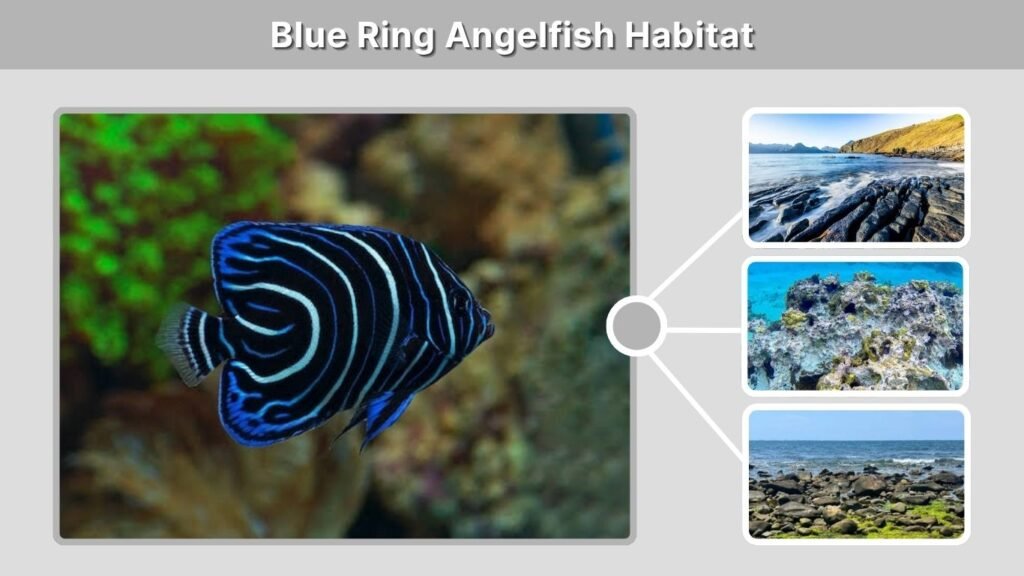
Blue ring angelfish inhabit tropical coastal reefs at depths ranging from about 1 to 60 meters. Adults are often observed alone or in pairs around caves and rocky reef structures, while juveniles occupy shallower inshore habitats containing algae-covered rocks and dead coral.
Their natural habitats provide:
- Caves for nighttime shelter
- Rocky crevices
- Coral and hard-bottom areas
- Sponges and tunicates
- Algae-covered surfaces
- Open areas for swimming
An aquarium should reproduce this combination by providing open swimming space alongside secure caves and well-arranged live rock.
What Do Blue Ring Angelfish Eat?
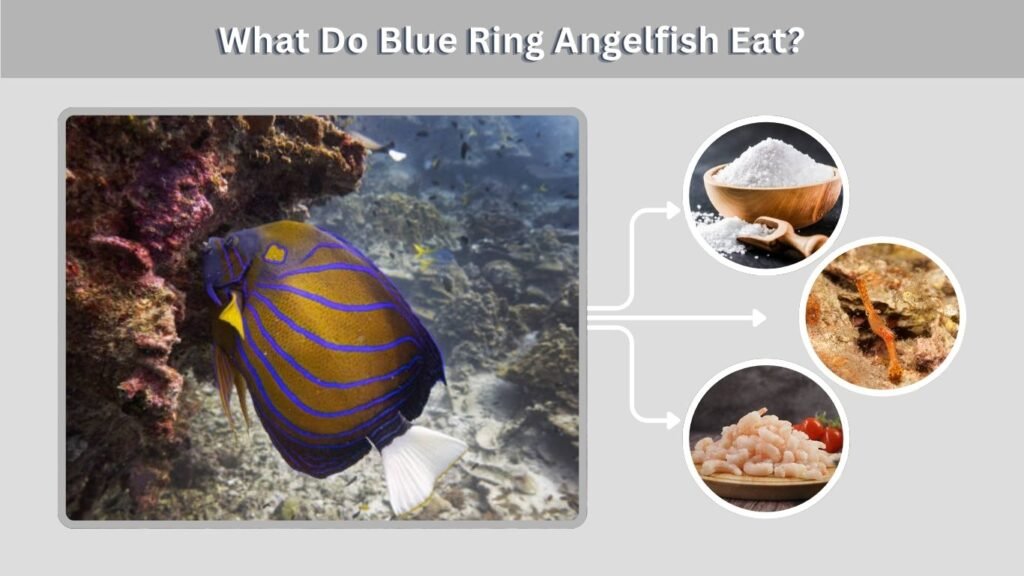
In the wild, blue ring angelfish feed primarily on sponges and tunicates. They may also consume algae, zooplankton, and other small reef organisms while searching across rocks and reef surfaces.
Feeding in an Aquarium
A captive blue ring angelfish should receive a varied diet rather than a single pellet or frozen food.
Suitable foods include:
- Sponge-based marine angelfish preparations
- High-quality marine pellets
- Marine flakes
- Mysis shrimp
- Enriched brine shrimp
- Chopped shrimp or other seafood
- Seaweed sheets
- Spirulina-based foods
Offer moderate portions two or three times daily. Live rock also provides grazing surfaces and can help a newly introduced fish adjust to the aquarium. Captive-bred juveniles may accept pellets, flakes, seaweed, and frozen foods more readily because they have already been raised on prepared diets.
Blue Ring Angelfish Care
This species is best suited to an aquarist with experience maintaining large saltwater systems. It becomes large, produces substantial waste, and may become territorial after settling into the aquarium.
Tank Size and Setup
A minimum aquarium size of approximately 220 gallons is recommended for one adult. A small juvenile may temporarily live in a smaller aquarium, but purchasing one without planning for its adult size can lead to crowding and aggression.
The aquarium should include:
- Mature biological filtration
- Strong water movement
- Efficient protein skimming
- Open swimming space
- Several large caves
- Securely positioned live rock
- A tightly fitted cover
Handle the fish carefully during transfers. Marine angelfish possess cheek spines that can become caught in nets, so a rigid container is generally safer than chasing the fish with fine mesh.
Water Parameters
Maintain stable marine conditions rather than allowing rapid fluctuations.
| Parameter | Recommended range |
| Temperature | 72–78°F |
| Specific gravity | 1.020–1.025 |
| pH | 8.1–8.4 |
| Carbonate hardness | 8–12 dKH |
Regular testing, water changes, and strong filtration are especially important because large angelfish eat heavily and create significant waste.
Behavior and Tank Compatibility
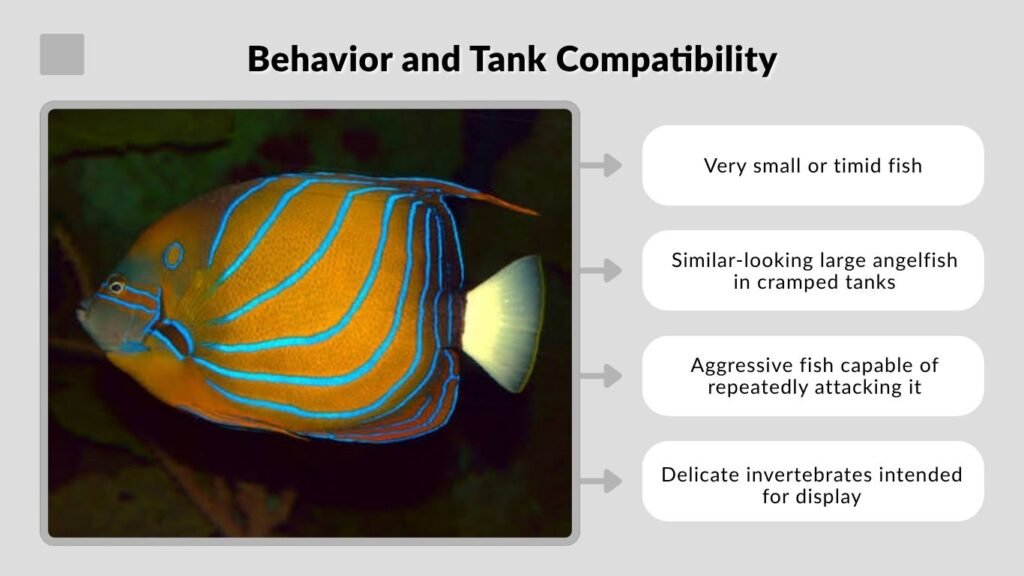
The blue ring angelfish is considered semi-aggressive. A newly introduced individual may initially hide, but it can become territorial after becoming established.
Suitable companions generally include robust marine fish that are not small enough to be intimidated. Possible tankmates include larger tangs, triggerfish, rabbitfish, wrasses, groupers, and similarly sized community fish, depending on the aquarium’s dimensions and each animal’s temperament.
Avoid placing it with:
- Very small or timid fish
- Similar-looking large angelfish in cramped tanks
- Aggressive fish capable of repeatedly attacking it
- Multiple territorial angelfish without extensive space
- Delicate invertebrates intended for display
Introduce the most territorial fish last when possible, and use rockwork to create visual barriers.
Is the Blue Ring Angelfish Reef Safe?
The blue ring angelfish is not reliably reef safe. Retail care guidance classifies it as reef compatible only with caution because it may nip at soft corals, stony corals, clam mantles, feather dusters, tube worms, and other stationary invertebrates.
Individual behavior varies. One fish may ignore certain corals for months, while another may begin feeding on them soon after introduction. A fish-only-with-live-rock aquarium is therefore the safest arrangement.
Heavy, varied feeding may reduce exploratory nipping, but it cannot guarantee that corals and clams will remain undamaged.
Reproduction and Life Cycle
Blue ring angelfish are believed to be protogynous hermaphrodites, meaning individuals begin life as females and some later change into males. In the wild, spawning generally occurs around dusk.
A male and female rise through the water together and release eggs and sperm for external fertilization. The floating eggs hatch quickly, and the larvae remain among the plankton before settling into shallow reef habitats as juveniles.
Breeding this species in a home aquarium is extremely difficult because adults require considerable space and the tiny planktonic larvae need specialized food and rearing conditions. However, captive-bred juveniles are available through parts of the ornamental-fish trade.
Predators and Defensive Adaptations
Detailed species-specific predator records are limited. Juveniles are likely vulnerable to larger predatory reef fish, while adults reduce danger through their large body size, territorial behavior, cave use, and prominent cheek spines.
Their flattened bodies help them maneuver among rocks and reef crevices. Juvenile markings may also make their body outline difficult to interpret against contrasting reef backgrounds, although this is a reasonable biological interpretation rather than a confirmed defense unique to this species.
Price and Buying Considerations

Blue ring angelfish are sold as juveniles, transitioning individuals, and adults. Prices vary according to size, color stage, origin, retailer, shipping costs, and whether the fish is captive-bred or wild-collected. Retail listings may offer specimens ranging from approximately one-inch juveniles to adults exceeding eight inches.
Before purchasing, confirm that the fish:
- Has clear eyes
- Breathes normally
- Swims upright
- Has an undamaged mouth and fins
- Shows no visible white spots or sores
- Accepts prepared food
- Has not become severely thin
- Comes from a responsible supplier
Captive-bred juveniles are often preferable because they are accustomed to aquarium conditions and prepared foods.
Interesting Blue Ring Angelfish Facts
- Its scientific name is Pomacanthus annularis.
- Adults can approach 18 inches long.
- Juveniles and adults have completely different patterns.
- The blue ring near the gill cover gives the species its common name.
- Its natural diet includes sponges and tunicates.
- Adults are frequently observed around reef caves.
- The species occurs throughout much of the Indo-West Pacific.
- It can live for approximately two decades under suitable care.
- It is not reliably safe with corals or clams.
- Its global conservation status is Least Concern.
FAQs
Is a blue ring angelfish suitable for beginners?
It is generally better for an intermediate aquarist. The fish needs a very large, mature saltwater aquarium, stable water conditions, a specialized diet, and carefully selected tankmates.
How large does a blue ring angelfish grow?
The maximum documented length is approximately 45 centimeters, or 17.7 inches. An aquarium must accommodate its adult dimensions, even when the purchased juvenile is only one or two inches long.
Can two blue ring angelfish live together?
Keeping two is risky unless they form a compatible pair and are housed in an exceptionally large aquarium. Unrelated adults may become territorial and fight over swimming space, food, or caves.
Why is my blue ring angelfish changing color?
Juveniles naturally transform from a dark body with narrow blue and white vertical bands into brown adults with widely spaced curved blue lines. This change is a normal part of development.
Does a blue ring angelfish eat coral?
It may nip or consume coral polyps and other stationary invertebrates. Clams, feather dusters, tube worms, soft corals, and stony corals may be damaged, making the species unsuitable for many reef aquariums.