
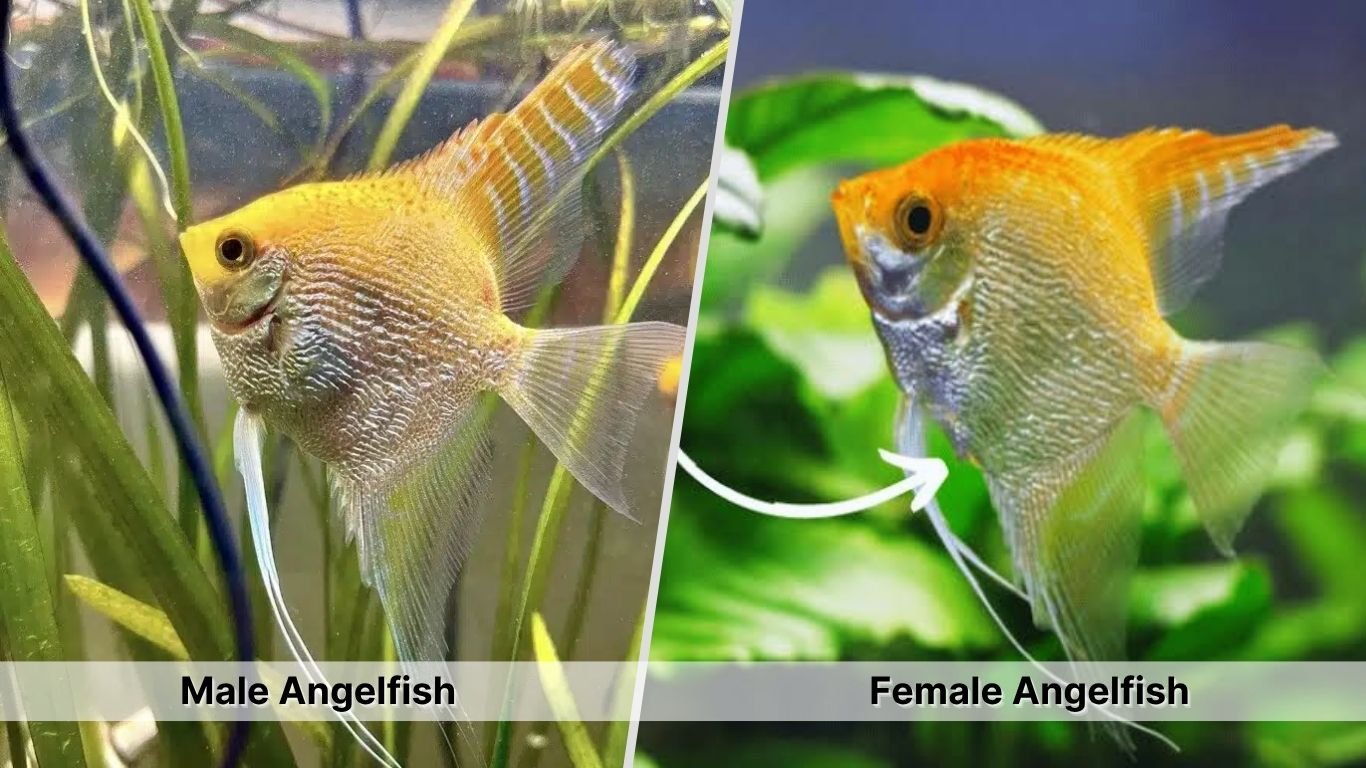
Identifying male and female freshwater angelfish can be difficult because the sexes look extremely similar, especially while young. Body shape, forehead size, fins, and behavior may offer clues, but none of these features is completely dependable.
The most reliable method is to examine the breeding tube when mature angelfish are preparing to spawn. A female has a thicker, blunt ovipositor for depositing eggs, while a male has a smaller, pointed papilla used to fertilize them.
Male vs. Female Angelfish at a Glance
| Feature | Male angelfish | Female angelfish |
| Breeding tube | Narrow and pointed | Wider, thicker, and blunt |
| Role during spawning | Follows and fertilizes eggs | Deposits rows of eggs |
| Forehead | May develop a small hump | Usually smoother |
| Body shape | Sometimes rounder and heavier | Sometimes more angular |
| Aggression | May be territorial | Can also be territorial |
| Egg laying | Cannot lay eggs | Can lay fertile or unfertilized eggs |
The breeding tube and direct observation of spawning provide much stronger evidence than body shape alone.
Check the Breeding Tube
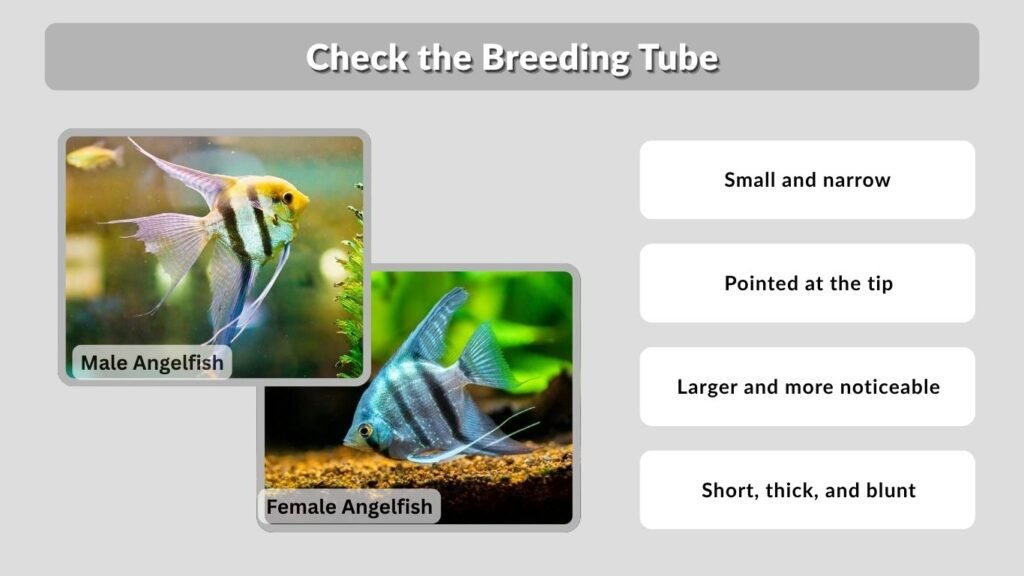
The breeding tube, also called the genital papilla, is located beneath the fish between the ventral fins and the front of the anal fin. It becomes easiest to see shortly before and during spawning.
Male Angelfish Breeding Tube
A male’s breeding tube is generally:
- Small and narrow
- Pointed at the tip
- Similar in appearance to a sharpened pencil point
- Less prominent than the female’s tube
After the female deposits eggs, the male swims over the same surface and releases sperm through this papilla.
Female Angelfish Breeding Tube
A female’s breeding tube is the ovipositor. It is generally:
- Larger and more noticeable
- Short, thick, and blunt
- Rounded at the tip
- Similar to a small pencil eraser
The female uses this tube to attach rows of eggs to a leaf, slate, aquarium glass, filter pipe, spawning cone, or another vertical surface. Examining the tubes during spawning is considered the most dependable visual method of distinguishing the sexes.
Observe Their Spawning Behavior
Watching a mature pair spawn can confirm which fish is male and which is female.
The pair usually begins by cleaning a flat surface. When spawning starts, the female moves slowly across the surface and leaves a row of adhesive eggs. The male follows the same path and fertilizes them.
Both parents may then fan, clean, and defend the eggs. Therefore, guarding eggs does not prove that a fish is male or female; both sexes participate in parental care.
How to Identify Them During Spawning
- Watch which fish deposits visible eggs.
- That fish is the female.
- Watch for the second fish following over the eggs.
- The following fish is usually the male fertilizing them.
- Confirm the identification by comparing their breeding tubes.
Spawning observation is more accurate than guessing from fins, coloration, or aggression.
Examine the Forehead and Head Shape
Some mature male angelfish develop a noticeable rounded forehead or nuchal hump above the eyes. Their heads may look broader, while females sometimes have a smoother or more gently sloping forehead.
However, this method is not reliable by itself. Some males never develop an obvious hump, while well-fed females may also have rounded head profiles. Age, genetics, body condition, and angelfish variety can all affect head shape.
Compare Body Shape and Size
Male angelfish are sometimes described as larger, rounder, or more muscular. Females may appear slightly smaller or have a fuller abdomen when carrying eggs.
These differences frequently overlap:
- A large fish is not automatically male.
- A small fish is not automatically female.
- Females may appear larger when filled with eggs.
- Growth depends on age, diet, health, genetics, and aquarium conditions.
- Different angelfish strains naturally have different body shapes.
There is no dependable rule stating that either male or female angelfish are always larger.
Look at the Fins Carefully
Some aquarists attempt to identify sex by examining the dorsal, anal, or ventral fins. Mature males are sometimes said to have more pointed or strongly angled fins, while females may have smoother contours.
Fin shape is only a secondary clue. Long-fin varieties, injuries, age, genetics, and selective breeding can significantly change fin appearance. A forked or pointed fin does not reliably confirm that an angelfish is male.
Does Aggression Reveal the Sex?
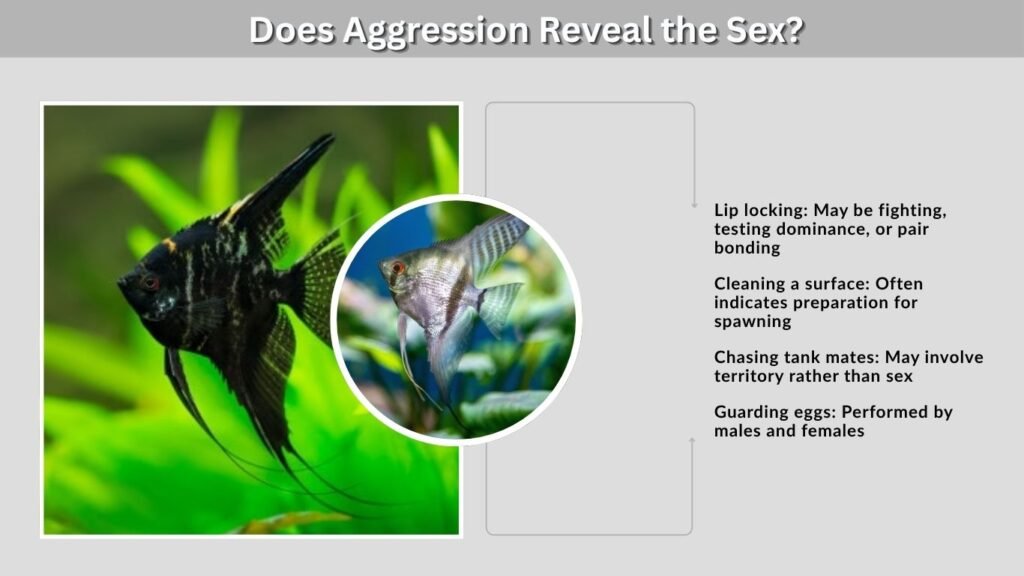
Male angelfish may become highly territorial, especially when competing for mates or defending a spawning area. They may chase other fish, flare their fins, lock mouths, or strike at tank mates.
However, females can be equally aggressive when selecting a partner or protecting eggs. Aggression alone cannot determine sex.
Common Angelfish Behaviors
- Lip locking: May be fighting, testing dominance, or pair bonding
- Cleaning a surface: Often indicates preparation for spawning
- Chasing tank mates: May involve territory rather than sex
- Guarding eggs: Performed by males and females
- Swimming together: May indicate a pair, including a same-sex pair
Behavior becomes useful only when combined with breeding-tube observations or actual egg laying.
When Can You Tell an Angelfish’s Sex?
Young angelfish are extremely difficult to identify accurately. Sexual characteristics become more noticeable as the fish mature and prepare to reproduce.
Depending on care and aquarium conditions, freshwater angelfish may reach sexual maturity at approximately six to twelve months or later. Even mature specimens can remain difficult to identify until their breeding tubes appear.
Aquarists who want a breeding pair often raise a small group of juveniles together and allow mature fish to choose their own partners naturally.
Can a Female Angelfish Lay Eggs Without a Male?

Yes. A mature female can produce and lay eggs even when no male is present. However, the eggs will remain unfertilized and cannot develop into fry.
Unfertilized eggs commonly turn white or opaque and may eventually develop fungus. Finding eggs therefore confirms that at least one fish is female, but it does not prove that the second fish is male. Two females can form a pair, clean a surface, lay eggs, and guard them together.
Can Two Female Angelfish Live Together?
Two females can live together and may even form a social or spawning-like pair. Both might clean a surface, become territorial, and deposit eggs.
Compatibility depends more on individual temperament, tank dimensions, hiding places, and stocking levels than sex alone. Angelfish can fight regardless of whether they are male or female, especially in cramped aquariums or during breeding periods.
The Most Accurate Identification Method
For the best chance of identifying male and female angelfish correctly:
- Wait until the fish are mature.
- Watch for surface-cleaning behavior.
- Examine the breeding tubes from the side.
- Identify the thicker, blunt tube as female.
- Identify the smaller, pointed tube as male.
- Observe which fish lays the eggs.
- Avoid relying on one body feature alone.
When no breeding tube is visible and the fish have never spawned, identification remains an educated guess.
FAQs
What Does a Female Angelfish Look Like?
A female generally resembles a male but may have a smoother forehead and fuller abdomen. During spawning, her best identifying feature is a thick, blunt ovipositor located immediately in front of the anal fin.
Are Male Angelfish Bigger Than Females?
Not consistently. Some mature males grow larger, but females may be equally large or appear fuller when carrying eggs. Age, diet, health, genetics, and aquarium conditions influence size more than sex in many individuals.
Are Female Angelfish More Aggressive?
Females can be aggressive, particularly when forming pairs or protecting eggs. Males may also defend territories and challenge rivals. Aggression varies between individuals and is not a dependable method of identifying sex.
Why Are Two Angelfish Hitting Their Mouths Together?
Mouth or lip locking can indicate territorial fighting, dominance testing, or conflict between paired fish. It should not automatically be interpreted as mating. Provide sufficient space and separate the fish when one is being repeatedly injured or prevented from eating.
Can Female Bettas Live With Angelfish?
The combination can be risky. Angelfish and female bettas may both become territorial, while their long fins can attract biting or aggression. Compatibility varies, but a spacious, heavily planted aquarium and close monitoring are essential.