
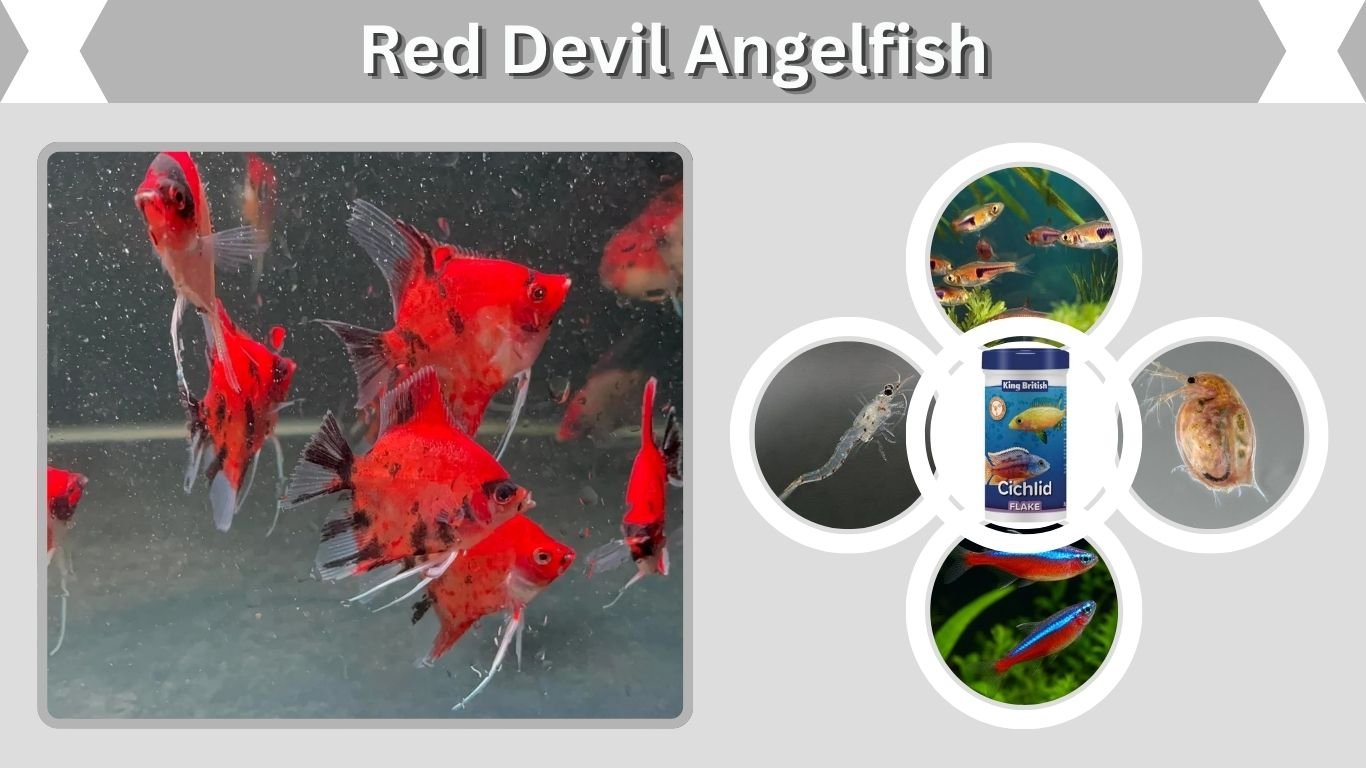
The red devil angelfish is a selectively bred freshwater angelfish known for its vivid orange, scarlet, or red coloration. It is usually a color variety of Pterophyllum scalare, not a separate species. Names such as solid red, super red devil, German red devil, and red devil koi may describe different breeding lines, so appearance varies considerably between sellers.
What Is a Red Devil Angelfish?
Red devil angelfish are domestic freshwater cichlids descended primarily from the common angelfish, Pterophyllum scalare. Breeders select fish with strong red or orange pigmentation and pair them over multiple generations to produce more intensely colored offspring.
The term “red devil” is a commercial variety name rather than an officially standardized strain. One breeder may use it for a nearly solid-red fish, while another may apply it to a red koi angelfish with white or black patches.
| Feature | Red Devil Angelfish |
| Scientific classification | Usually Pterophyllum scalare |
| Water type | Freshwater |
| Adult body length | About 5–6 inches |
| Total height with fins | Often 8–10 inches |
| Lifespan | Approximately 8–12 years |
| Temperament | Semi-aggressive |
| Diet | Omnivorous |
| Recommended tank | 40 gallons for a pair; larger for groups |
| Temperature | Approximately 76–82°F |
Red Devil Angelfish Appearance
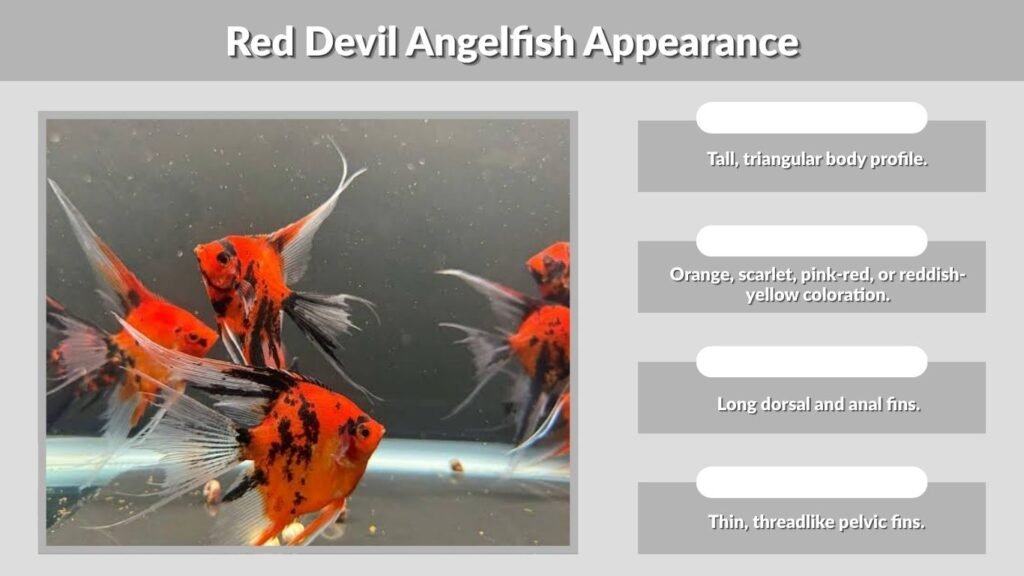
A healthy red devil angelfish has the same tall, laterally compressed body as other freshwater angelfish. Its dorsal and anal fins extend vertically, while two thin pelvic fins hang beneath the body.
Identification Features
- Tall, triangular body profile
- Orange, scarlet, pink-red, or reddish-yellow coloration
- Long dorsal and anal fins
- Thin, threadlike pelvic fins
- Rounded forehead and small mouth
- Red, white, silver, or black patterning
- Clear, smoky, or dark-colored fins
- Possible marbling or vertical bars
Some juveniles appear pale orange or yellow and develop deeper coloration with maturity. Others may lose or gain black markings as they grow.
Solid Red Red Devil Angelfish
Solid-red individuals are selected for extensive color coverage and minimal white or silver areas. Completely uniform coloration is difficult to produce, so many “solid red” fish still have lighter bellies, translucent fins, or subtle dark markings.
Photographs taken under blue, red, or enhanced aquarium lighting may make a fish look more intensely colored than it appears under ordinary white light.
Red Devil Koi Angelfish
A red devil koi angelfish combines strong red-orange pigmentation with koi-style patterning. It may have:
- White or cream-colored sections
- Orange or red patches
- Black marbling
- A red cap or reddish upper body
- Clear or patterned fins
The word “koi” describes its appearance only. It is not related to or crossed with koi carp.
German and Super Red Devil Angelfish
German red devil and super red devil are names commonly used for breeding lines selected for richer pigmentation. They are not separate species, and there is no universal standard defining how red a fish must be to receive these names.
Ask the seller for current photographs of the actual fish and, when possible, pictures of mature adults from the same breeding line.
Red Devil Angelfish Size
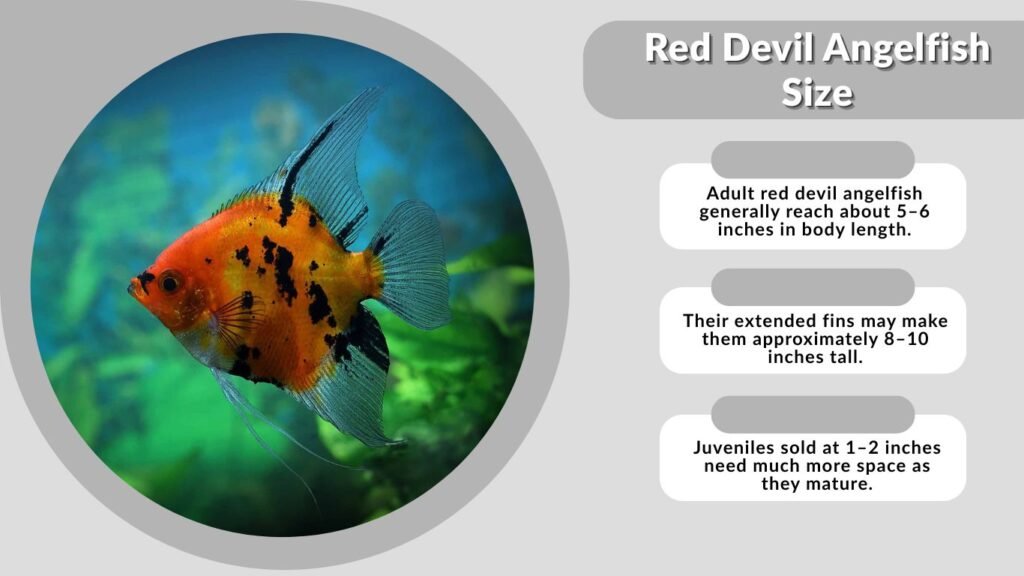
Adult red devil angelfish generally reach about 5–6 inches in body length. Their extended fins may make them approximately 8–10 inches tall.
Females and males are similar in size, although mature males may develop a more pronounced forehead. Body shape alone is not a reliable way to determine sex.
Juveniles sold at 1–2 inches need much more space as they mature. A small fish should not be assumed to be a miniature angelfish.
Tank Setup and Water Requirements
Red devil angelfish need a tall, heated, and well-filtered freshwater aquarium. Stable water quality is more important than achieving one exact pH value.
Recommended Tank Size
A tank of around 40 gallons provides better space for an adult pair. A group generally needs at least 55 gallons, with additional room preferred when several adults establish territories.
Tall aquariums are particularly suitable because angelfish need vertical clearance for their extended fins.
Aquarium Setup
Provide:
- Tall live or artificial plants
- Vertical driftwood or branches
- Open swimming space
- Gentle to moderate water flow
- A reliable heater
- Efficient biological filtration
- Smooth decorations without sharp edges
- A secure lid
Broad-leaved plants also provide possible spawning surfaces.
Water Conditions
Suitable conditions generally include:
- Temperature: 76–82°F
- pH: Approximately 6.0–7.5
- Ammonia: 0 ppm
- Nitrite: 0 ppm
- Nitrate: Kept as low as practical
Avoid sudden temperature or pH changes. Perform regular partial water changes and test the aquarium whenever fish show unusual behavior.
What Do Red Devil Angelfish Eat?
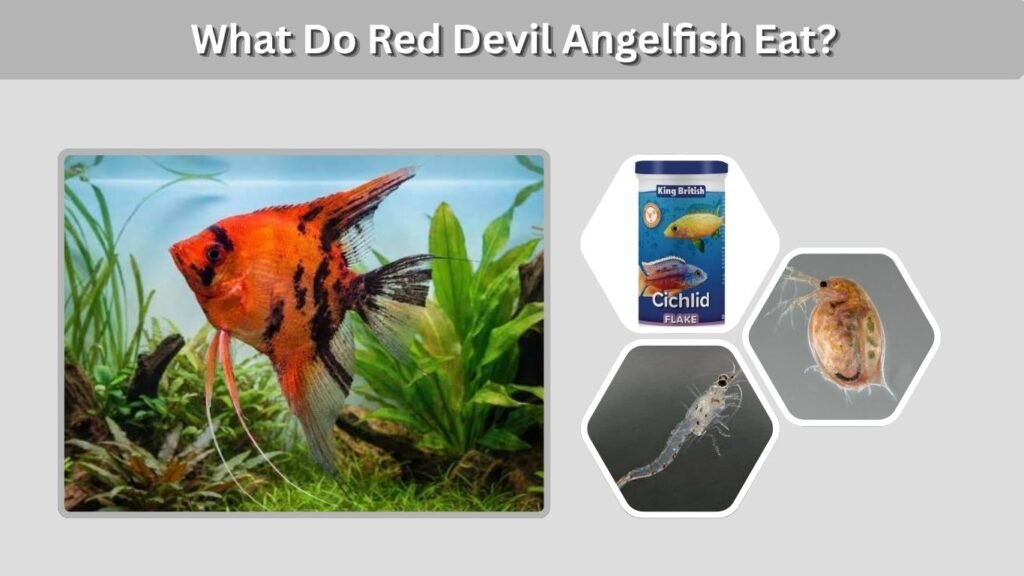
Red devil angelfish are omnivores. Their diet should contain both animal protein and plant-based nutrients.
Suitable foods include:
- High-quality cichlid flakes
- Slow-sinking angelfish pellets
- Frozen brine shrimp
- Mysis shrimp
- Daphnia
- Bloodworms as an occasional food
- Insect-based aquarium foods
- Spirulina-containing flakes
Feed portions the fish can consume within a few minutes. Excess food decomposes and may cause ammonia, cloudy water, and algae problems.
Color-enhancing foods containing natural carotenoids may support red and orange pigmentation. However, diet cannot turn a genetically pale fish into a solid-red adult.
Temperament and Tank Mates
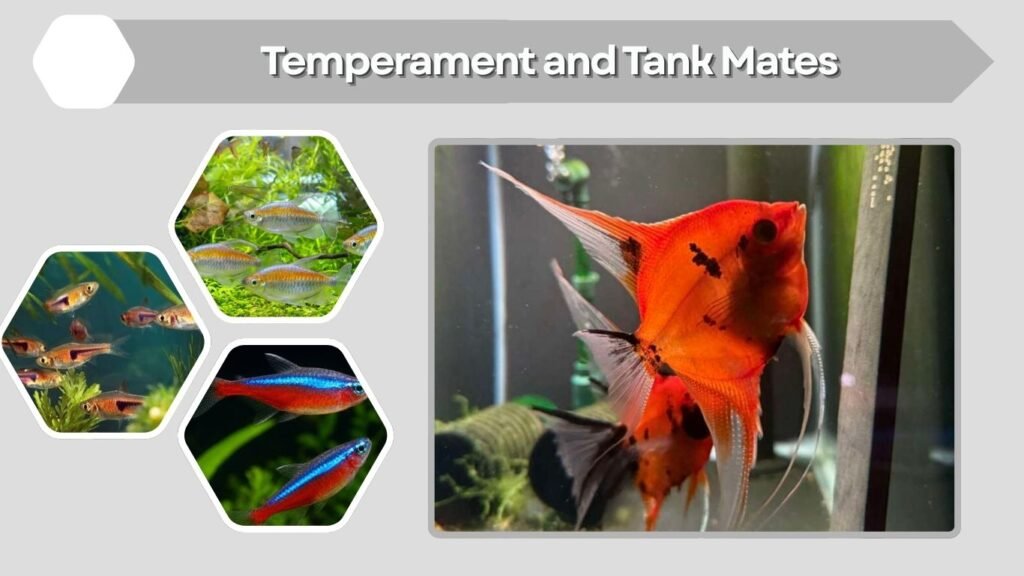
Red devil angelfish are usually calmer than many large cichlids, but they are not completely peaceful. They may chase other angelfish, defend feeding areas, and become strongly territorial when breeding.
Compatible tank mates may include:
- Medium-sized peaceful tetras
- Corydoras catfish
- Peaceful plecos
- Larger rasboras
- Calm gouramis in suitable setups
- Other angelfish in spacious tanks
Avoid very small fish that may be swallowed and aggressive fin-nippers that can damage the angelfish’s long fins.
Can Red-Tail Sharks Live With Angelfish?
This combination is possible but carries risk. Adult red-tail sharks can become territorial and may chase angelfish, especially in a cramped aquarium.
A large tank with caves, plants, driftwood, and visual barriers improves the chances of compatibility. Separate the fish if persistent chasing, torn fins, hiding, or refusal to eat occurs.
Red Devil Angelfish Breeding
A mature pair may clean a broad leaf, slate, filter pipe, or aquarium glass before spawning. The female lays rows of adhesive eggs, and the male follows to fertilize them.
Both parents may guard and fan the eggs. However, inexperienced pairs sometimes eat their first batches, especially when disturbed.
Basic Breeding Conditions
Successful breeding is supported by:
- A compatible mature pair
- Clean, warm water
- A flat vertical spawning surface
- Nutritious food
- Minimal disturbance
- Protection from aggressive tank mates
The eggs may hatch within several days. The larvae remain attached near the spawning area before becoming free-swimming fry.
Red Devil Angelfish vs Red Devil Cichlid
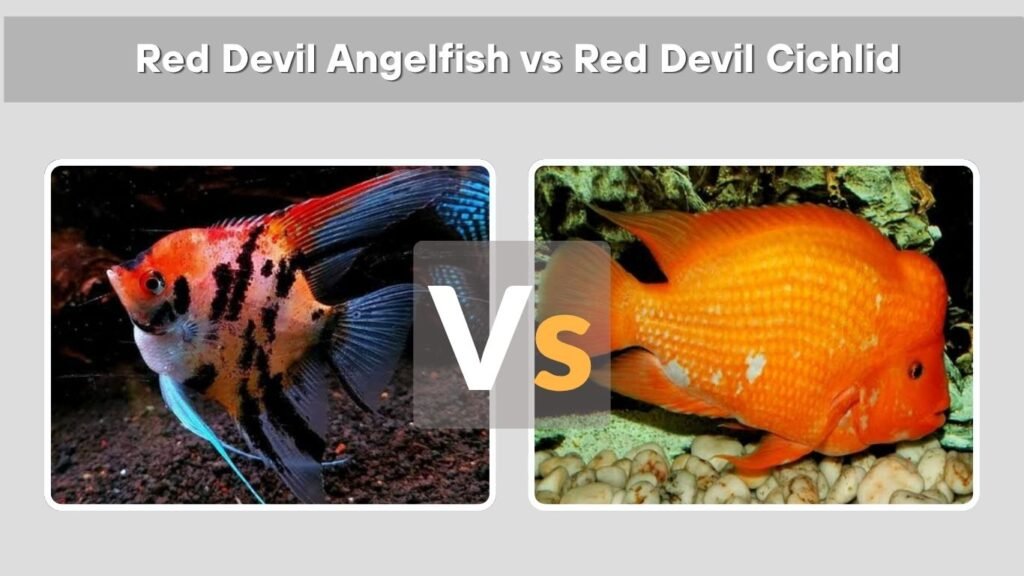
These are completely different fish despite their similar names.
| Characteristic | Red Devil Angelfish | Red Devil Cichlid |
| Typical species | Pterophyllum scalare | Amphilophus labiatus |
| Body shape | Tall and compressed | Thick and muscular |
| Temperament | Semi-aggressive | Highly aggressive |
| Adult size | Around 5–6 inches long | Commonly much larger |
| Community suitability | Possible with careful selection | Usually poor |
| Tank requirement | Tall community-style aquarium | Large species-focused aquarium |
A red devil cichlid should not be housed with freshwater angelfish. It is much stronger and more aggressive and may severely injure or kill them.
Buying a Red Devil Angelfish
Prices vary according to size, coloration, breeder reputation, location, and whether the fish comes from a specialized line. Solid-red and intensely colored adults are generally harder to produce than ordinary juveniles.
Before purchasing, check that the fish has:
- Open, undamaged fins
- Clear eyes
- Smooth scales
- Normal breathing
- A strong feeding response
- No white spots, ulcers, or cottony growths
- No sunken belly
- No persistent isolation or erratic swimming
Quarantine new fish before adding them to an established aquarium. This reduces the risk of introducing parasites and infectious disease.
FAQs
Is the red devil angelfish a separate species?
No. It is usually a selectively bred color variety of the freshwater angelfish Pterophyllum scalare. Red devil is a trade or strain name rather than a scientifically recognized species.
How big does a red devil angelfish get?
Adults commonly reach about 5–6 inches in body length. Their tall dorsal and anal fins can produce a total height of approximately 8–10 inches, which is why a tall aquarium is recommended.
Why is my juvenile red devil angelfish not red?
Juveniles may begin yellow, pale orange, or cream and develop stronger color as they mature. Genetics, age, health, diet, stress, water quality, and lighting all influence their final appearance.
Are red devil angelfish aggressive?
They are semi-aggressive cichlids. They may defend territories, compete with other angelfish, or become aggressive while breeding. Adequate space, plants, and visual barriers help reduce conflict.
Can red devil angelfish live with red devil cichlids?
No. Red devil cichlids grow larger and are far more aggressive than angelfish. Keeping them together creates a serious risk of stress, injury, and death for the angelfish.