
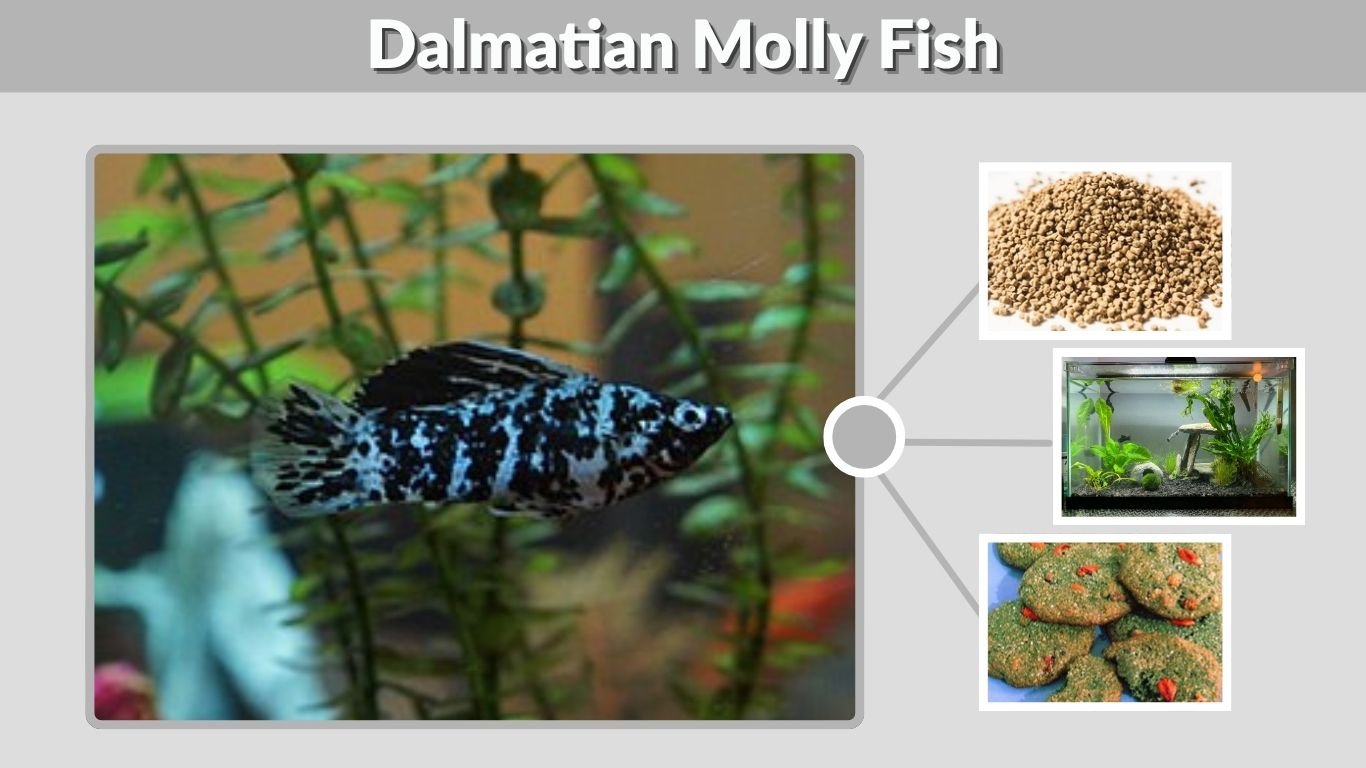
The Dalmatian molly fish is a popular freshwater aquarium fish recognized by its striking black-and-white spotted pattern. Peaceful, active, and relatively easy to care for, Dalmatian mollies can be a good choice for both beginner and experienced fishkeepers. They are livebearers, meaning females give birth to free-swimming babies rather than laying eggs. With proper water conditions, a balanced diet, enough swimming space, and compatible tank mates, these attractive tropical fish can remain healthy and colorful for several years.
Dalmatian Molly Fish Appearance and Size
Dalmatian mollies are varieties of mollies in the genus Poecilia, commonly associated with Poecilia sphenops and related aquarium strains. Their spotted coloration resembles a Dalmatian dog, although patterns differ considerably between individual fish. Some are nearly white with scattered black spots, while others become predominantly black as they mature.
Identification
- Color: White or silver body covered with irregular black spots
- Adult size: Commonly about 3–5 inches
- Body shape: Moderately elongated with a rounded abdomen
- Fins: Clear, white, black, or spotted depending on the individual
- Temperament: Generally peaceful and active
- Water type: Freshwater, though mollies tolerate moderately brackish conditions
- Activity: Usually swims throughout the middle and upper parts of the aquarium
Dalmatian Balloon and Lyretail Mollies
A Dalmatian balloon molly fish has a shorter, rounder body created through selective breeding. Its care requirements are broadly similar, although its unusual body shape can make it more vulnerable to health and swimming problems.
The Dalmatian lyretail molly has elongated upper and lower extensions on its tail fin. It displays the familiar spotted coloration but has a more dramatic silhouette.
Dalmatian Molly Fish Care and Tank Setup
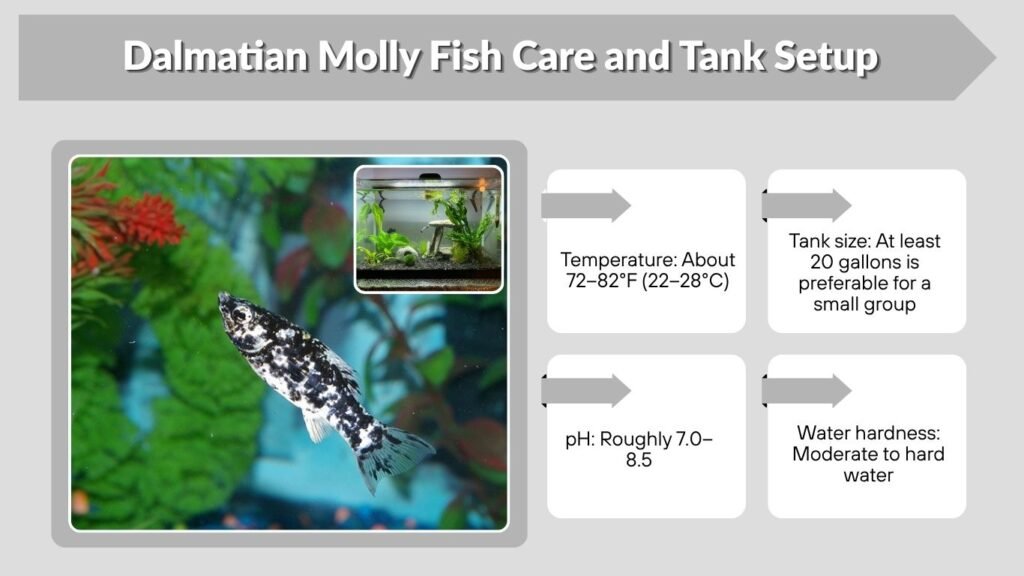
Good Dalmatian molly fish care begins with stable, clean water and adequate swimming room. Mollies generally prefer warm, mineral-rich water rather than very soft, acidic conditions. They can tolerate some variation, but abrupt changes in temperature or water chemistry can cause stress and illness.
Recommended Tank Conditions
- Temperature: About 72–82°F (22–28°C)
- pH: Roughly 7.0–8.5
- Tank size: At least 20 gallons is preferable for a small group
- Water hardness: Moderate to hard water
- Filtration: Reliable filter with gentle to moderate circulation
- Decor: Live plants, open swimming space, and hiding areas
- Water changes: Regular partial changes to control waste
How Many Dalmatian Mollies for a 20-Gallon Tank?
A 20-gallon aquarium can generally accommodate a small group of around three to four mollies when filtration and maintenance are good. Avoid overcrowding, especially because mollies reproduce quickly.
Keeping more females than males can reduce persistent mating pressure. A common arrangement is one male with two or three females.
What Do Dalmatian Molly Fish Eat?

Dalmatian mollies are omnivorous and naturally consume a combination of algae, plant matter, and small animal foods. Variety is important because relying on one food alone may not provide ideal nutrition. Their regular diet should contain quality prepared food supplemented by vegetables and occasional protein-rich treats.
Best Foods for Dalmatian Mollies
- High-quality tropical flakes
- Small sinking or floating pellets
- Spirulina-based foods
- Blanched spinach or zucchini
- Algae-based foods
- Brine shrimp
- Daphnia
- Bloodworms as an occasional treat
Feed small portions once or twice daily rather than giving a large amount at once. The fish should consume most food within a few minutes. Overfeeding can quickly reduce water quality and contribute to digestive problems.
Dalmatian Molly Fish Male vs Female
Male and female Dalmatian molly fish can usually be distinguished once they mature. The most reliable difference is found in the anal fin. This makes sexing Dalmatian molly fish considerably easier than identifying the sex of many other aquarium species.
Male and Female Differences
- Male: Has a narrow, pointed anal fin called a gonopodium
- Female: Has a broad, fan-shaped anal fin
- Male body: Often slimmer and slightly smaller
- Female body: Usually larger with a rounder abdomen
- Male behavior: Frequently follows and courts females
- Pregnant female: Develops an enlarged, increasingly squared abdomen near birth
Are Dalmatian Molly Fish Aggressive?
Dalmatian mollies are generally peaceful community fish, but occasional chasing, fin nipping, and territorial behavior can occur. Males commonly chase females as part of mating behavior, and males may also compete with one another.
If Dalmatian mollies keep biting other fish, check for overcrowding, an unbalanced male-to-female ratio, insufficient hiding places, or incompatible tank mates. Providing more space and vegetation often reduces conflict.
Dalmatian Molly Fish Breeding and Pregnancy
Dalmatian mollies are prolific livebearers and can reproduce readily in a well-maintained aquarium. Unlike egg-laying fish, the female retains developing embryos inside her body and gives birth to fully formed, free-swimming fry. Females can also store sperm, meaning pregnancy may occur even when a male is no longer present.
Pregnancy and Giving Birth Signs
- Noticeably enlarged abdomen
- Belly becomes more squared near delivery
- Increased hiding or isolation
- Reduced activity shortly before birth
- Spending more time near plants or sheltered areas
- Changes in appetite
- Restlessness around the time of delivery
Pregnancy commonly lasts around four to six weeks, although temperature, age, genetics, and environmental conditions can influence the timing.
Baby Dalmatian Molly Fish
Dalmatian molly babies are able to swim and search for food shortly after birth. Adults may eat their fry, so dense plants such as Java moss, guppy grass, or floating vegetation improve survival.
Feed babies finely crushed flakes, powdered fry food, baby brine shrimp, or other appropriately sized foods several times in small amounts. Regular water changes are particularly important because young fish grow best in clean water.
Lifespan, Health, and Color Changes
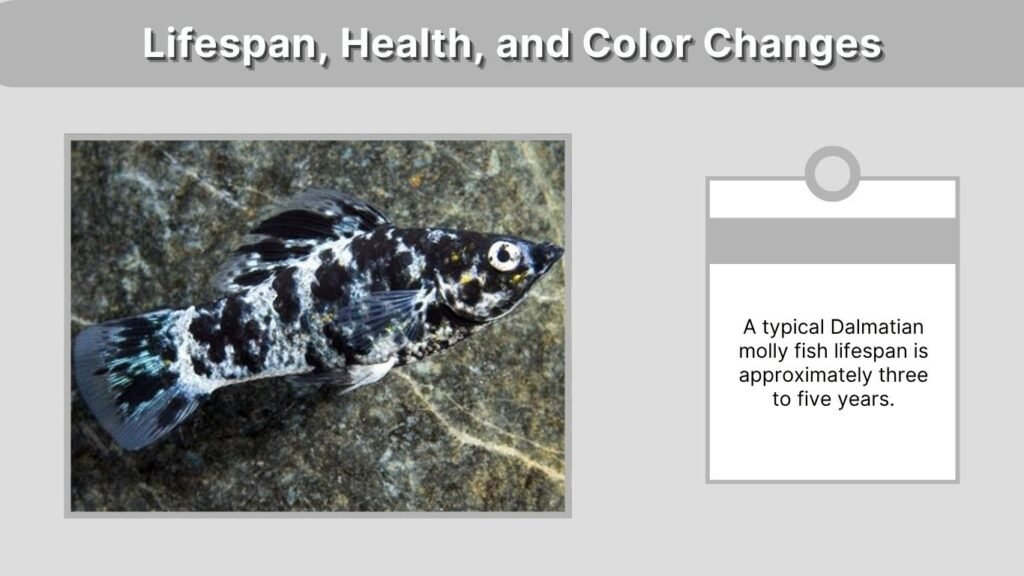
With suitable care, Dalmatian molly fish commonly live for several years. Genetics, water quality, nutrition, stress, and disease all affect their lifespan. Maintaining stable conditions is considerably more important than trying to achieve a single exact water parameter.
Dalmatian Molly Fish Lifespan
A typical Dalmatian molly fish lifespan is approximately three to five years. Some individuals may live longer under excellent aquarium conditions.
Young fish generally mature within several months and can begin reproducing relatively early. Because females may produce repeated broods, population growth can be rapid in a mixed-sex aquarium.
Why Is My Dalmatian Molly Turning Black?
A Dalmatian molly fish turning black is not automatically sick. Many individuals naturally develop more black pigmentation as they mature because their patterns can change with age.
However, sudden color changes accompanied by clamped fins, poor appetite, rapid breathing, spots, unusual swimming, or staying near the surface may indicate stress or illness. Test ammonia, nitrite, nitrate, temperature, and pH if behavioral changes appear.
FAQs
Are Dalmatian Mollies Schooling Fish?
Dalmatian mollies are social but are not true schooling fish. They usually do better with other mollies and may loosely group together. Keeping a small group can help them feel secure, provided the aquarium is large enough.
Are Dalmatian Mollies Tropical Fish?
Yes. Dalmatian mollies are tropical fish that require consistently warm aquarium water. They are commonly maintained at approximately 72–82°F and should not be exposed to sudden temperature changes.
How Big Do Dalmatian Molly Fish Get?
Most Dalmatian mollies reach approximately 3–5 inches long as adults. Their final size depends on genetics, sex, diet, tank conditions, and the particular molly strain.
Does the Dalmatian Molly Fish Lay Eggs?
No. Dalmatian mollies are livebearers. Eggs develop inside the female’s body, and she gives birth to free-swimming baby fish rather than depositing eggs in the aquarium.
How Long Is a Dalmatian Molly Fish Pregnant?
A pregnant Dalmatian molly commonly carries developing young for roughly four to six weeks. The exact period can vary with water temperature, age, genetics, and overall health.