
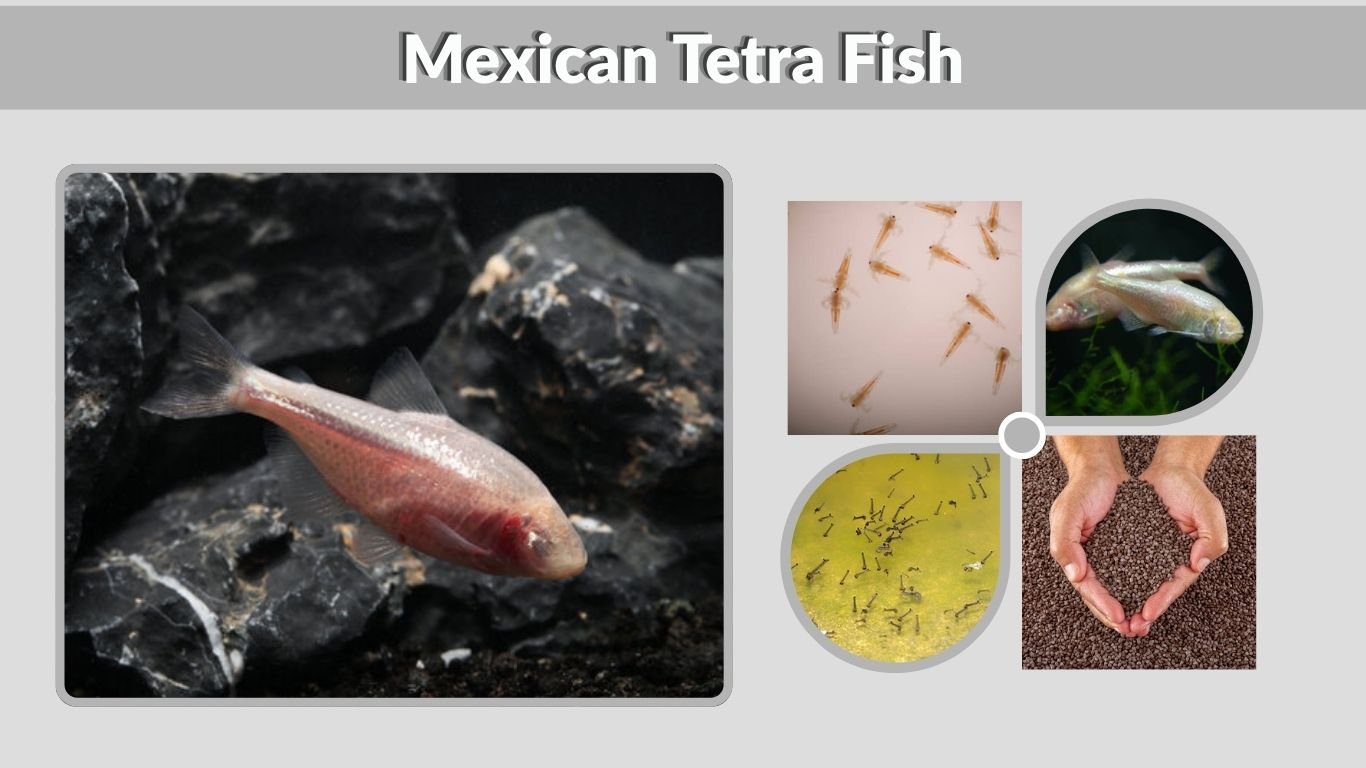
The Mexican tetra is a fascinating freshwater fish best known for existing in two dramatically different forms. Surface-dwelling Mexican tetras have normal eyes and silvery bodies, while cave populations may have reduced eyes, little pigmentation, and a pale pink appearance. Both belong to the species Astyanax mexicanus. The blind cave form is especially popular among aquarists and scientists because it demonstrates how animals adapt to permanent darkness. Mexican tetras are active, hardy fish, but they require a spacious aquarium, a proper school, stable water conditions, and carefully selected tank mates.
What Is a Mexican Tetra?
The Mexican tetra, scientifically known as Astyanax mexicanus, is a freshwater characin native to North America. Its natural distribution includes parts of Mexico and river systems extending into southern Texas. The species inhabits rivers, creeks, springs, pools, backwaters, and underground cave systems.
The species is widely known by several common names, including:
- Mexican tetra
- Mexican cavefish
- Blind cave tetra
- Blind cavefish
- Blind cave characin
These names can cause confusion because not every Mexican tetra is blind. The species includes sighted surface populations as well as several independently evolved cave populations.
Surface Mexican Tetra vs. Blind Cave Tetra
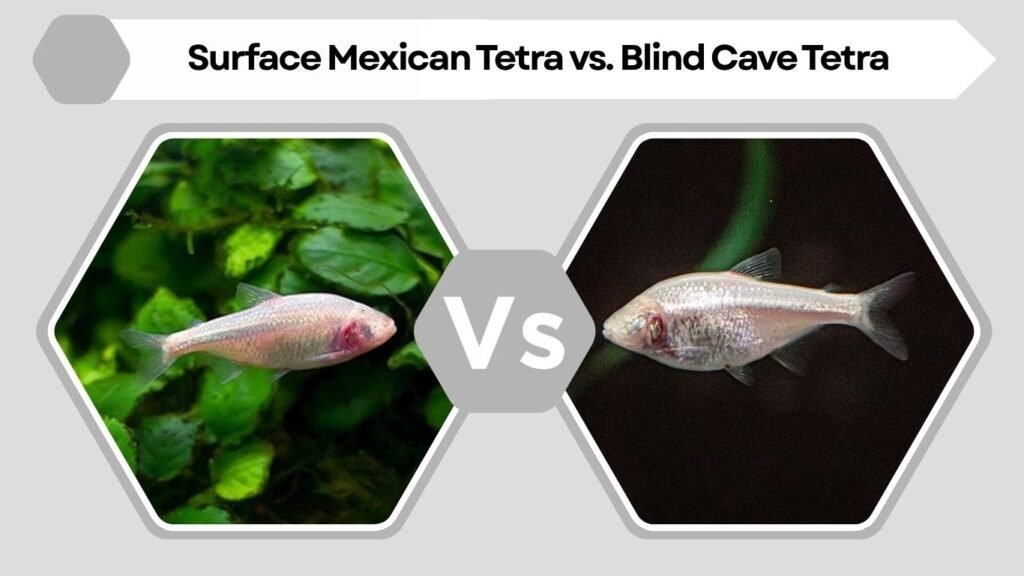
The surface and cave forms belong to the same species, but their appearances and behaviors can be very different.
| Feature | Surface Mexican tetra | Blind cave tetra |
|---|---|---|
| Eyes | Fully developed | Reduced, covered, or absent externally |
| Color | Silver or gray | Pale pink, cream, or nearly white |
| Habitat | Rivers, streams, springs, and pools | Permanently dark caves |
| Navigation | Relies partly on vision | Relies heavily on vibration and water movement |
| Pigmentation | Normal pigmentation | Reduced or absent pigmentation |
| Activity | Typical day-and-night patterns | Adapted to a dark environment |
Surface fish generally have a silvery body, visible eyes, and a shape similar to other medium-sized tetras. Cave forms often appear pink because their reduced pigmentation allows blood vessels beneath the skin to become more visible.
Cave populations did not simply lose their eyes once. Scientific research indicates that separate cave populations repeatedly evolved traits such as eye reduction and loss of pigmentation after becoming isolated underground. This makes Astyanax mexicanus an important model for studying evolution and development.
Mexican Tetra Identification
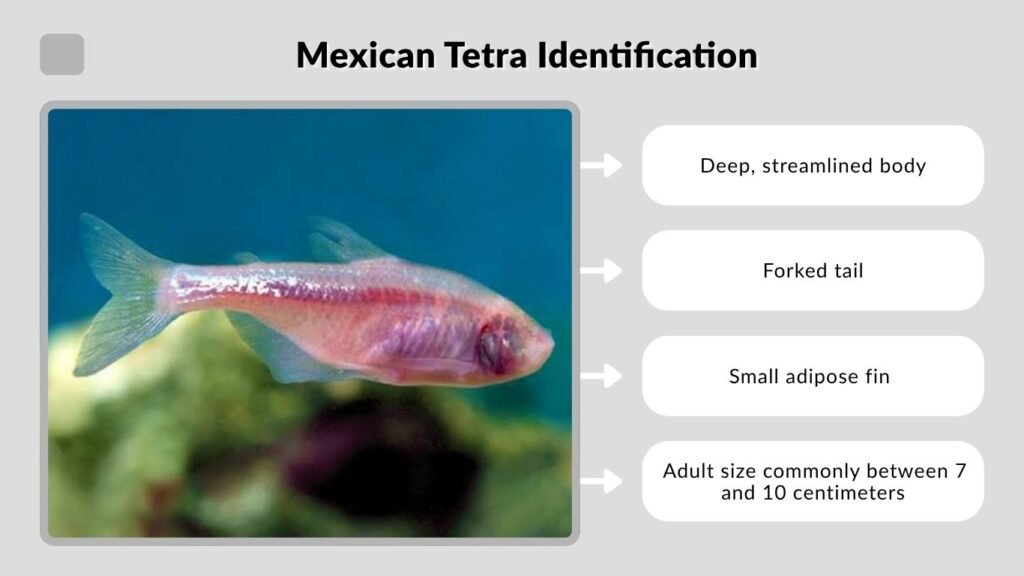
Adult Mexican tetras have a deep, laterally compressed body with a forked tail and a small adipose fin between the dorsal and tail fins.
Common identifying characteristics include:
- Deep, streamlined body
- Forked tail
- Small adipose fin
- Adult size commonly between 7 and 10 centimeters
- Maximum recorded length of approximately 12 centimeters
- Active schooling behavior
- Strong response to vibrations and movement
The blind cave form has a pale body and reduced or externally invisible eyes. Young cavefish may begin development with eye structures, but these become reduced as the fish grows.
The absence of visible eyes does not prevent the cavefish from swimming confidently. It uses sensory systems along its body to detect currents, nearby objects, food, and the movements of other fish.
How Big Do Mexican Tetras Get?
Mexican tetras can reach about 12 centimeters in total length, although many aquarium specimens remain around 7–10 centimeters. Their relatively deep bodies make them appear larger and heavier than slim tetras of a similar length.
The final size depends on genetics, diet, aquarium space, water quality, and the age of the fish. Poorly maintained fish may remain smaller, but restricted growth is not a healthy method of controlling their size.
Because adults are larger and more active than neon tetras, Mexican tetras should not be placed in very small desktop aquariums.
Mexican Tetra Tank Size
A group of Mexican tetras should generally be kept in an aquarium of at least 30 gallons. A 40-gallon breeder or another long aquarium is preferable for a larger school or a community setup.
The fish are active swimmers and need open horizontal space. A long tank is therefore more useful than a tall aquarium with the same water volume.
A larger aquarium offers several benefits:
- More swimming space
- Greater water stability
- Reduced aggression
- Room for a larger school
- Better feeding access
- More options for compatible tank mates
A secure lid is important because startled Mexican tetras may jump. Leave some space between the water surface and the cover, and close openings around filters or cables.
How Many Mexican Tetras Should Be Kept Together?
Mexican tetras are social fish and should be maintained in a school. A group of at least six is recommended, although eight or more usually creates more natural behavior.
When too few are kept together, they may become nervous or direct excessive chasing toward one fish. Larger groups distribute social interactions and help individuals feel more secure.
Blind cave tetras may occasionally bump into one another while feeding, but they are highly capable of navigating around their companions. They do not need to be isolated simply because they lack functional vision.
Water Parameters
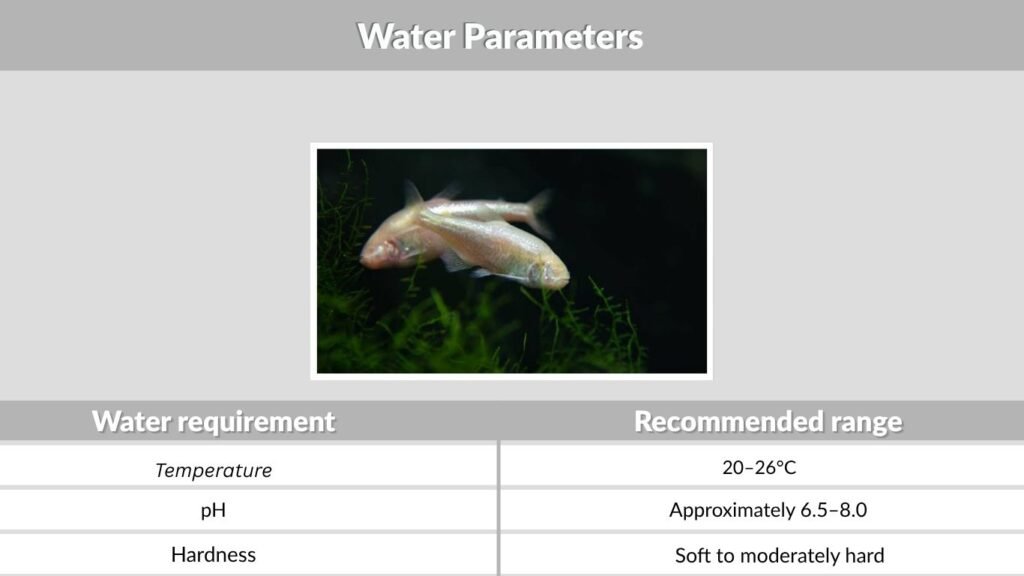
Mexican tetras are considered hardy and can tolerate a reasonably broad range of freshwater conditions. Stability remains more important than trying to reach one perfect measurement.
Suitable aquarium conditions include:
| Water requirement | Recommended range |
|---|---|
| Temperature | 20–26°C |
| pH | Approximately 6.5–8.0 |
| Hardness | Soft to moderately hard |
| Ammonia | 0 ppm |
| Nitrite | 0 ppm |
| Nitrate | Kept low |
A temperature near 22–25°C works well for most aquarium populations. Avoid sudden changes in temperature, pH, or hardness.
Change approximately 20–30 percent of the water each week, depending on stocking density and nitrate levels. Always treat tap water with a suitable conditioner before adding it to the aquarium.
The tank must be fully cycled before the fish are introduced. Even hardy tetras can suffer gill damage or death when exposed to ammonia and nitrite.
Setting Up a Mexican Tetra Aquarium
A practical setup should combine open swimming room with sheltered areas. Surface tetras appreciate plants and wood, while blind cave tetras benefit from structures they can explore using touch and vibration.
Suitable decorations include:
- Smooth rocks
- Rounded caves
- Driftwood
- Hardy live plants
- Artificial caves without sharp edges
- Fine gravel or sand
- Open swimming space
Avoid decorations with sharp points. Blind fish can navigate extremely well, but they may still injure themselves during sudden movements or feeding excitement.
Lighting can be moderate for surface fish. Blind cave tetras do not require bright lighting and may appear more comfortable under dim illumination. Floating plants can soften strong aquarium lights.
A moderate filter current helps maintain oxygen and water quality. However, the flow should not be so powerful that the fish must struggle continuously.
What Do Mexican Tetras Eat?
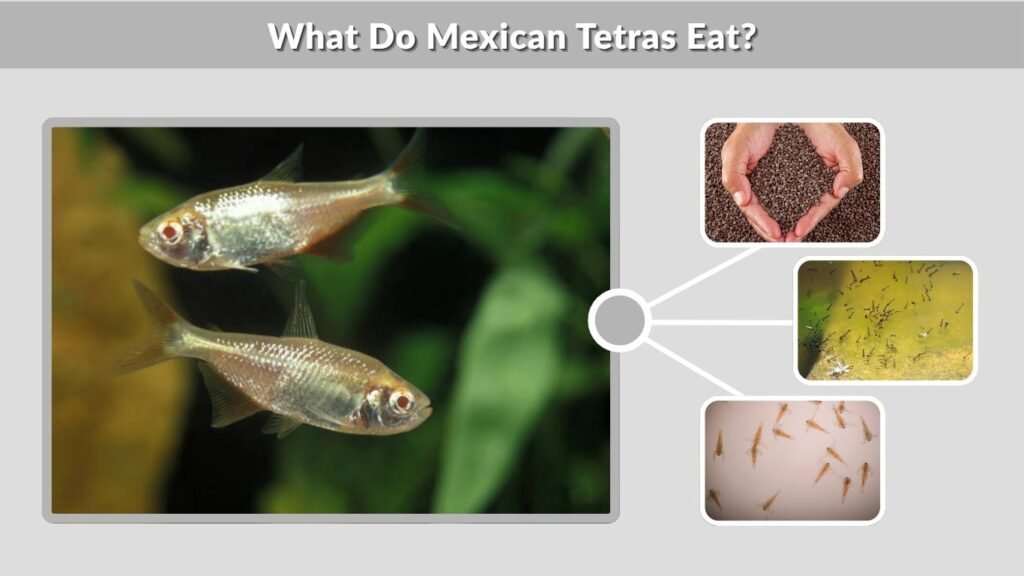
Mexican tetras are omnivorous and adaptable feeders. Wild populations consume insects, crustaceans, worms, and other available food.
In an aquarium, their diet can include:
- Quality tropical flakes
- Small or medium pellets
- Frozen bloodworms
- Brine shrimp
- Daphnia
- Mosquito larvae from safe sources
- Chopped earthworms
- Insect-based foods
- Occasional vegetable-based flakes
Feed one or two controlled meals per day. Offer only as much as the fish can consume within a few minutes.
Blind cave tetras find food through smell, taste, vibration, and water movement. Sinking or slowly falling foods can make feeding easier. Distribute food across several areas so every fish has an opportunity to eat.
Watch the body condition of each individual. A dominant or faster fish may consume more than the others, especially in a mixed community aquarium.
Mexican Tetra Behavior
Mexican tetras are active, curious, and social. They spend much of their time swimming through the middle levels of the aquarium.
Surface fish use vision to explore their surroundings, while cavefish depend more heavily on their lateral-line system. This sensory system detects water movement and pressure changes, allowing the fish to identify obstacles and approaching animals.
Cave populations have also evolved behavioral differences related to feeding, activity, and sleep. Studies have found that some cavefish populations sleep considerably less than surface forms, although the degree of change varies among populations.
Occasional chasing within a school is normal. Constant attacks, torn fins, hiding, or one fish being repeatedly excluded may indicate overcrowding, an undersized school, or unsuitable tank mates.
Mexican Tetra Tank Mates
Mexican tetras can live in a community aquarium, but their energetic feeding and occasional fin-nipping must be considered.
Suitable tank mates may include:
- Larger peaceful tetras
- Danios
- Peaceful barbs
- Corydoras catfish
- Medium-sized rasboras
- Bristlenose plecos
- Weather loaches in suitable temperatures
- Other similarly sized, active community fish
Avoid very slow fish and species with long, flowing fins. Bettas, fancy guppies, and delicate long-finned varieties may be stressed or nipped.
Very small fish and tiny shrimp may be viewed as food. Large predatory cichlids may eat the tetras.
Blind and sighted Mexican tetras can sometimes be kept together when their size and temperament are compatible. Feeding should be monitored to ensure the sighted fish do not consume all available food first.
Are Mexican Tetras Aggressive?
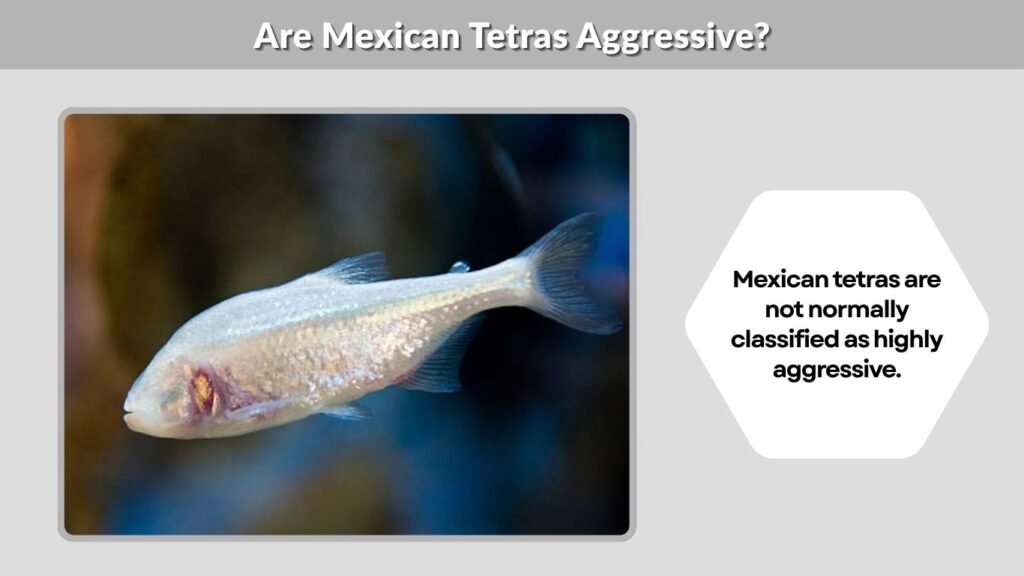
Mexican tetras are not normally classified as highly aggressive, but they can be boisterous. They may chase one another, compete strongly for food, or nip the fins of slower tank mates.
Problematic behavior is more likely when:
- The school is too small
- The aquarium is overcrowded
- Swimming space is limited
- Food is insufficient
- Long-finned fish are present
- Water quality is poor
- One fish is sick or weakened
Increasing the group size and providing a larger aquarium often reduces aggression. Visual barriers created with plants and wood can also give weaker fish temporary shelter.
Mexican Tetra Breeding
Mexican tetras are egg-scattering fish and do not care for their eggs or fry. Adults may eat the eggs soon after spawning.
A separate breeding aquarium improves the chance of success. It should contain:
- Mature, conditioned adults
- Fine-leaved plants or spawning mops
- A mesh or marble layer
- Gentle sponge filtration
- Clean, stable water
- Dim lighting
Condition potential breeders with varied live and frozen foods. Females become fuller when carrying eggs, while males usually remain slimmer.
During spawning, the female releases eggs and the male fertilizes them. The eggs fall among plants, through mesh, or between marbles where adults cannot easily reach them.
Remove the adults after spawning. Once the fry become free-swimming, offer microscopic foods such as infusoria before moving to newly hatched brine shrimp and finely crushed prepared food.
Blind cavefish fry may initially develop eye structures. As they mature, eye growth is reduced and surrounding tissue may cover the remaining structures. Research into this process has made the species valuable in studies of eye development and evolutionary change.
Mexican Tetra Lifespan
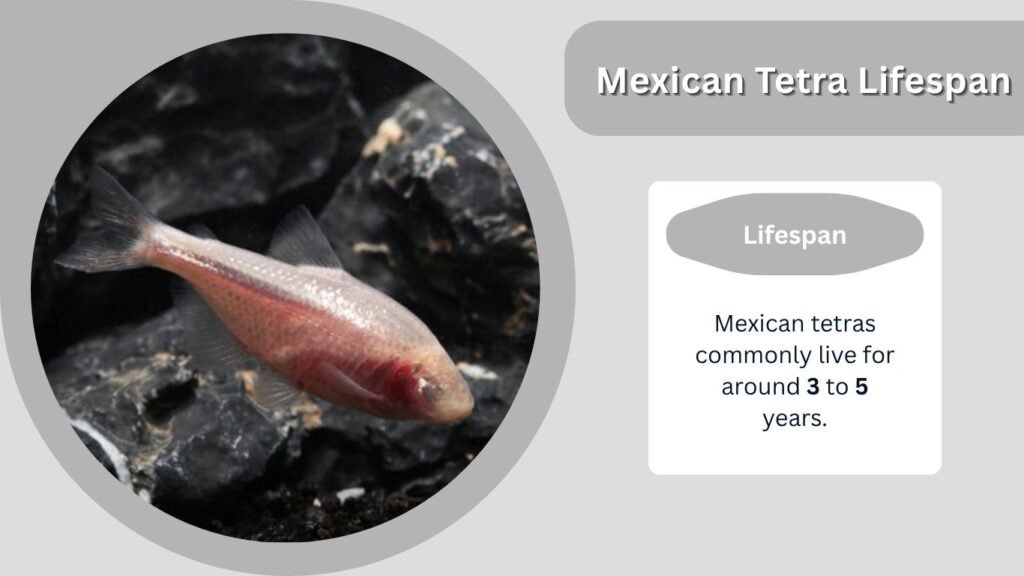
Mexican tetras commonly live for around three to five years in aquariums, although well-maintained individuals may live longer.
Factors affecting lifespan include:
- Genetic quality
- Water stability
- Tank size
- Diet
- Stress
- Disease exposure
- Temperature
- Aggression from tank mates
Quarantine new fish before adding them to an established aquarium. This reduces the risk of introducing parasites or infections.
Avoid keeping the fish constantly at the highest tolerated temperature because warmer water increases metabolism and reduces dissolved oxygen.
Common Health Problems
Mexican tetras may develop the same diseases seen in other freshwater aquarium fish.
Potential problems include:
- Ich or white spot disease
- Fin rot
- Fungal infections
- Internal parasites
- Bacterial infections
- Gill irritation
- Ammonia or nitrite poisoning
Blind cave tetras naturally lack visible eyes and pigmentation, so these features should not be mistaken for illness.
Warning signs include refusing food, rapid breathing, clamped fins, open sores, unusual swelling, white spots, loss of balance, or isolation from the school.
Always test ammonia, nitrite, nitrate, temperature, and pH before adding medication. Poor water conditions frequently cause or worsen symptoms.
Interesting Mexican Tetra Facts
- Sighted and blind Mexican tetras belong to the same species.
- Different cave populations evolved reduced eyes independently.
- Cavefish can navigate accurately without functional vision.
- Their lateral-line system detects water movement and nearby objects.
- Cave forms may have reduced pigmentation and pale pink bodies.
- Some cave populations sleep less than surface populations.
- Mexican tetras are important animals in evolutionary research.
- They are larger and more active than many popular aquarium tetras.
- Both surface and cave forms are omnivorous.
- The species can reach approximately 12 centimeters in length.
FAQs
Are all Mexican tetras blind?
No. Surface Mexican tetras have normal eyes and silver coloration. Blindness and reduced pigmentation occur in cave populations that evolved in permanently dark underground habitats.
Can blind Mexican tetras find food?
Yes. They detect food through smell, taste, vibrations, and changes in water movement. They can feed successfully without sight, although food should be distributed so every fish gets enough.
How many Mexican tetras should be kept together?
Keep at least six, but a school of eight or more is generally better. A larger group creates more natural behavior and reduces excessive attention toward a single fish.
Can Mexican tetras live with other fish?
Yes. They can live with active, similarly sized community fish. Avoid tiny species, very slow swimmers, and fish with long fins that may be chased or nipped.
Do blind cave tetras need aquarium lights?
They do not need light for vision, and bright lighting is unnecessary. Dim light helps owners observe the fish while creating a more natural and comfortable environment.