
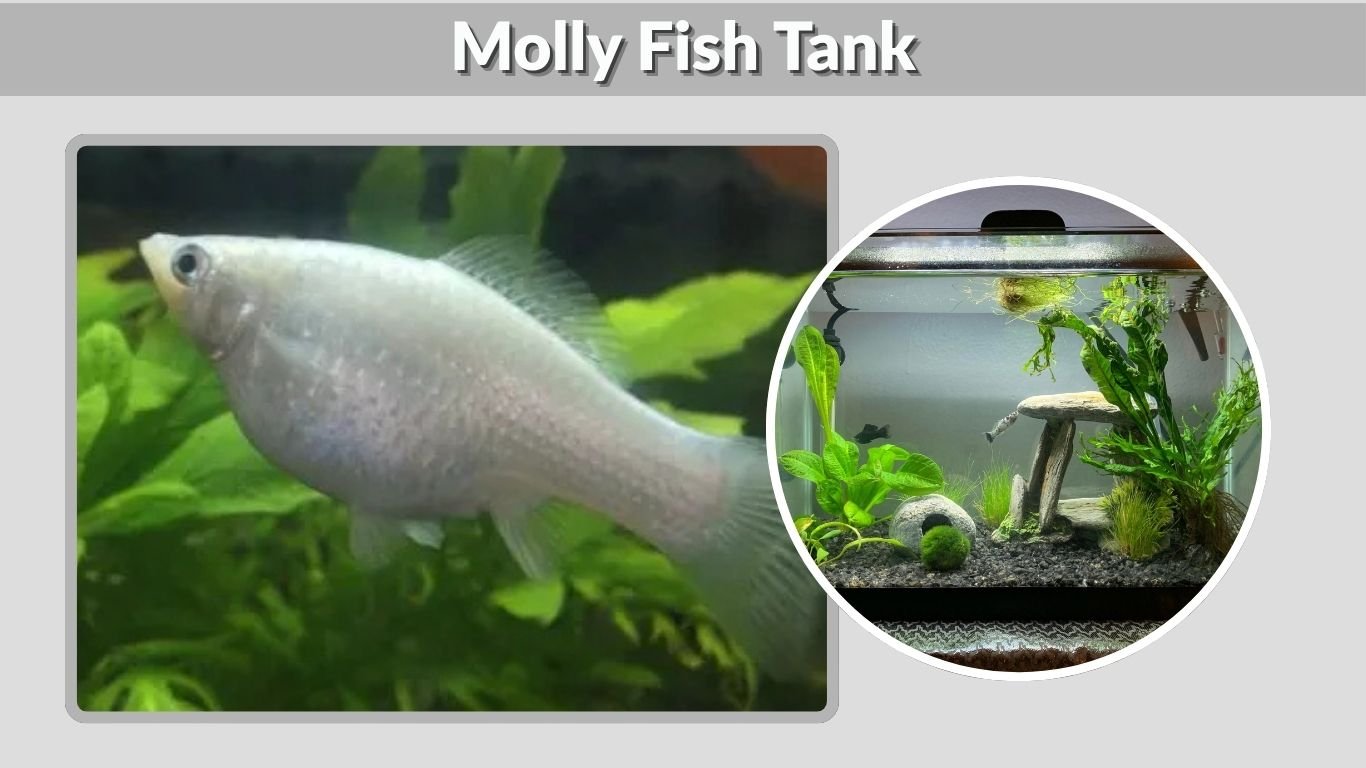
A well-planned molly fish tank gives these active, colorful livebearers enough room to swim, socialize, and stay healthy. Mollies are generally hardy, but they still need stable water conditions, adequate filtration, compatible tank mates, and enough space to prevent stress and aggression. Whether you keep black mollies, Dalmatian mollies, balloon mollies, or sailfin varieties, proper tank setup makes a major difference. This guide covers molly fish tank size, temperature, stocking, decorations, tank mates, breeding, and common behaviors.
Molly Fish Tank Requirements
Mollies adapt well to home aquariums, but they should not simply be placed in a small bowl or uncycled tank. They are active fish that produce a reasonable amount of waste, so good filtration and stable water chemistry are important.
Basic Tank Requirements
A suitable molly fish aquarium should include:
- Minimum tank size: About 20 gallons for a small group
- Temperature: Approximately 75–80°F (24–27°C)
- pH: Around 7.5–8.5
- Water hardness: Moderately hard to hard
- Filtration: Moderate to strong biological filtration
- Lighting: Moderate aquarium lighting
- Substrate: Sand, gravel, or planted-tank substrate
- Plants: Live or artificial plants for shelter
- Lid: Recommended because mollies can jump
Mollies generally prefer harder, slightly alkaline water. More important than chasing an exact number is keeping water parameters stable.
Molly Fish Tank Temperature
A temperature around 75–80°F works well for most common mollies, including black and Dalmatian mollies.
Sudden temperature changes can stress them, so an aquarium heater is useful when room temperatures fluctuate. A thermometer makes it easier to monitor conditions.
Do Molly Fish Need Salt?
Mollies can tolerate mildly brackish conditions better than many freshwater fish, but aquarium salt is not automatically necessary.
Captive-bred mollies can normally live successfully in freshwater when their water is sufficiently hard and alkaline. Adding salt without considering plants and tank mates may create unnecessary problems.
What Size Tank Do Molly Fish Need?
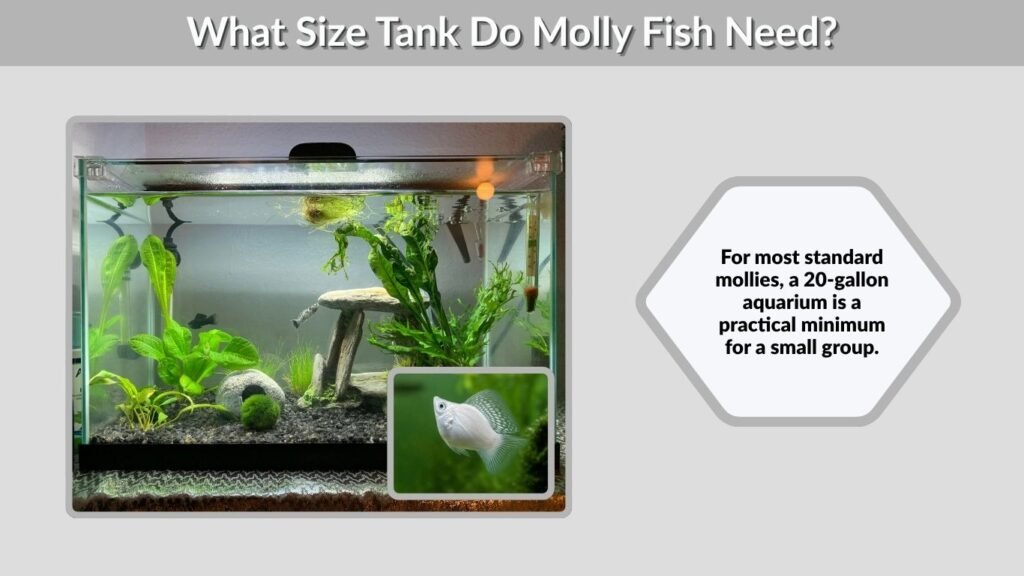
Tank size is one of the biggest considerations when keeping mollies. Although pet stores sometimes display them in small aquariums, adult mollies are active swimmers and should have more space.
Molly Fish Minimum Tank Size
For most standard mollies, a 20-gallon aquarium is a practical minimum for a small group.
Larger varieties, particularly sailfin mollies, benefit from tanks of 30 gallons or more.
Balloon mollies have shorter, rounded bodies but should not automatically be placed in tiny tanks. They still need clean water and adequate swimming space.
How Many Molly Fish Per Tank?
Approximate stocking suggestions include:
- 5-gallon tank: Not recommended for adult mollies
- 10-gallon tank: Generally too small for a permanent molly group
- 20-gallon tank: About 3–4 mollies
- 30-gallon tank: About 5–6 mollies
- 55-gallon tank: A larger community of roughly 8–12 may be possible
These numbers are only general guidelines. Filtration, tank dimensions, other fish, adult size, plants, and maintenance habits all affect safe stocking levels.
Can Molly Fish Live in a 10-Gallon Tank?
A molly may physically survive in a 10-gallon aquarium, but it is usually not the best long-term choice.
Mollies are social and active, and keeping several adults in only 10 gallons can cause crowding, rapid waste buildup, aggression, and unstable water quality.
A 20-gallon or larger aquarium provides much better conditions.
How to Set Up a Molly Fish Tank
A good molly aquarium combines open swimming space with plants and sheltered areas. The aquarium should also be fully cycled before introducing a complete group of fish.
Molly Fish Tank Setup
A basic setup can include:
- Choose a 20-gallon or larger aquarium.
- Add washed aquarium gravel or sand.
- Install an appropriately sized filter.
- Add a heater and thermometer if necessary.
- Include plants, rocks, or aquarium-safe decorations.
- Fill the aquarium with conditioned water.
- Cycle the aquarium before fully stocking it.
- Introduce mollies gradually.
- Test water regularly for ammonia, nitrite, nitrate, and pH.
Never use untreated tap water because chlorine or chloramine can harm fish and beneficial filter bacteria.
Molly Fish Planted Tank
Mollies work particularly well in planted community tanks. Plants provide hiding places for females and newborn fry while making the aquarium feel more natural.
Useful aquarium plants may include Java fern, Java moss, Anubias, Vallisneria, hornwort, and water sprite.
Keep some open areas for swimming rather than filling the entire aquarium with decorations.
Molly Fish Tank Decoration Ideas
Mollies do not require elaborate decorations. You can use smooth rocks, driftwood suitable for your water chemistry, aquarium caves, and groups of plants.
Avoid decorations with extremely sharp edges because they may damage fins.
Best Tank Mates for Molly Fish
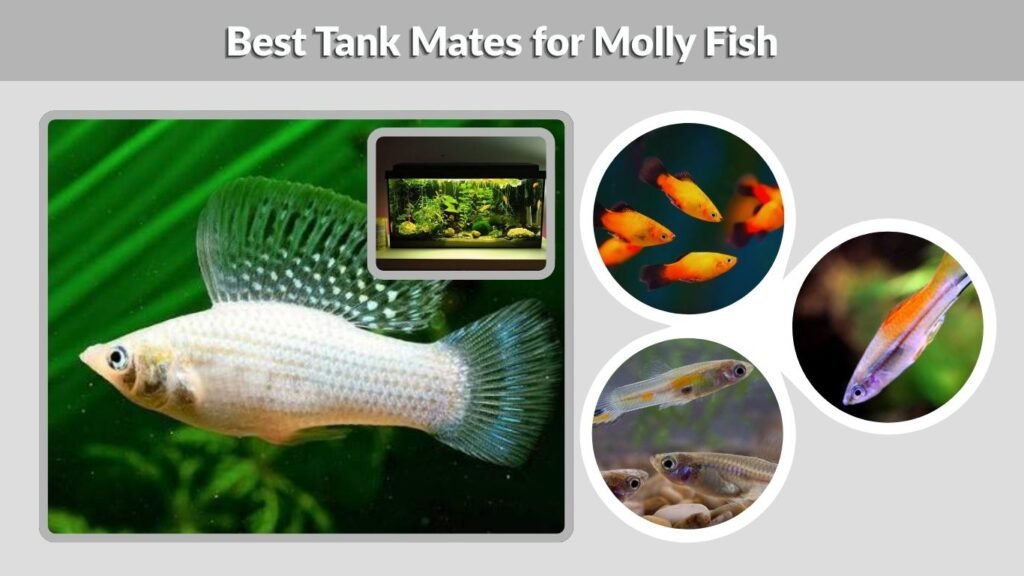
Mollies are usually peaceful community fish, although males may chase females or compete with other males. Tank mates should tolerate similar warm, moderately hard water conditions.
Compatible Molly Fish Tank Mates
Possible companions include:
- Platies
- Swordtails
- Guppies
- Some peaceful rainbowfish
- Certain compatible Corydoras species
- Bristlenose plecos
- Peaceful snails
- Other mollies
Always consider aquarium size and water requirements before combining species.
Male-to-Female Ratio
Male mollies frequently pursue females during breeding behavior.
Keeping approximately one male for every two or three females can help distribute attention and reduce stress on individual females.
Provide dense plants and hiding places so females can move away when necessary.
Tank Mates to Avoid
Avoid aggressive or highly territorial species that may attack mollies or nip their fins.
Fish requiring very soft, acidic water may also be poor companions because their ideal water chemistry differs significantly from that preferred by mollies.
Why Is My Molly Fish at the Bottom of the Tank?
Occasionally resting near the bottom does not always indicate a serious problem. However, a molly that continuously sits, hides, or lies on the bottom needs attention.
Common Reasons Mollies Stay at the Bottom
Possible causes include:
- Poor water quality
- Ammonia or nitrite exposure
- Incorrect temperature
- Stress from aggressive tank mates
- Illness or parasites
- Pregnancy or recent birth
- Sudden water-parameter changes
- Low oxygen levels
Test the water first when a molly suddenly changes behavior.
Molly Laying on the Bottom and Breathing Heavily
Heavy breathing combined with lying on the substrate can indicate a serious water-quality or health problem.
Check ammonia, nitrite, nitrate, temperature, and filtration immediately. A water change may be appropriate if harmful waste levels are detected.
Persistent symptoms, unusual spots, swelling, damaged fins, or abnormal swimming can indicate disease requiring further investigation.
Why Is My Molly Fish Staying at the Top?
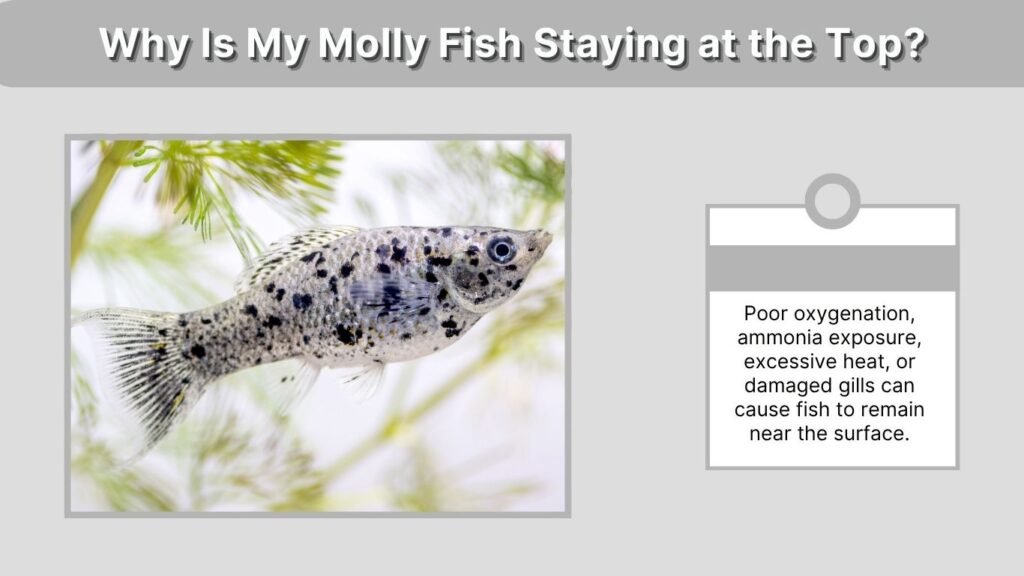
Mollies naturally explore every level of the aquarium, so occasional swimming near the surface is normal.
Continuous surface hovering or gasping is more concerning.
Poor oxygenation, ammonia exposure, excessive heat, or damaged gills can cause fish to remain near the surface.
Increase surface movement and test the water if several fish begin gasping at the same time.
Do Molly Fish Jump Out of the Tank?
Yes. Molly fish can jump out of aquariums, particularly when startled, chased, stressed, or experiencing unsuitable water conditions.
Use a secure aquarium lid and cover large openings around filters and equipment.
If a molly suddenly begins attempting to escape, check water quality rather than assuming jumping is simply normal behavior.
Molly Fish Breeding Tank
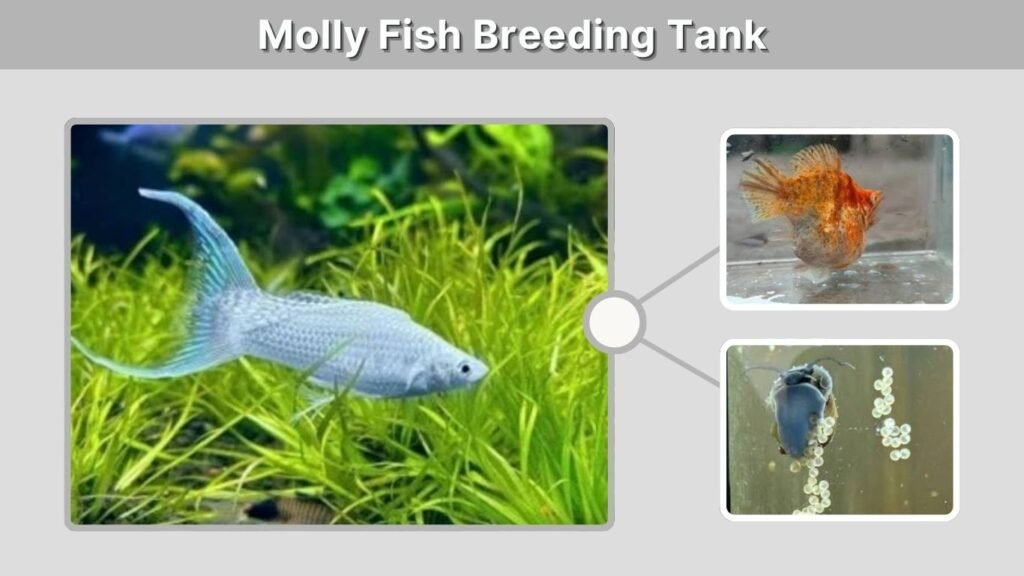
Mollies are livebearers, meaning females give birth to free-swimming babies rather than laying conventional eggs.
A heavily planted community tank may allow some fry to survive, although adults can eat newborn mollies.
Molly Fish Eggs in the Tank
You generally will not find normal molly fish eggs attached to plants or aquarium decorations.
Molly embryos develop inside the female until she gives birth. What appears to be an egg in the aquarium may be something else, such as food, snail eggs, debris, or material associated with an unsuccessful pregnancy.
Baby Molly Fish Tank
Newborn mollies can stay in a separate nursery aquarium or a well-planted main tank.
Provide gentle filtration, stable warm water, and appropriately sized foods such as finely crushed flakes or specialized fry food.
Avoid severely overcrowding breeding tanks because mollies reproduce quickly.
How to Clean a Molly Fish Tank
Regular aquarium maintenance helps prevent many common molly health problems.
Each week or as needed:
- Replace approximately 20–30% of the water.
- Vacuum waste from the substrate.
- Remove dead plant material.
- Clean algae from the glass.
- Test important water parameters.
- Rinse filter media gently in removed aquarium water when necessary.
Do not replace all filter media or completely sterilize the aquarium during routine cleaning because beneficial bacteria help control toxic ammonia and nitrite.
FAQs
What is the best tank size for molly fish?
A 20-gallon aquarium is a good starting size for a small group of standard mollies. Larger tanks provide more stable water quality and swimming space.
How many mollies can live in a 20-gallon tank?
Around three to four adult mollies can often be kept in a 20-gallon aquarium, depending on their variety, filtration, and whether other fish are present.
Can molly fish live in a 5-gallon tank?
A 5-gallon aquarium is generally too small for adult mollies. A larger tank provides better swimming room, water stability, and social conditions.
How long do molly fish live in a tank?
Molly fish commonly live for roughly 3–5 years in captivity when provided with good nutrition, suitable water conditions, adequate space, and proper care.
What are the best tank mates for molly fish?
Good options can include platies, swordtails, guppies, peaceful bottom-dwellers, and other compatible community fish that tolerate similar water conditions.