
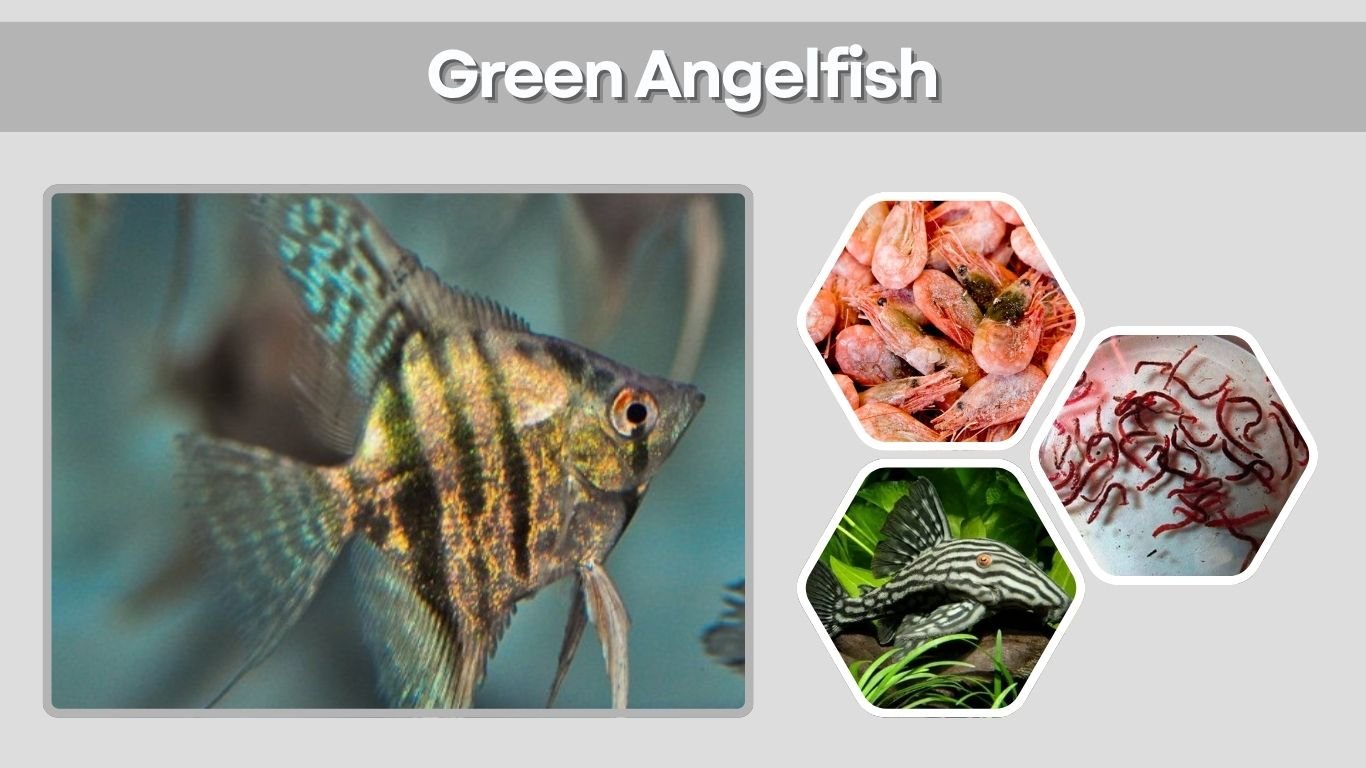
Green angelfish are freshwater aquarium fish valued for their metallic, olive, turquoise, or fluorescent coloration. However, “green angelfish” is not one scientifically recognized species. The name may describe selectively bred Bulgarian green angelfish, green Pinoy or Avatar varieties, or the fluorescent Electric Green GloFish angelfish. Despite their different appearances, most share the same general care requirements as other domestic freshwater angelfish.
What Is a Green Angelfish?
Most green angelfish sold for home aquariums are color varieties of the common freshwater angelfish, Pterophyllum scalare. This South American cichlid naturally has a laterally compressed body, tall fins, and dark vertical bars. Selective breeding has produced numerous colors and patterns, including fish with green, blue-green, silver-green, and fluorescent bodies.
| Feature | Description |
| Scientific name | Usually Pterophyllum scalare |
| Family | Cichlidae |
| Adult body length | Up to approximately 6 inches |
| Total height | Potentially 8–10 inches with fins |
| Tank type | Warm freshwater aquarium |
| Temperament | Semi-aggressive and territorial |
| Diet | Omnivorous |
| Typical lifespan | Around 8–12 years with proper care |
The word “green” may describe a genetic color strain, metallic reflection, or fluorescent coloration. Therefore, two fish marketed under similar green names may look noticeably different.
Types of Green Angelfish
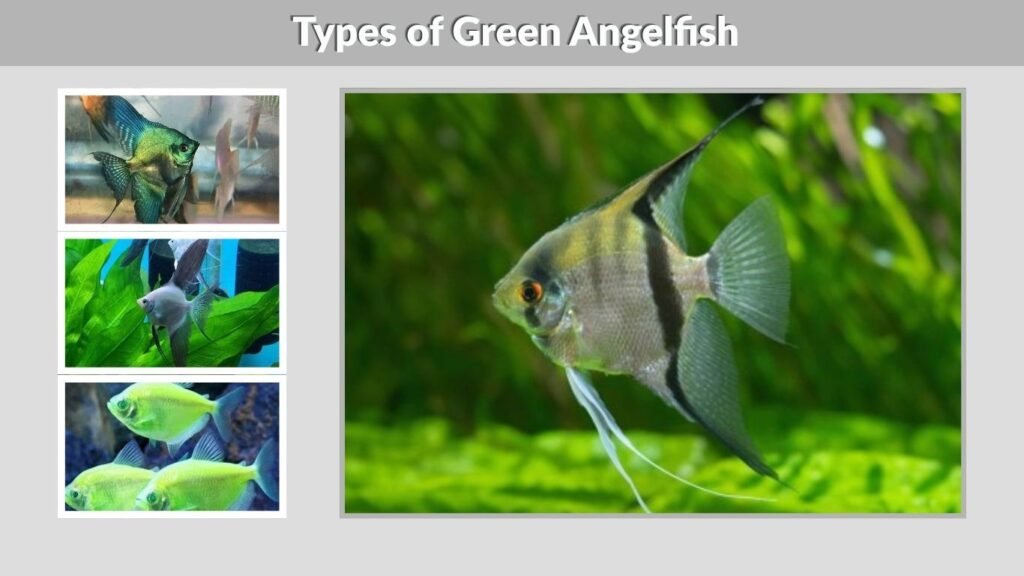
Green coloration can result from several different breeding lines. Buyers should check the fish’s exact trade name and appearance rather than assuming every green angelfish is the same variety.
Bulgarian Green Angelfish
The Bulgarian green angelfish is a selectively bred form known for a muted green, gray-green, or silvery body. Its color may appear stronger under planted-tank lighting or against dark backgrounds.
The Bulgarian Green Seal Point variety was developed from breeding work associated with Bulgarian breeder Raiko Slavkov. Early examples were described as Bulgarian Seal Point angelfish, and the trait was later combined with other established angelfish colors and patterns.
Common Bulgarian green forms include:
- Bulgarian Green Seal Point
- Bulgarian Green Blushing
- Bulgarian Green Pearlscale
- Bulgarian Green Smokey
- Bulgarian Green Pinoy
- Bulgarian Green Leopard
Seal Point fish frequently have pale bodies with darker fins, tails, or rear sections. Blushing forms may show pink or red coloration near the gill covers.
Electric Green GloFish Angelfish
The Electric Green GloFish angelfish has vivid fluorescent green coloration that becomes especially noticeable under blue aquarium lighting. It is an official GloFish variety and has the same basic care requirements as conventional freshwater angelfish.
These fish are not manually dyed. Their fluorescent color is an inherited trait passed from parents to offspring. The manufacturer states that GloFish require the same general care as their nonfluorescent counterparts.
Green Pinoy and Avatar Angelfish
Pinoy angelfish commonly display dark bodies with blue, turquoise, or green iridescence. When combined with Bulgarian green, smokey, marble, pearlscale, or stripeless traits, breeders may market them under names such as:
- Green Pinoy
- Green Avatar
- Black Green Avatar
- Avatar Turkey Green
- Green Smoke
- Green Leopard
- Green Sapphire
These are domestic strain names rather than separate species. Their exact coloration can vary according to ancestry, age, lighting, stress level, and the breeder’s naming system.
California Green and Green Giant Angelfish
Names such as California Green, Giant Green, Jolly Green Giant, and Green Lace are also used in the aquarium trade. They generally describe selectively bred domestic angelfish with particular color, size, fin, or pattern combinations.
Because these labels are not always standardized, ask the seller for photos of the parents or mature fish. Juvenile coloration may change substantially as an angelfish grows.
Green Angelfish Identification
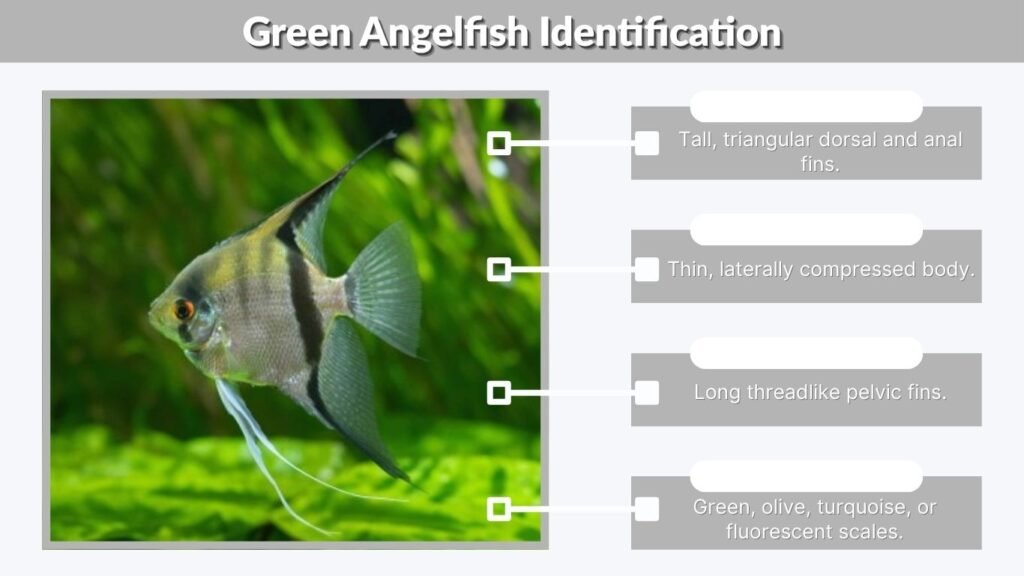
A green angelfish has the same basic body structure as other freshwater angelfish. The intensity of its green coloration depends on the specific variety.
Key Identification Features
- Tall, triangular dorsal and anal fins
- Thin, laterally compressed body
- Long threadlike pelvic fins
- Green, olive, turquoise, or fluorescent scales
- Rounded forehead and small mouth
- Dark, pale, smoky, or transparent fins
- Possible vertical bars, spots, marbling, or blushing cheeks
Wild-type P. scalare adults typically have four dark vertical bars, while domestic green varieties may have reduced, altered, or completely absent bars.
Do Green Angelfish Glow?
Only fluorescent varieties such as the Electric Green GloFish angelfish produce the intense glowing appearance associated with GloFish. Bulgarian green, Pinoy, Avatar, and metallic green strains may reflect green or blue light but are not necessarily fluorescent.
Blue aquarium lights can intensify fluorescent coloration. However, the tank should still receive a regular day-and-night cycle rather than remaining illuminated continuously.
Green Angelfish Tank Size and Setup
Angelfish need more space than their thin juvenile bodies initially suggest. Their adult height, long fins, and territorial behavior make tall, spacious aquariums essential.
Recommended Tank Size
A 29- or 30-gallon tall aquarium can house one angelfish, but a 40-gallon tank offers more comfortable long-term space. A bonded pair generally benefits from 40–55 gallons, while a group should have at least 55 gallons or more.
Aqueon recommends tall aquariums and states that fully grown angelfish may require 55 gallons or larger. FishBase recommends an aquarium at least 100 centimeters long and notes that angelfish may be maintained in groups.
Ideal Tank Conditions
| Requirement | Recommended range |
| Temperature | 76–82°F |
| pH | Approximately 6.0–8.0 |
| Water hardness | Soft to moderately hard |
| Water flow | Gentle to moderate |
| Tank height | At least 18 inches |
| Group tank | 55 gallons or larger |
FishBase records a natural temperature range of 24–30°C and a pH range of 6.0–8.0 for P. scalare. Stability is more important than constantly adjusting the water toward one exact number.
Aquarium Decoration
Provide tall plants, vertical driftwood, and open swimming areas. These features resemble the densely vegetated swamps and flooded habitats occupied by wild angelfish.
Good plant choices include Amazon swords, Java fern, Vallisneria, Anubias, and floating plants. Avoid sharp plastic decorations that could damage long fins.
Green Angelfish Diet and Feeding
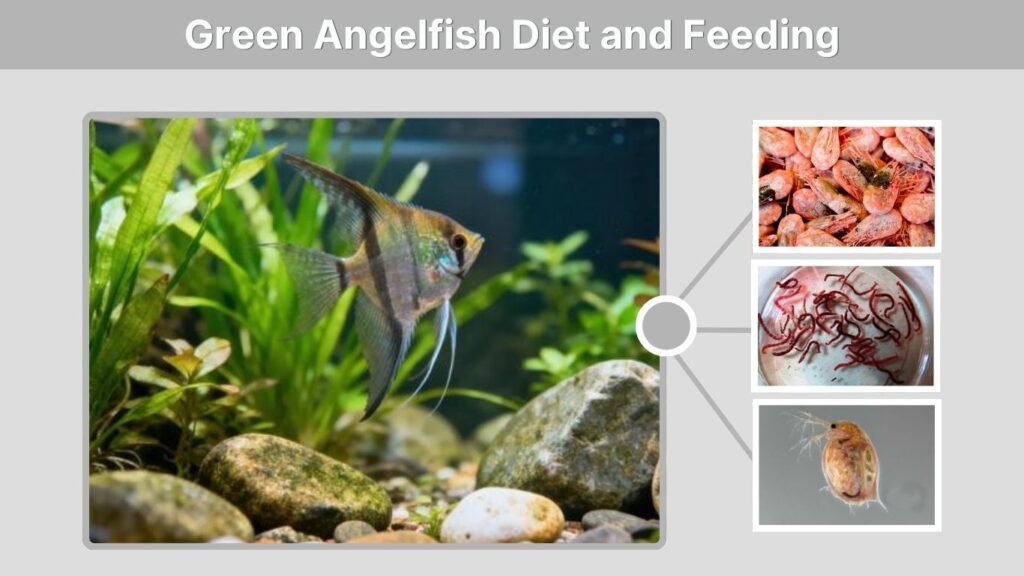
Green angelfish are omnivores and should receive a varied diet. Use high-quality angelfish pellets or flakes as the staple food and supplement them with frozen, live, or freeze-dried foods.
Suitable foods include:
- Brine shrimp
- Mysis shrimp
- Bloodworms
- Daphnia
- Insect larvae
- Spirulina-based food
- Quality cichlid pellets
Feed adults once or twice daily, offering only what they can finish within a few minutes. Remove uneaten food to prevent ammonia and nitrate problems.
Green coloration does not require a unique diet. However, high-quality nutrition and low stress can help a fish display its strongest natural color. Fluorescent GloFish angelfish can eat standard freshwater angelfish food.
Green Angelfish Temperament and Tank Mates
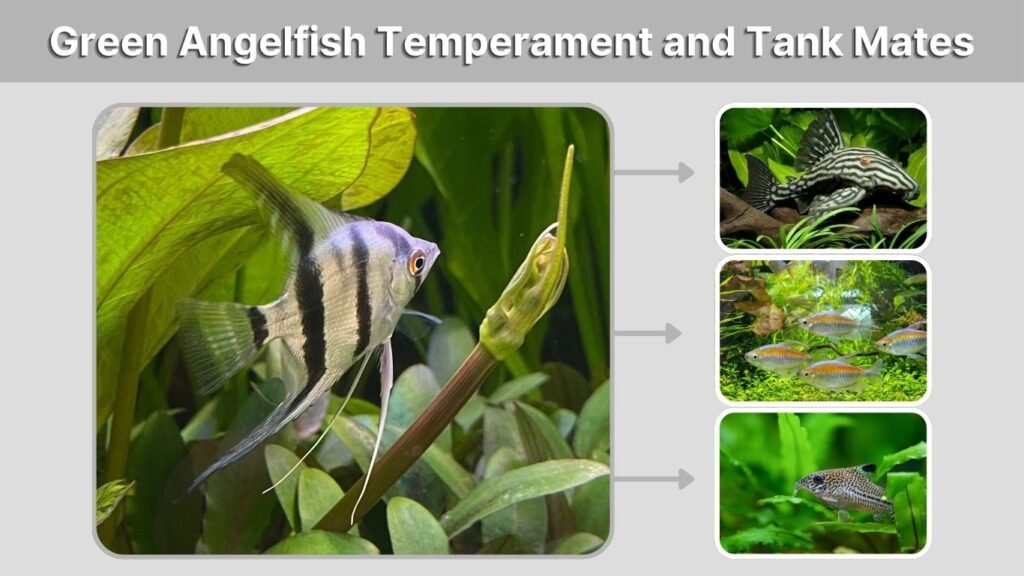
Green angelfish are cichlids, so they may become territorial as they mature. Breeding pairs can aggressively defend eggs, fry, and spawning surfaces. Both parents naturally guard eggs attached to vegetation or another vertical surface.
Suitable tank mates may include:
- Corydoras catfish
- Medium-sized peaceful tetras
- Larger rasboras
- Peaceful plecos
- Dwarf gouramis
- Bolivian rams
- Peaceful loaches
Avoid fin-nipping fish, extremely aggressive cichlids, and fish small enough to be swallowed. Tiger barbs, green tiger barbs, and some fast aggressive species may repeatedly bite an angelfish’s fins.
Green terrors and angelfish are generally a poor combination because green terrors grow larger and can become highly aggressive. Green spotted puffers are also unsuitable because they have different water requirements and may bite fins.
Green Angelfish Breeding
A mature pair normally selects a vertical surface, cleans it, and deposits rows of adhesive eggs. Both parents may fan and guard the eggs, although inexperienced aquarium pairs sometimes eat their first batches.
A separate 20- to 30-gallon tall breeding aquarium can be used for an established pair. Provide a spawning cone, broad plant leaf, filter pipe, or smooth slate positioned vertically.
Breeding different green strains can produce unpredictable offspring. Fish carrying Bulgarian green, Pinoy, marble, smokey, pearlscale, or blushing traits may produce several colors within one spawn.
Intentional commercial reproduction of trademarked GloFish is restricted by the company’s licensing terms, so owners should review the applicable rules before breeding or distributing them.
FAQs
Are green angelfish naturally green?
Wild freshwater angelfish are mainly silver with dark vertical bands. Most strongly green aquarium angelfish are selectively bred varieties. Their color may come from Bulgarian green, Pinoy, smokey, marble, or fluorescent traits rather than representing a naturally green wild species.
Is a Bulgarian green angelfish the same as a GloFish?
No. Bulgarian green angelfish are conventional selectively bred fish with subtle green, silver, or gray tones. Electric Green GloFish angelfish display inherited fluorescent coloration that appears exceptionally bright under blue lighting.
How big does a green angelfish get?
Most domestic green angelfish have the same potential size as other Pterophyllum scalare. Their bodies may reach approximately 6 inches long, while the dorsal and anal fins can make a mature fish considerably taller.
Can green angelfish live together?
They can live in groups when provided with adequate space, plants, visual barriers, and careful monitoring. Aggression may increase when adults establish territories or form breeding pairs. A 55-gallon or larger aquarium is preferable for a group.
Why is my green angelfish losing color?
Faded color can result from stress, poor water quality, sudden temperature changes, bullying, illness, inadequate nutrition, or unsuitable lighting. Test ammonia, nitrite, nitrate, pH, and temperature, then observe the fish for appetite changes, damaged fins, spots, or abnormal behavior.