
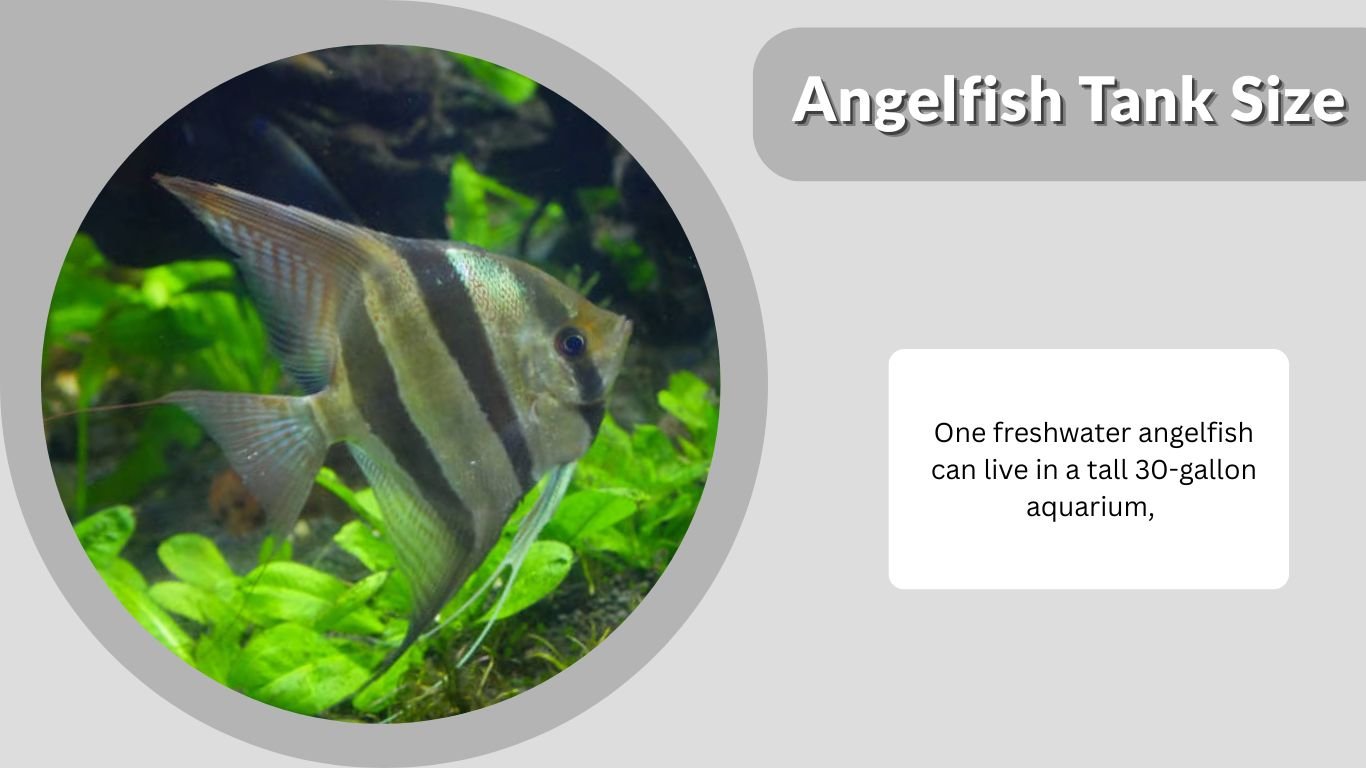
Choosing the correct angelfish tank size depends on whether you keep freshwater or saltwater angelfish, how many fish you have, and their adult size. One freshwater angelfish can live in a tall 30-gallon aquarium, while a group usually needs at least 55–75 gallons. Marine angelfish have very different requirements, ranging from approximately 55 gallons for pygmy species to more than 200 gallons for emperor, queen, and other large angels.
What Size Tank Do Freshwater Angelfish Need?
Freshwater angelfish are tall, laterally compressed cichlids that require more vertical room than many similarly sized aquarium fish. Although 20 gallons is sometimes presented as a minimum, a tall 29- or 30-gallon tank is a more practical starting point for one adult. Aqueon recommends tall aquariums and suggests 55 gallons or more for full-grown angelfish.
| Number of angelfish | Minimum practical size | Better long-term size |
| One juvenile | 20 gallons temporarily | 30 gallons |
| One adult | 29–30 gallons tall | 40 gallons |
| One bonded pair | 40 gallons | 55 gallons |
| Two unbonded adults | 55 gallons | 75 gallons |
| Four to six juveniles | 55 gallons | 75 gallons |
| Five to six adults | 75 gallons | 90–100 gallons |
| Breeding pair | 20–29 gallons | 40 gallons |
| Altum angelfish group | 75 gallons | 100–125 gallons |
These figures assume effective filtration, regular maintenance, suitable tank dimensions, and restrained stocking. Adding tank mates increases the required capacity.
Tank Size for One Angelfish
A single adult freshwater angelfish should have a tall aquarium of at least 29–30 gallons. This provides more swimming room, greater water stability, and better clearance for its extended dorsal, anal, and pelvic fins.
A 20-gallon tall aquarium may accommodate a juvenile or serve as temporary housing, but it gives a fully grown fish limited territory. Standard, long-style 20-gallon tanks are particularly unsuitable because they lack sufficient height.
Tank Size for Two Angelfish
A bonded adult pair should ideally receive 40–55 gallons. They need room to establish territory, especially when preparing to breed.
Two random adults are more difficult to keep than a proven pair. Angelfish are cichlids, and one may continually chase or injure the other. A 55- to 75-gallon aquarium with plants and visual barriers is safer, but owners should still have a backup tank available.
Tank Size for Five or More Angelfish
Start a group of five or six juvenile angelfish in at least 55 gallons, with 75 gallons being a better long-term choice. A 90- or 100-gallon tank provides more territory once pairs begin forming.
FishBase recommends keeping freshwater angelfish in groups of five or more and lists a minimum aquarium length of approximately 100 centimeters. It also notes that adults naturally inhabit densely vegetated swamps and flooded areas.
Why Tank Height Matters for Angelfish
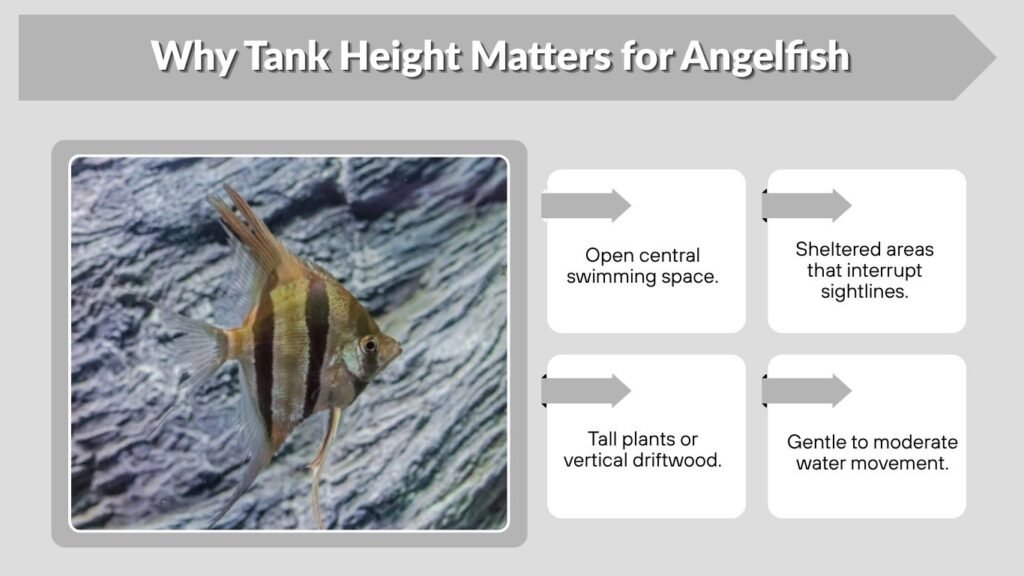
Tank capacity is important, but gallons alone do not describe whether an aquarium is suitable. Freshwater angelfish have deep bodies and long vertical fins, so a tall tank is generally more useful than a shallow aquarium holding the same amount of water.
Recommended Tank Dimensions
For common freshwater angelfish, choose a tank at least 18 inches high. A height of 20–24 inches is preferable for large adults and veil-fin varieties.
A suitable tank should also provide:
- Open central swimming space
- Tall plants or vertical driftwood
- Sheltered areas that interrupt sightlines
- Gentle to moderate water movement
- Enough surface area for oxygen exchange
Aqueon specifically recommends tall aquariums for full-grown angelfish and suggests vertical plants and driftwood that resemble their natural surroundings.
Tank Size for Different Freshwater Angelfish
Most color varieties sold in aquarium stores belong to Pterophyllum scalare. Their colors may differ, but their basic space requirements remain similar.
Koi, Black, Marble, Panda and Gold Angelfish
Koi, black, marble, panda, blue, gold, and assorted angelfish generally require the same tank size. Plan for approximately 30 gallons for one adult, 40–55 gallons for a pair, and 75 gallons or more for a group.
LiveAquaria lists a 30-gallon minimum for several captive-bred freshwater varieties, including blue, gold, and marble angelfish.
Veil Angelfish
Veil angelfish have unusually long fins and benefit from extra height and uncluttered swimming space. A tall 40-gallon aquarium is preferable for one, while a pair should receive approximately 55 gallons.
Avoid sharp decorations that could tear their fins. Strong currents may also make swimming difficult for heavily finned varieties.
Altum Angelfish
Altum angelfish are taller and more demanding than common freshwater angelfish. A small group should have a tank approximately 24–30 inches high, with 75 gallons considered a starting point and 100–125 gallons preferred.
Fluval recommends approximately 15–20 US gallons, or 60–80 liters, per altum angelfish when keeping a group.
Angelfish Breeding and Grow-Out Tank Size
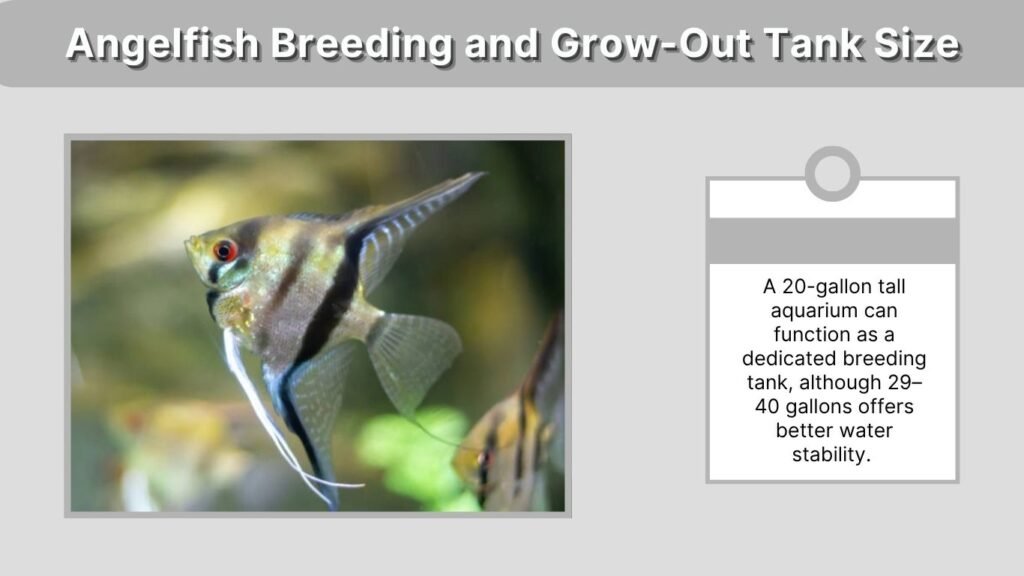
Breeding tanks can be smaller than permanent display aquariums because they usually contain only a bonded pair, limited decorations, and dedicated filtration. FishBase notes that established pairs may be kept in smaller aquariums for breeding.
Breeding Pair Tank
A 20-gallon tall aquarium can function as a dedicated breeding tank, although 29–40 gallons offers better water stability. Provide a vertical spawning surface such as slate, a broad plant leaf, or a spawning cone.
A breeding aquarium should have gentle filtration so eggs and newly free-swimming fry are not pulled into the intake.
Fry and Grow-Out Tank
Newly hatched fry can initially remain with their parents or move into a smaller rearing aquarium. As they grow, overcrowding quickly reduces water quality.
A 20–30-gallon grow-out tank may hold a modest number of small juveniles temporarily. Larger groups require 40–75 gallons, frequent partial water changes, and eventual separation as the fish mature.
Saltwater Angelfish Tank Size
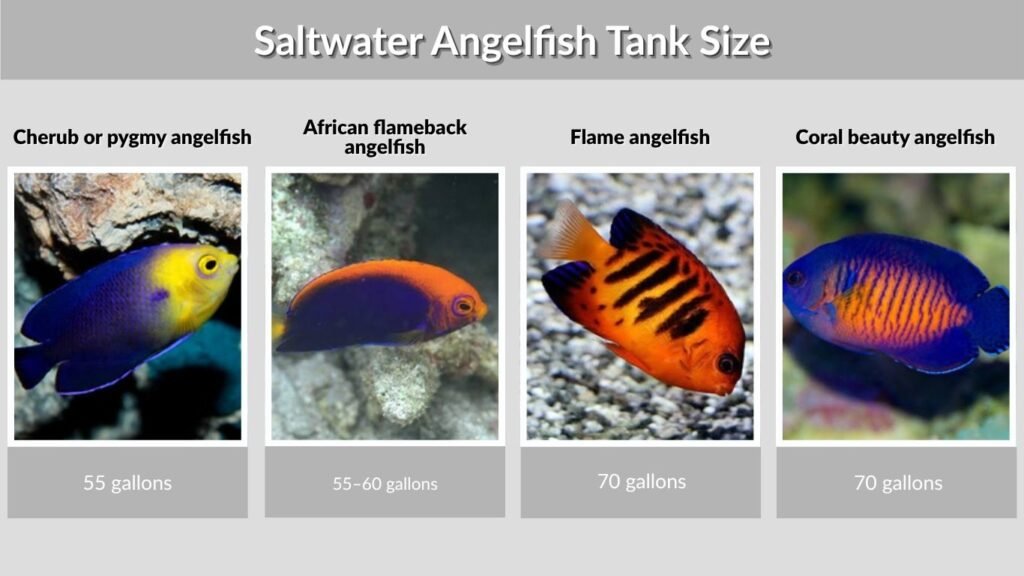
Saltwater angelfish are unrelated to freshwater angelfish and require established marine aquariums. Even dwarf marine angels are active, territorial fish that need rockwork, grazing surfaces, hiding places, and open swimming room.
| Saltwater species | Recommended minimum |
| Cherub or pygmy angelfish | 55 gallons |
| African flameback angelfish | 55–60 gallons |
| Flame angelfish | 70 gallons |
| Coral beauty angelfish | 70 gallons |
| Bicolor angelfish | 70 gallons |
| Regal angelfish | 130 gallons |
| Majestic or blue-girdled angelfish | 180 gallons |
| Emperor angelfish | 220 gallons |
| Blueface angelfish | 220 gallons |
| Queen angelfish | 250 gallons |
| French angelfish | 250 gallons |
LiveAquaria recommends 55 gallons for the pygmy angel, 70 gallons for flame, coral beauty, and bicolor angels, and 130 gallons for a regal angel.
Large marine species require dramatically more room. Emperor angelfish can reach about 40 centimeters, while queen angelfish can reach approximately 45 centimeters. Recommended minimums are around 220 gallons for an emperor and 250 gallons for queen and French angelfish.
Do Angelfish Grow to the Size of Their Tank?
Angelfish do not naturally stop growing because their aquarium is small. Poor water quality, restricted movement, chronic stress, and inadequate nutrition can suppress development, but this is unhealthy stunting rather than normal size control.
A juvenile that currently fits inside a small aquarium may still require a much larger setup as it matures. Always choose a tank according to the fish’s expected adult size, territorial behavior, and swimming needs.
FAQs
Is a 20-gallon tank big enough for an angelfish?
A 20-gallon tall tank may temporarily house a juvenile or serve as a breeding aquarium. However, it is restrictive for a permanent adult display. A tall 29- or 30-gallon tank is a safer minimum for one adult, while 40 gallons provides better swimming room.
Can two angelfish live in a 30-gallon tank?
Two juveniles may live in 30 gallons temporarily, but two adults can become territorial. A bonded pair should preferably have 40–55 gallons. Two unbonded adults may require 55–75 gallons, visual barriers, and a separate aquarium if persistent aggression develops.
Is a 55-gallon tank suitable for angelfish?
Yes. A standard 55-gallon aquarium can house a bonded pair comfortably or a small group of juveniles. However, its narrow front-to-back width may limit territories for multiple adults. A wider 75-gallon tank is generally better for a permanent group.
How many angelfish can live in a 75-gallon tank?
A properly filtered 75-gallon aquarium can usually house approximately four to six adult freshwater angelfish, depending on tank dimensions, tank mates, and aggression. Monitor the fish as pairs form because breeding adults may claim large territories and chase other angels.
What is the minimum tank size for a flame angelfish?
A flame angelfish requires an established saltwater aquarium of approximately 70 gallons or larger. The tank should contain substantial live rock for hiding and grazing while retaining open swimming areas. It should not be confused with freshwater angelfish, which have completely different requirements.