
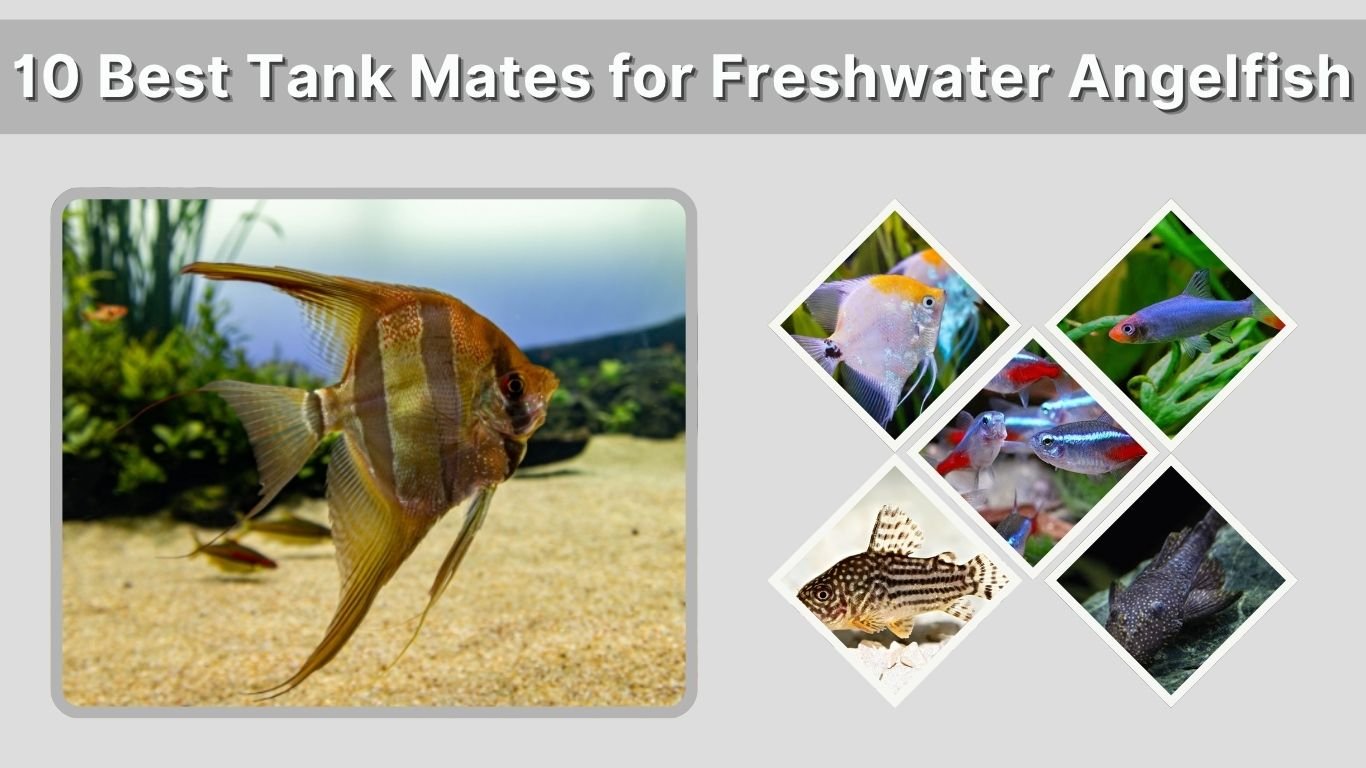
Freshwater angelfish can live successfully in a community aquarium, but their tank mates must be selected carefully. These South American cichlids are generally calm, yet adults may become territorial, eat very small fish, or defend a breeding site. Suitable companions should tolerate warm water, avoid biting long fins, and be large enough not to become prey. Corydoras, bristlenose plecos, larger tetras, peaceful loaches, and mild dwarf cichlids are among the best choices.
What Makes a Good Angelfish Tank Mate?
Freshwater angelfish, usually Pterophyllum scalare, can grow approximately 6 inches long and 8 inches tall when their extended fins are included. They prefer warm tropical water and may become territorial while pairing or breeding.
A suitable tank mate should be:
- Peaceful or only mildly territorial
- Too large to fit inside an adult angelfish’s mouth
- Unlikely to bite long fins
- Comfortable at approximately 78–82°F
- Able to compete for food without overwhelming the angelfish
- Suited to the aquarium’s pH and hardness
- Given an appropriate school or group
Compatibility is never guaranteed. Individual angelfish may be unusually peaceful or aggressive, especially after forming a breeding pair.
10 Best Tank Mates for Angelfish
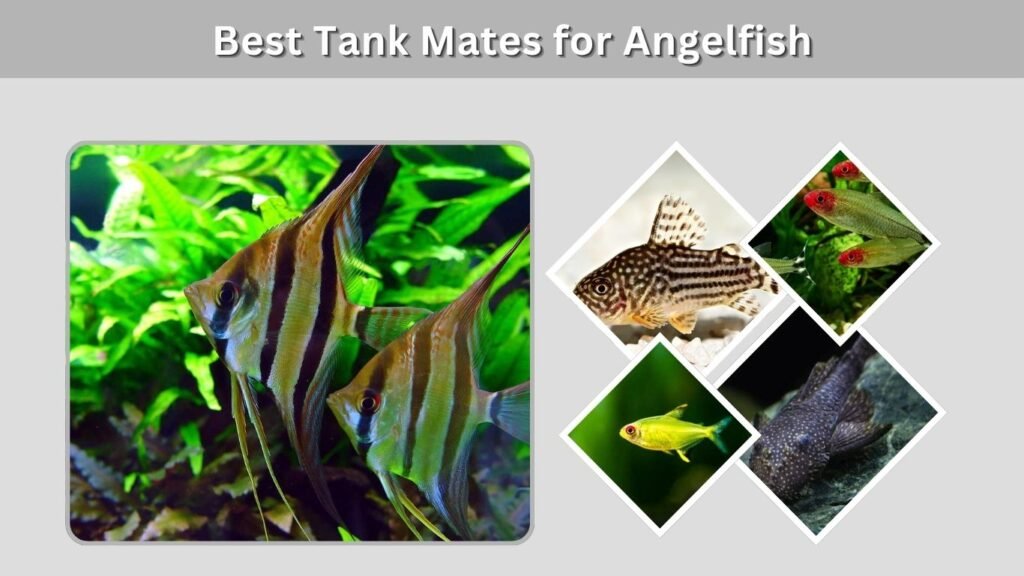
The following species are generally good choices when provided with sufficient space, suitable group sizes, and compatible water conditions.
1. Sterbai Corydoras
Sterbai corydoras are peaceful bottom-dwelling catfish that usually remain outside an angelfish’s preferred swimming area. They tolerate warmer temperatures better than many other corydoras species, making them especially suitable for angelfish aquariums.
Keep at least six together over smooth sand or fine gravel. They need sinking food and should not be expected to survive only on leftovers. Corydoras are among the tank mates experienced angelfish keepers report keeping successfully.
2. Bristlenose Pleco
Bristlenose plecos are peaceful, armored bottom dwellers that normally ignore angelfish. Unlike common plecos, they remain relatively manageable in size and can fit into many large community aquariums.
Provide driftwood, caves, algae wafers, and vegetable-based foods. A pleco may help graze on some algae, but it will not replace regular aquarium cleaning. Avoid overcrowding the bottom with several territorial plecos.
3. Rummy-Nose Tetra
Rummy-nose tetras are attractive schooling fish that thrive in warm community aquariums. Their active group movement contrasts beautifully with the slower, graceful swimming of angelfish.
Keep them in a school of at least eight, preferably more. Choose full-sized individuals because small juveniles could be viewed as prey by an adult angelfish. Rummy-nose tetras tolerate temperatures in the low to mid-80s and are commonly paired with other warm-water species.
4. Adult Cardinal Tetra
Adult cardinal tetras can live with angelfish when introduced as a healthy school in a sufficiently large, planted aquarium. Their preference for warm, relatively soft water overlaps well with angelfish requirements.
Small cardinals may be eaten, particularly when added to a tank containing fully grown angelfish. Purchase mature individuals and provide dense plants where the school can retreat. Experienced breeders have reported success with adult cardinal tetras as companions.
5. Lemon Tetra
Lemon tetras are peaceful, moderately sized schooling fish that usually avoid fin-nipping when kept in an appropriate group. Their yellow coloring also provides an attractive contrast to silver, marble, black, or koi angelfish.
Maintain at least eight lemon tetras. A proper school reduces nervousness and prevents individuals from focusing unwanted attention on slower fish. They work best in a planted aquarium with open swimming space.
6. Congo Tetra
Congo tetras are larger than many common tetras, making healthy adults less likely to become angelfish prey. Their iridescent colors and flowing fins create an impressive display in a spacious aquarium.
They are active swimmers and require a long tank, so this combination is better suited to aquariums of approximately 75 gallons or more. Keep a proper school and monitor feeding to ensure the faster Congo tetras do not prevent the angelfish from eating.
7. Harlequin Rasbora
Adult harlequin rasboras are peaceful schooling fish that generally avoid harassing angelfish. Their copper-orange bodies and black markings make them colorful additions to planted community aquariums.
Use mature rasboras rather than tiny juveniles, and maintain a school of at least eight. Because they are smaller than several other choices on this list, they are safest with angelfish raised around community fish rather than adults with a history of hunting smaller tank mates.
8. Bolivian Ram
Bolivian rams are mild South American cichlids that usually occupy the lower portion of an aquarium. They can coexist with angelfish when both species have enough room to establish separate territories.
Provide caves, driftwood, plants, and visual barriers. Conflict may increase when either species begins breeding, so a larger aquarium is essential. Avoid placing multiple territorial cichlid pairs into a small community tank.
9. Keyhole Cichlid
Keyhole cichlids are among the more peaceful medium-sized cichlids. They are generally shy and less confrontational than species such as convicts, Jack Dempseys, or firemouths.
A planted tank with driftwood and sheltered areas helps keyholes feel secure. They can become territorial while spawning, but their normal temperament makes them a possible companion for angelfish in a large, carefully arranged aquarium.
10. Kuhli Loach
Kuhli loaches are peaceful, eel-shaped bottom dwellers that hide beneath plants, wood, and caves. They are active mainly during the evening and rarely interfere with angelfish.
Keep at least six together and provide a soft substrate that will not damage their bodies. Secure all filter openings and small gaps because kuhli loaches can enter unexpectedly narrow spaces.
Angelfish Tank Mate Compatibility Chart
| Tank mate | Compatibility | Important requirement |
| Sterbai corydoras | Excellent | Keep six or more |
| Bristlenose pleco | Excellent | Provide caves and dedicated food |
| Rummy-nose tetra | Good | Keep mature fish in a large school |
| Cardinal tetra | Good with caution | Adults are safer than juveniles |
| Lemon tetra | Good | Maintain a proper school |
| Congo tetra | Good in large tanks | Needs swimming length |
| Harlequin rasbora | Good with caution | May be eaten if too small |
| Bolivian ram | Good | Provide separate territories |
| Keyhole cichlid | Good | Monitor during breeding |
| Kuhli loach | Excellent | Keep a group over soft substrate |
Bad Tank Mates for Angelfish
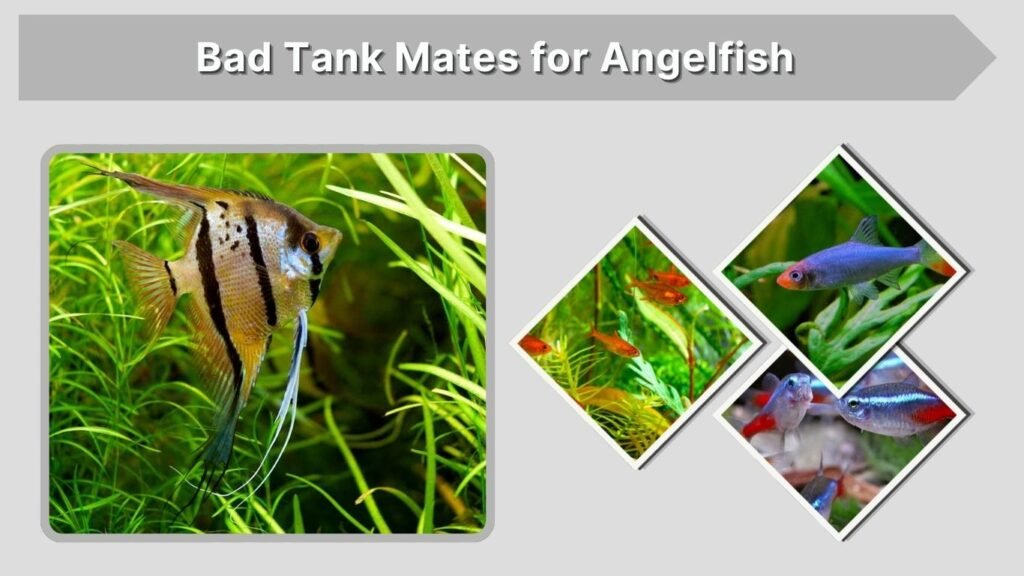
Angelfish have long, delicate fins and relatively slow swimming movements. Avoid companions likely to bite their fins, bully them, outcompete them, or become food.
Fin-Nipping Fish
Tiger barbs and serpae tetras are risky because they may repeatedly bite an angelfish’s dorsal, anal, and trailing ventral fins. Some black skirt tetras can also nip when kept in small groups, although larger schools sometimes coexist successfully.
Very Small Fish and Invertebrates
Adult angelfish may eat:
- Tiny neon tetras
- Ember tetras
- Microrasboras
- Small guppy fry
- Dwarf shrimp
- Newly hatched fish
An angelfish that ignores a small companion as a juvenile may begin hunting it after reaching adult size. Aquarium Co-Op specifically recommends avoiding nano fish and dwarf shrimp that can fit in an angelfish’s mouth.
Bettas and Long-Finned Guppies
Bettas and angelfish may react aggressively to one another’s tall bodies and long fins. Fancy guppies can also be chased, bitten, or eaten, while their preference for harder water may not match a soft-water angelfish setup.
Large Aggressive Cichlids
Avoid oscars, green terrors, Jack Dempseys, jaguar cichlids, and other powerful species that can seriously injure an angelfish. African rift-lake cichlids are also unsuitable because of major differences in behavior and preferred water chemistry.
Goldfish
Goldfish require cooler conditions than tropical angelfish and produce a substantial amount of waste. Their temperature, feeding, and aquarium requirements make them poor companions.
Tank Setup for Angelfish and Tank Mates
Although angelfish can be kept in smaller tall aquariums, a community with several adults is easier to manage in a 55-gallon or larger tank. More space allows weaker fish to retreat when territories form. FishBase recommends an aquarium at least 100 centimeters long, while experienced angelfish breeders emphasize adjusting stocking according to tank size and aggression.
A suitable planted setup should include:
- Tall plants along the back and sides
- Open central swimming space
- Driftwood and visual barriers
- Gentle to moderate water movement
- Reliable filtration
- Stable tropical temperatures
- Caves for bottom-dwelling species
Java fern, Amazon sword, anubias, vallisneria, and similar plants provide cover without completely blocking swimming space. Dense planting can reduce direct lines of sight and help bullied fish escape. Angelfish naturally occur around dense aquatic and riverbank vegetation.
Tank Mates for Breeding Angelfish
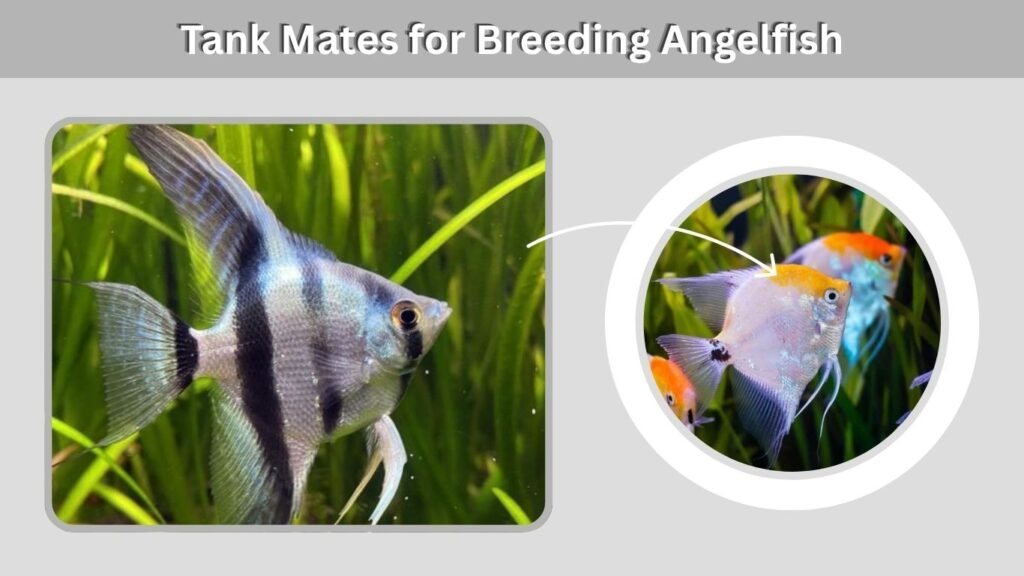
A breeding pair should ideally be moved into a separate aquarium. Both parents guard their eggs and may attack peaceful tank mates that approach the spawning site. Wild and captive angelfish display biparental defense of eggs and their chosen breeding territory.
Keeping a pair in a community tank can result in:
- Injured tank mates
- Continuous chasing
- Stressed parents
- Eggs being eaten
- Newly hatched fry disappearing
- One angelfish attacking its partner
A dedicated breeding aquarium also makes feeding and protecting the fry easier.
FAQs
What is the best tank mate for an angelfish?
Sterbai corydoras are among the safest choices because they are peaceful, tolerate warm water, and occupy the bottom of the aquarium. Keep them in a group of at least six and provide sinking food rather than relying on uneaten angelfish food.
Can angelfish live with other angelfish?
Yes, but they establish a hierarchy and may fight after pairing. Groups require a spacious aquarium with visual barriers. A single angelfish is often easier to maintain in a community tank because there is less competition and breeding-related aggression.
Can angelfish live with Bolivian rams?
They can coexist in a sufficiently large aquarium because Bolivian rams primarily occupy the lower area. Provide separate territories, plants, caves, and driftwood. Monitor closely during spawning, when both species may defend their eggs and chase nearby fish.
Can gouramis live with angelfish?
The combination is unpredictable. Both fish occupy similar areas and can become territorial. Peaceful gourami species may coexist in a large planted aquarium, but aggressive individuals may fight or bite fins. Keep a backup tank available when attempting the combination.
How many tank mates can live with angelfish?
There is no universal number. Stocking depends on aquarium volume, filtration, fish size, territorial behavior, and the group requirements of each species. Plan according to adult sizes and leave room for an angelfish pair to establish territory.