
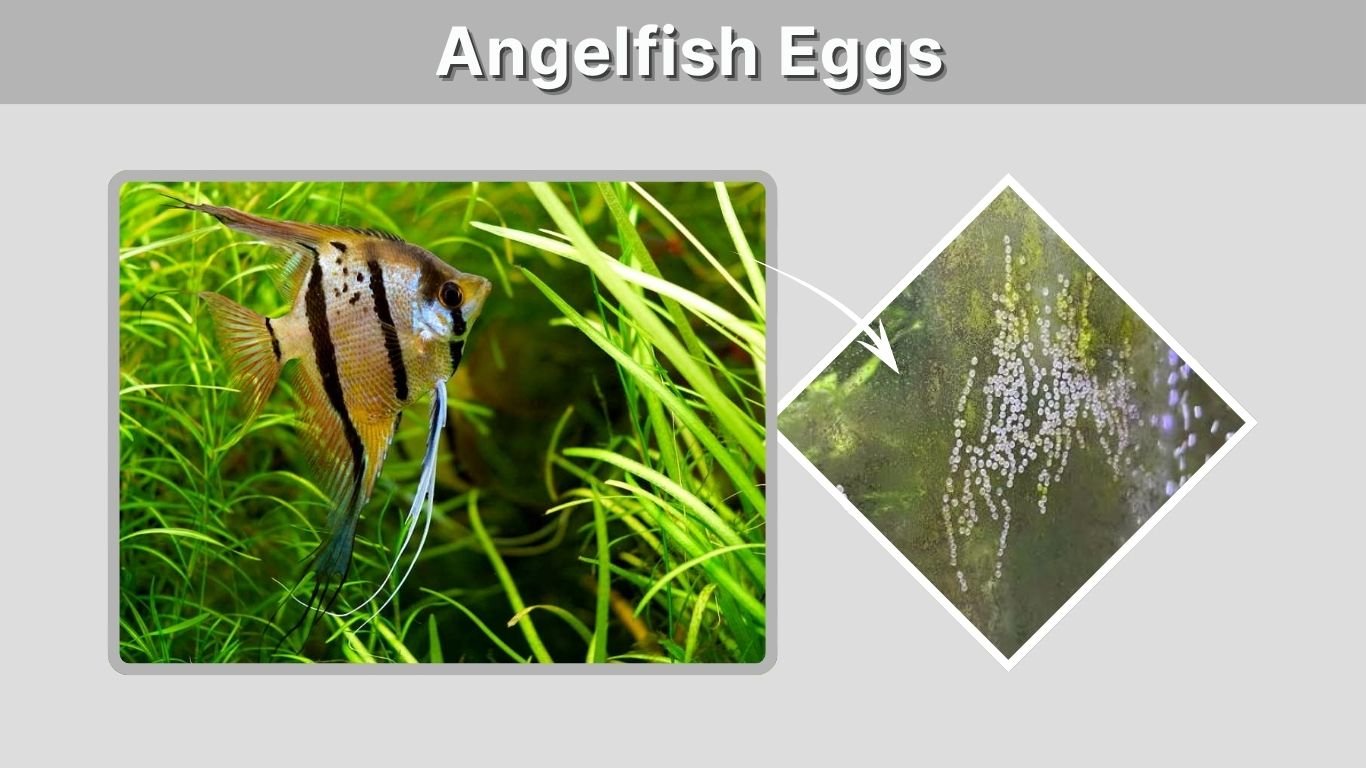
Angelfish eggs are one of the first signs that a bonded pair of freshwater angelfish is ready to reproduce. Females usually attach hundreds of tiny eggs to a clean vertical surface, and the male follows behind to fertilize them. Healthy eggs are generally translucent to amber, while eggs that turn opaque white are often infertile or dying. Under suitable aquarium conditions, angelfish eggs normally hatch within about two to three days, followed by a “wiggler” stage before the fry become free-swimming.
What Do Angelfish Eggs Look Like?
Freshwater angelfish (Pterophyllum scalare) produce small, sticky eggs that adhere firmly to surfaces.
A scientific study found angelfish eggs to be amber-colored and oval, averaging roughly 1.4 × 1.2 mm. Their adhesive coating allows them to remain attached to leaves and other spawning surfaces.
Where Do Angelfish Lay Their Eggs?
Angelfish usually choose a flat or nearly vertical surface and carefully clean it before spawning.
Common locations include:
- Broad plant leaves
- Aquarium glass
- Filter pipes
- Heaters
- Breeding cones
- Slate
- Other smooth vertical decorations
The female passes over the selected area and deposits rows of eggs. The male then follows over the same area, releasing sperm to fertilize them.
Both parents may guard the nest afterward.
How Do Angelfish Fertilize Their Eggs?
Angelfish use external fertilization.
The female lays a line of adhesive eggs on the spawning surface. Immediately afterward, the male swims across them and releases sperm.
This process repeats until spawning is complete.
A healthy pair can produce several hundred eggs during one spawning event, although clutch size varies with the female’s size, age, health, and breeding experience.
Can Angelfish Lay Eggs Without a Male?
Yes.
A female angelfish can lay eggs even if there is no male in the aquarium. However, those eggs cannot develop because they have not been fertilized.
Two females may even form what appears to be a breeding pair and lay eggs. If every clutch repeatedly turns white without embryo development, lack of fertilization is one possible explanation.
How to Tell If Angelfish Eggs Are Fertilized
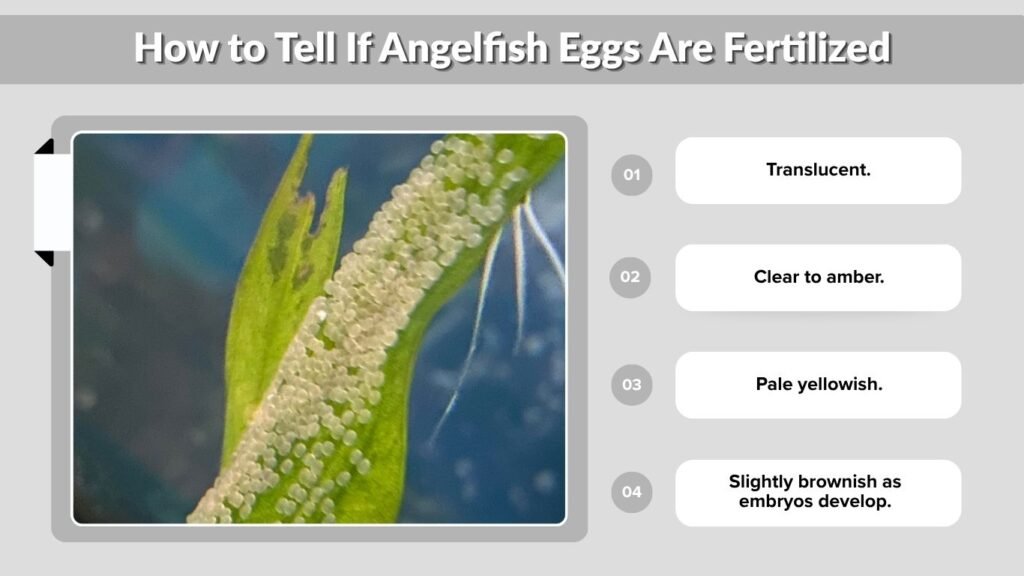
Color and development provide useful clues.
Fertilized Angelfish Eggs
Healthy fertilized eggs generally remain:
- Translucent
- Clear to amber
- Pale yellowish
- Slightly brownish as embryos develop
As development progresses, darker structures may become visible inside the eggs.
Unfertilized Angelfish Eggs
Unfertilized or dead eggs commonly become:
- Opaque
- Milky
- Bright white
White eggs are also particularly susceptible to fungal growth.
Parents often recognize bad eggs and remove them from the clutch by picking them off with their mouths.
Angelfish Egg Stages
Development happens remarkably quickly when the water is warm and stable.
| Stage | Approximate Time | What Happens |
| Freshly laid eggs | Day 0 | Female deposits eggs and male fertilizes them |
| Early embryo | Day 1 | Healthy eggs remain translucent/amber |
| Developing embryo | Day 2 | Embryonic structures become more visible |
| Hatching | About 2–3 days | Larvae emerge from eggs |
| Wiggler stage | Next few days | Fry remain attached and use yolk sacs |
| Free swimming | Around day 6–7 | Fry begin swimming and need food |
At around 80°F (27°C), eggs may hatch in approximately 48 hours, while cooler water can lengthen development.
How Long Do Angelfish Eggs Take to Hatch?
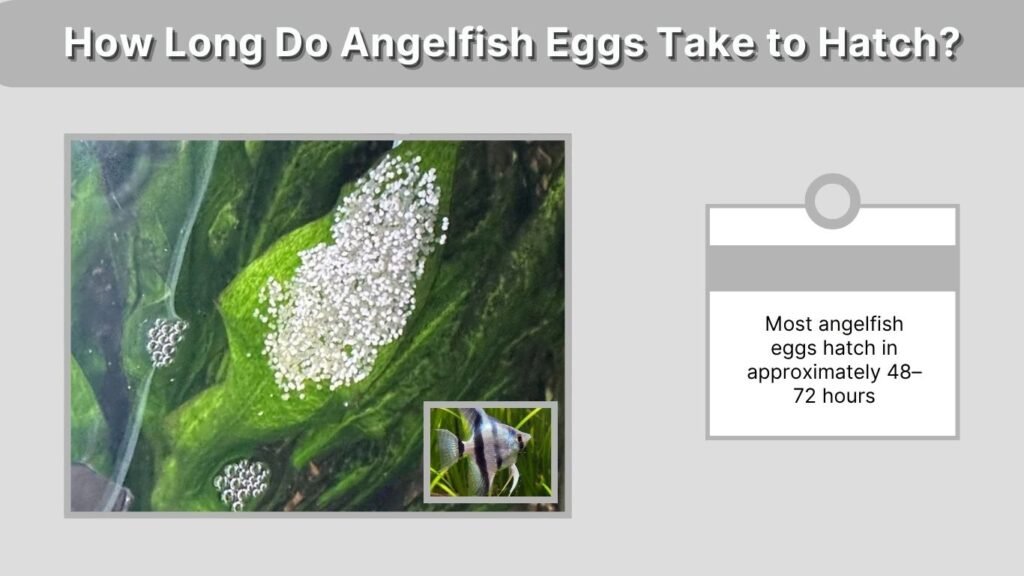
Most angelfish eggs hatch in approximately 48–72 hours under suitable aquarium conditions.
Temperature plays an important role.
At about 80°F (27°C), healthy eggs may hatch at around 48 hours. Cooler water usually slows development, while slightly warmer conditions may shorten it.
What Happens When Angelfish Eggs Hatch?
Newly hatched angelfish do not immediately begin swimming around the aquarium.
They enter the wiggler stage.
The larvae remain attached to a surface while absorbing nutrients from their yolk sacs. Their parents may pick them up and relocate them to another cleaned surface.
Around a week after spawning, healthy fry typically begin swimming freely.
Why Do Angelfish Eggs Turn White?
White angelfish eggs are one of the most common concerns for aquarium keepers.
A few white eggs within a large clutch are normal.
Unfertilized Eggs
The most common reason is unsuccessful fertilization.
Possible causes include:
- Inexperienced male
- Two females pairing together
- Male infertility
- Poor spawning technique
- Stress during reproduction
If virtually every egg repeatedly becomes white, fertilization may be failing.
Fungus on Angelfish Eggs
Dead and infertile eggs can become covered with fungus.
Fungal growth may look white, fuzzy, or cotton-like and can spread around neighboring eggs.
Parents normally fan the clutch continuously, increasing water movement and oxygen around the eggs. They may also remove dead eggs before fungus spreads.
How to Care for Angelfish Eggs
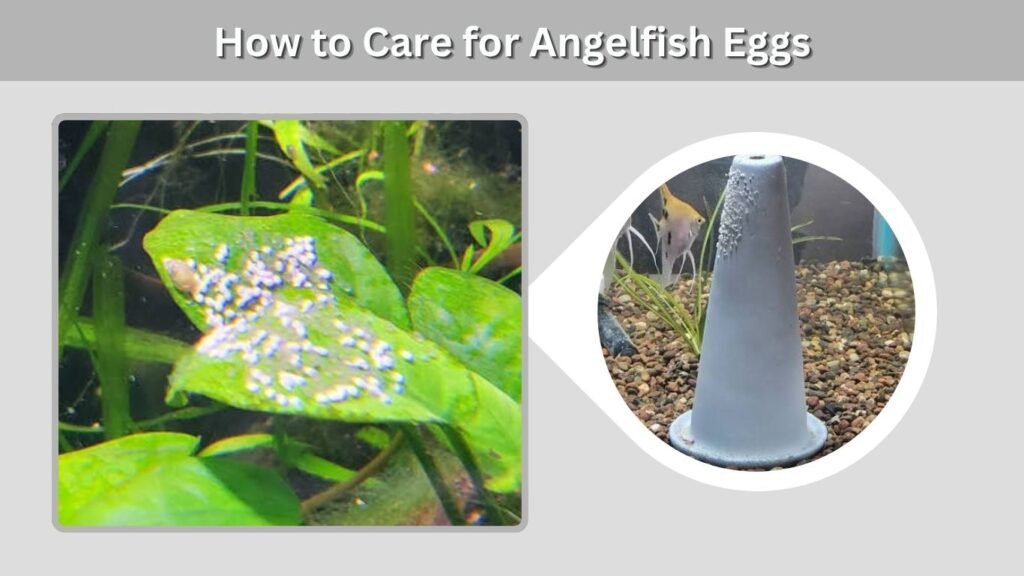
Angelfish are cichlids and normally provide parental care.
A good breeding pair will:
- Guard the spawning area
- Fan eggs with their fins
- Remove infertile eggs
- Defend against other fish
- Move newly hatched larvae when necessary
Stable water conditions and low stress are particularly important.
A study of early angelfish development found high embryo survival at approximately 28°C (82°F) and pH 6.8, while survival fell sharply under the more alkaline conditions tested.
Hatching Angelfish Eggs Without the Parents
Some breeders remove the spawning slate, leaf, or cone and hatch the eggs separately.
If doing this, the eggs should remain:
- Completely underwater during normal handling
- At a stable temperature
- In clean aquarium water
- Near gentle water movement
- Protected from strong filter suction
A gentle air stone can help provide circulation similar to parental fanning.
Some breeders use aquarium antifungal treatments when artificially hatching eggs. Any medication should be used strictly according to its aquarium-specific instructions rather than guessing concentrations.
Why Do Angelfish Eat Their Eggs?
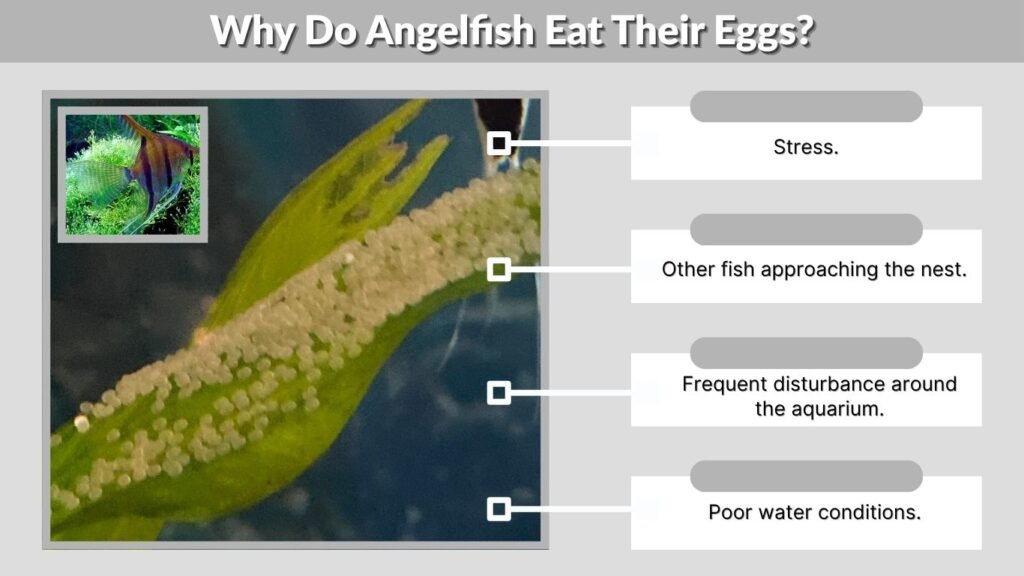
Yes, angelfish sometimes eat their own eggs.
This is especially common with inexperienced breeding pairs.
Possible reasons include:
- Stress
- Other fish approaching the nest
- Frequent disturbance around the aquarium
- Poor water conditions
- Infertile or dead eggs
- Inexperienced parents
Sometimes they are not actually destroying healthy eggs. Parents naturally remove infertile eggs and may move larvae with their mouths.
Young pairs often become better parents after several spawning attempts.
Angelfish Eggs in a Community Tank
A community aquarium is usually a difficult place to raise large numbers of fry.
Other fish may eat the eggs or newly hatched fry, while the angelfish parents can become extremely territorial when protecting their nest.
A dedicated breeding aquarium provides greater control over water quality, filtration, tankmates, and feeding.
If breeding is intentional, a bonded pair kept separately generally has a better chance of successfully raising fry.
How Often Do Angelfish Lay Eggs?
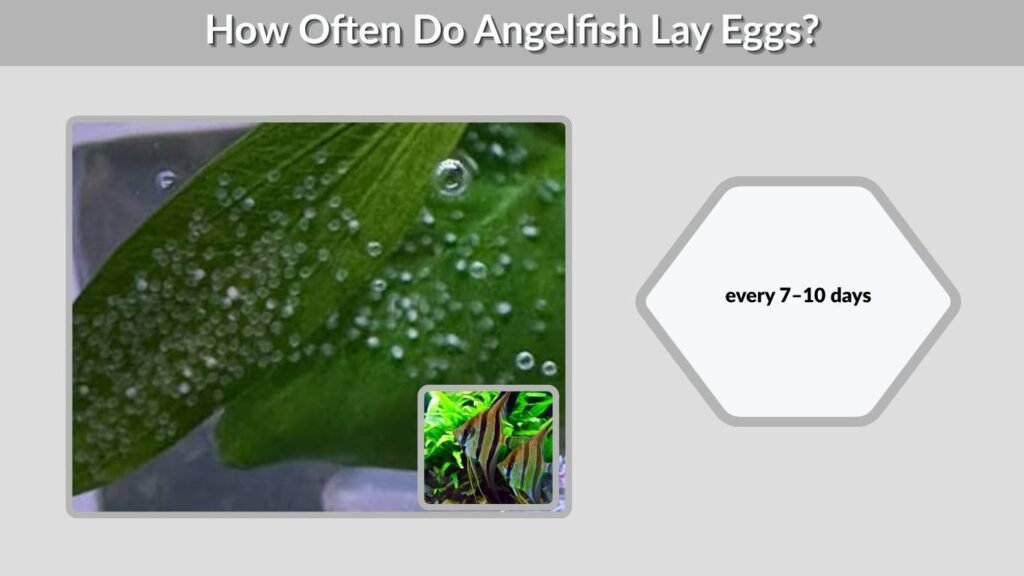
Healthy adult breeding pairs can spawn surprisingly frequently.
When eggs are removed, well-conditioned pairs may spawn roughly every 7–10 days under favorable aquarium conditions.
Actual frequency depends on:
- Age
- Diet
- Water temperature
- Water quality
- Stress
- Whether the parents are raising fry
Pairs caring for offspring naturally may not immediately begin another spawning cycle.
What Do Angelfish Fry Eat After Hatching?
Freshly hatched larvae do not require food immediately because they survive on their yolk sacs.
Once they become free-swimming, they need very small foods.
Newly hatched baby brine shrimp are a popular first food because they are appropriately sized and stimulate feeding behavior. Suitable commercial fry foods and other appropriately sized foods can also be used.
Feed small quantities several times daily while maintaining excellent water quality.
FAQs
1. How many days does it take for angelfish eggs to hatch?
Angelfish eggs usually hatch after approximately two to three days. At around 80°F (27°C), hatching may occur near the 48-hour mark. Temperature affects development, so slightly cooler water can cause eggs to take longer.
2. What color are fertilized angelfish eggs?
Healthy fertilized eggs normally remain translucent, amber, pale yellow, or slightly brownish rather than becoming solid white. As embryos mature, developing structures may become visible inside them. Opaque white eggs are more commonly infertile, dead, or affected by fungus.
3. Can female angelfish lay eggs without a male?
Yes. Female angelfish do not require a male to physically produce and deposit eggs. However, without a male fertilizing them, the eggs will remain infertile and eventually die, commonly turning opaque white.
4. How often can angelfish lay eggs?
Healthy breeding pairs may spawn approximately every seven to ten days when their eggs are repeatedly removed. The interval can be longer when parents are allowed to hatch and care for fry or when environmental conditions are less favorable.
5. Why did all my angelfish eggs turn white?
If nearly every egg turns opaque white, unsuccessful fertilization is a likely cause. Poor water conditions or egg death may also contribute. Dead and infertile eggs are particularly prone to fungal growth, which can create a white or fuzzy appearance.