
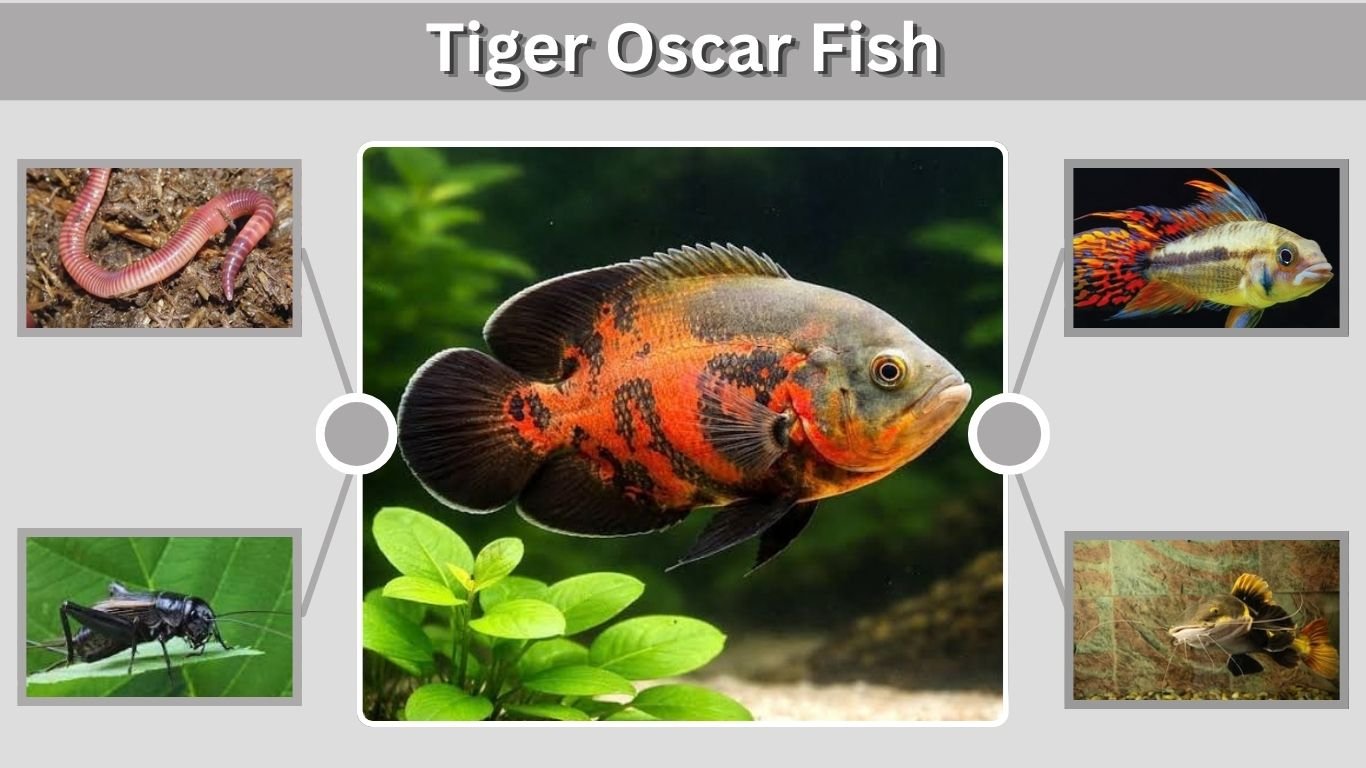
The tiger Oscar fish is a large, intelligent-looking South American cichlid known for its dark body covered with striking orange or red markings. A color form of Astronotus ocellatus, it can grow rapidly and live for many years when given enough space, strong filtration, and a balanced diet. Tiger Oscars are interactive but can also be territorial and predatory toward smaller fish. This guide covers tiger Oscar fish care, size, tank setup, food, lifespan, growth, behavior, tank mates, breeding, and popular color varieties.
What Is a Tiger Oscar Fish?
The tiger Oscar is one of the most familiar ornamental forms of the Oscar cichlid. Its irregular orange-red markings against a dark background create the striped or marbled appearance behind the name “tiger.” Although different Oscar colors are sold under various names, they generally belong to the same species and have essentially the same basic care requirements.
Tiger Oscar Fish Identification
- Scientific name: Astronotus ocellatus
- Family: Cichlidae
- Adult color: Dark brown to black with orange-red markings
- Body shape: Large, deep, and oval
- Eyes: Large and prominent
- Fins: Broad dorsal, anal, and tail fins
- Temperament: Territorial and predatory
- Natural origin: South America
- Typical lifespan: About 10–20 years with suitable care
Juveniles may look quite different from adults. Their patterns and coloration can develop considerably as they mature. Seriously Fish notes that juveniles are typically dark with lighter striping before adult coloration develops.
Red Tiger Oscar Fish
Red tiger Oscars have a dark background with particularly prominent red or orange markings. Individual patterns are highly variable, so no two fish necessarily develop exactly the same appearance.
Color intensity can also change with age, mood, lighting, diet, and environmental conditions.
Tiger Oscar Fish Size and Growth Rate
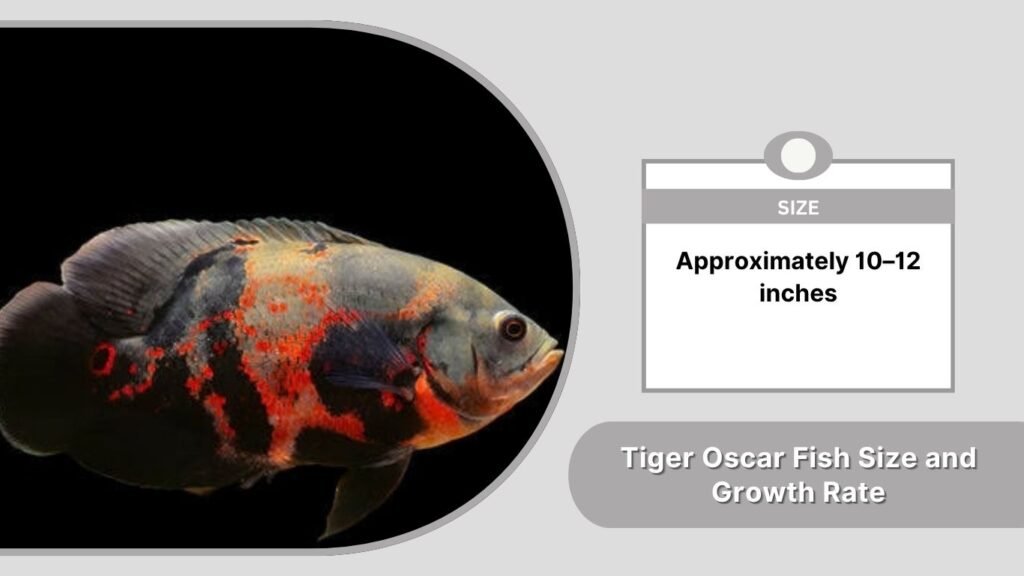
Tiger Oscars are often sold as small juveniles, but buyers should plan for a large adult fish from the beginning. Aquarium Co-Op reports that adults commonly reach approximately 10–12 inches or more, while Seriously Fish lists a standard length of about 14 inches. Juveniles can grow especially quickly during their first year.
How Big Do Tiger Oscar Fish Get?
Adult tiger Oscars commonly become roughly 10–14 inches long, although size varies among individuals. Their deep bodies make them considerably more substantial than many aquarium fish of similar length.
A young two- or three-inch Oscar therefore should not be treated as a permanently small aquarium fish. Proper space becomes increasingly important as its body mass and waste production increase.
How Fast Do Tiger Oscars Grow?
Oscar juveniles can grow quickly when healthy and well fed. Aquarium Co-Op notes that they may achieve around two-thirds of their adult size within the first 6–12 months, with growth slowing later.
Overfeeding should not be used to force rapid growth. Stable water quality, proper nutrition, and sufficient swimming space are more important than trying to maximize size as quickly as possible.
Tiger Oscar Fish Tank Setup and Care
A tiger Oscar needs considerably more aquarium space than its juvenile size suggests. These cichlids are messy eaters and produce a heavy biological load, so filtration and regular maintenance are major parts of successful care. They also dig, move objects, and may uproot plants, which makes a simple, sturdy aquarium setup more practical than delicate aquascaping.
Tiger Oscar Tank Requirements
- Tank size: 75 gallons or larger is a practical starting point for one adult
- Temperature: About 74–82°F (23–28°C)
- pH: Approximately 6.0–8.0 for captive fish
- Filtration: Strong filtration suitable for a heavy bioload
- Substrate: Sand or smooth gravel
- Decor: Stable rocks and large driftwood
- Swimming space: Plenty of open room
- Maintenance: Regular partial water changes
Aquarium Co-Op recommends around 75 gallons for one Oscar, while Seriously Fish takes a more spacious approach, suggesting a footprint of roughly 60 × 24 inches and about 143 gallons for a single adult. These differences illustrate why footprint and usable swimming space matter as much as gallon capacity.
Filtration and Water Quality
Large Oscars produce substantial waste. An aquarium may look clear while still accumulating dissolved waste, so reliable biological filtration and scheduled water changes are essential.
Seriously Fish recommends efficient filtration and weekly water changes of approximately 30–50%. Stable conditions can support better appetite, coloration, growth, and long-term health.
What Do Tiger Oscar Fish Eat?
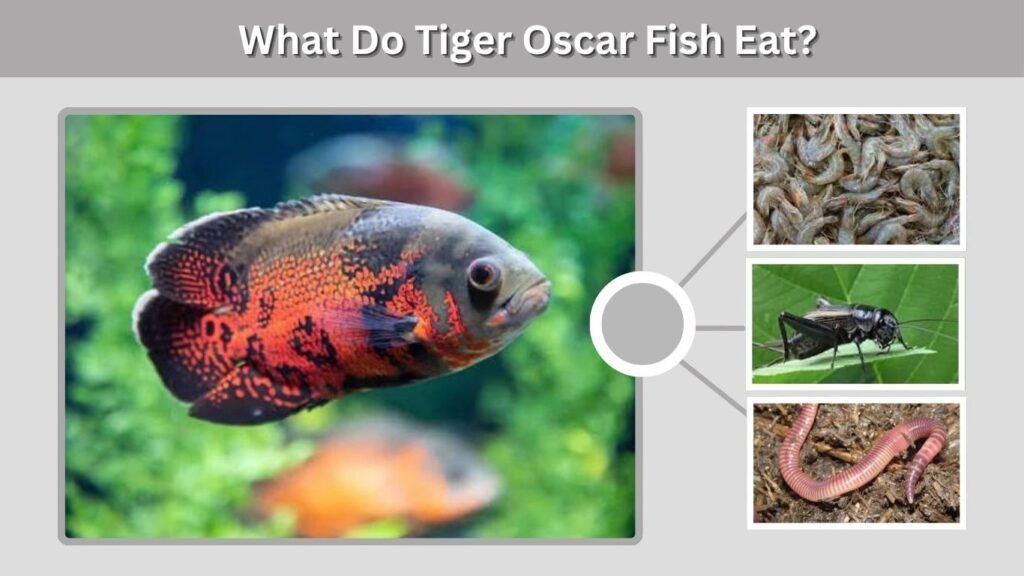
Tiger Oscars are generalist omnivores with a strong preference for meaty foods. Wild Oscars consume smaller fish, insects, crustaceans, zooplankton, and some plant material. In captivity, a quality prepared cichlid pellet makes a convenient nutritional foundation, supplemented by suitable whole or frozen foods for variety.
Best Foods for Tiger Oscars
- Quality large cichlid pellets
- Earthworms
- Shrimp or prawns
- Krill
- Crickets and other appropriate insects
- Frozen aquatic foods
- River shrimp
- Occasional plant-containing foods
Oscars quickly learn feeding routines and may approach the front of the aquarium whenever a person appears. This can make them seem constantly hungry, but excessive feeding can contribute to poor water quality and health problems.
Should Tiger Oscars Eat Feeder Fish?
Routine feeding of live feeder fish is unnecessary. Poor-quality feeders can introduce parasites and infectious organisms and may provide an unbalanced diet.
Seriously Fish also advises against regularly feeding mammalian or bird meat, such as beef heart or chicken. A formulated cichlid diet supplemented with appropriate aquatic or invertebrate foods is a more suitable long-term approach.
Tiger Oscar Fish Behavior and Intelligence
Oscars have a reputation for being unusually interactive aquarium fish. They can learn feeding routines, approach familiar people, react when their aquarium is rearranged, and investigate objects placed in their environment. These behaviors are sometimes described informally as intelligence, although giving an Oscar an “IQ” score would not be scientifically meaningful.
Are Tiger Oscar Fish Aggressive?
Tiger Oscars can be territorial and may behave aggressively toward other fish, especially when space is limited or a breeding pair forms.
They are also predators. Any fish small enough to fit in an Oscar’s mouth should generally be considered at risk of being eaten. Even similarly sized tank mates can be injured if personalities are incompatible.
Do Tiger Oscar Fish Bite?
Oscars have powerful jaws designed to seize food, so a large individual can nip or bite if threatened or highly focused on feeding. Hands should not be treated as toys or used to encourage aggressive feeding responses.
Their mouths contain structures suited to capturing and processing prey, even though their teeth are not as conspicuous as those of some predatory fish.
Tiger Oscar Fish Tank Mates
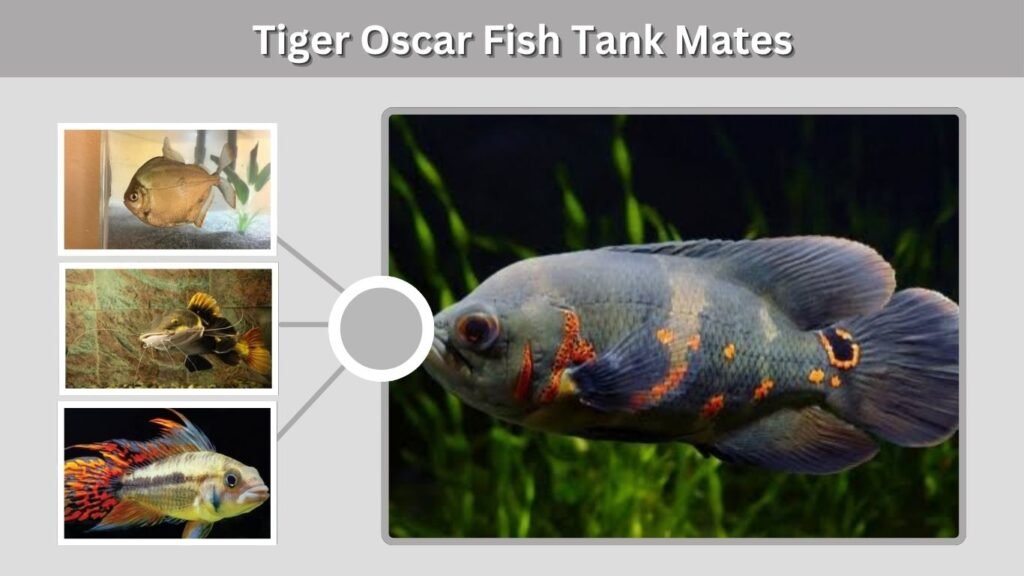
Tiger Oscars are not ideal community fish. Keeping them with other species requires a large aquarium and careful selection. Tank mates should generally be too large to swallow, robust enough to coexist with a big cichlid, and compatible with the same water conditions. Even then, individual behavior can make a seemingly reasonable combination unsuccessful.
Possible Tiger Oscar Tank Mates
- Other compatible adult Oscars
- Silver dollars
- Some large catfish
- Selected large South American cichlids
- Other robust fish too large to swallow
These are possibilities rather than guarantees. Overstocking large fish can quickly create water-quality and aggression problems.
Aquarium Co-Op recommends substantially more space for multiple Oscars, suggesting at least a 5–6-foot-long aquarium of roughly 90–100 gallons for two, while larger setups provide additional room.
Types and Colors of Tiger Oscar Fish
Selective breeding has produced numerous Oscar color forms. Some names describe recognizable patterns, while other labels are primarily commercial terms and may not be standardized among breeders or retailers. Regardless of color, most ornamental forms of Astronotus ocellatus require similar diets, water conditions, filtration, and adult aquarium space.
Common Tiger Oscar Varieties
- Classic Tiger Oscar: Dark body with orange-red irregular markings
- Red Tiger Oscar: More extensive or intense red coloration
- Albino Tiger Oscar: Pale body with orange-red markings and reduced dark pigment
- Lutino Tiger Oscar: Pale-colored form often retaining darker eye pigmentation
- Long-Finned Tiger Oscar: Selectively bred for extended fins
- Black Tiger Oscar: Commercial name generally emphasizing darker coloration
Names such as blue, golden, yellow, or white tiger Oscar may also appear in the aquarium trade, but retailer terminology is not always genetically precise.
Tiger Oscar Fish Breeding and Lifespan
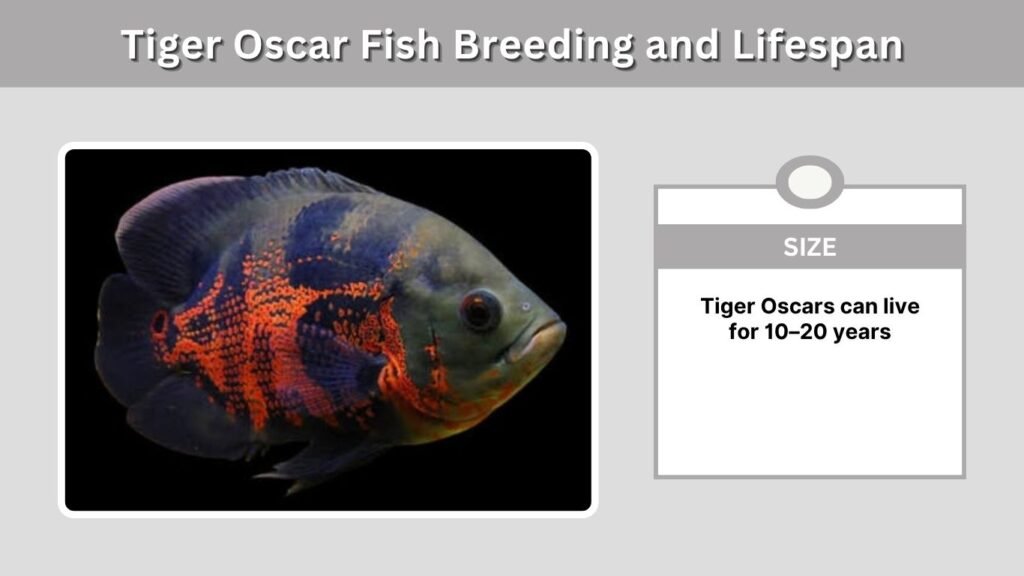
Tiger Oscars can live for 10–20 years, so keeping one is a long-term commitment. Breeding is possible in aquariums, but distinguishing males and females by appearance is difficult. Compatible adults usually form pairs and select a flat surface for spawning. Both parents can participate in guarding eggs and young.
Male vs. Female Tiger Oscar
There is no consistently reliable external feature that allows an inexperienced keeper to identify an Oscar’s sex simply from body shape, fin length, or coloration.
Sex becomes easier to determine when mature fish are preparing to spawn and their reproductive structures become visible. For breeding, allowing compatible juveniles to mature and naturally pair is often more reliable than attempting to select a male and female by appearance.
Breeding Tiger Oscars
A bonded pair generally cleans a flat rock or another firm surface before spawning. The female deposits eggs and the male fertilizes them.
Seriously Fish reports that a female may produce up to around 2,000 eggs, meaning anyone attempting to raise a full brood needs considerable aquarium space and resources.
FAQs
1. How big does a tiger Oscar fish get?
Tiger Oscars commonly reach around 10–14 inches as adults. They grow rapidly when young, so aquarium planning should be based on adult size rather than the small juvenile sold in stores.
2. How long do tiger Oscar fish live?
With appropriate care, Oscars commonly live around 10–20 years. Stable water quality, adequate tank space, good nutrition, and proper filtration support long-term health.
3. What size tank does a tiger Oscar need?
A 75-gallon aquarium is commonly used as a practical minimum starting point for one adult, although larger tanks with a wide footprint provide better swimming space and easier waste management.
4. Can tiger Oscars live with other fish?
They can, but compatibility is not guaranteed. Tank mates need to be large enough not to become prey, and the aquarium must provide enough space to reduce competition and territorial conflict.
5. What is the best food for a tiger Oscar?
A high-quality cichlid pellet can form the staple diet, supplemented with foods such as earthworms, shrimp, krill, crickets, and suitable frozen foods. Routine feeder fish and mammalian meats are best avoided.