
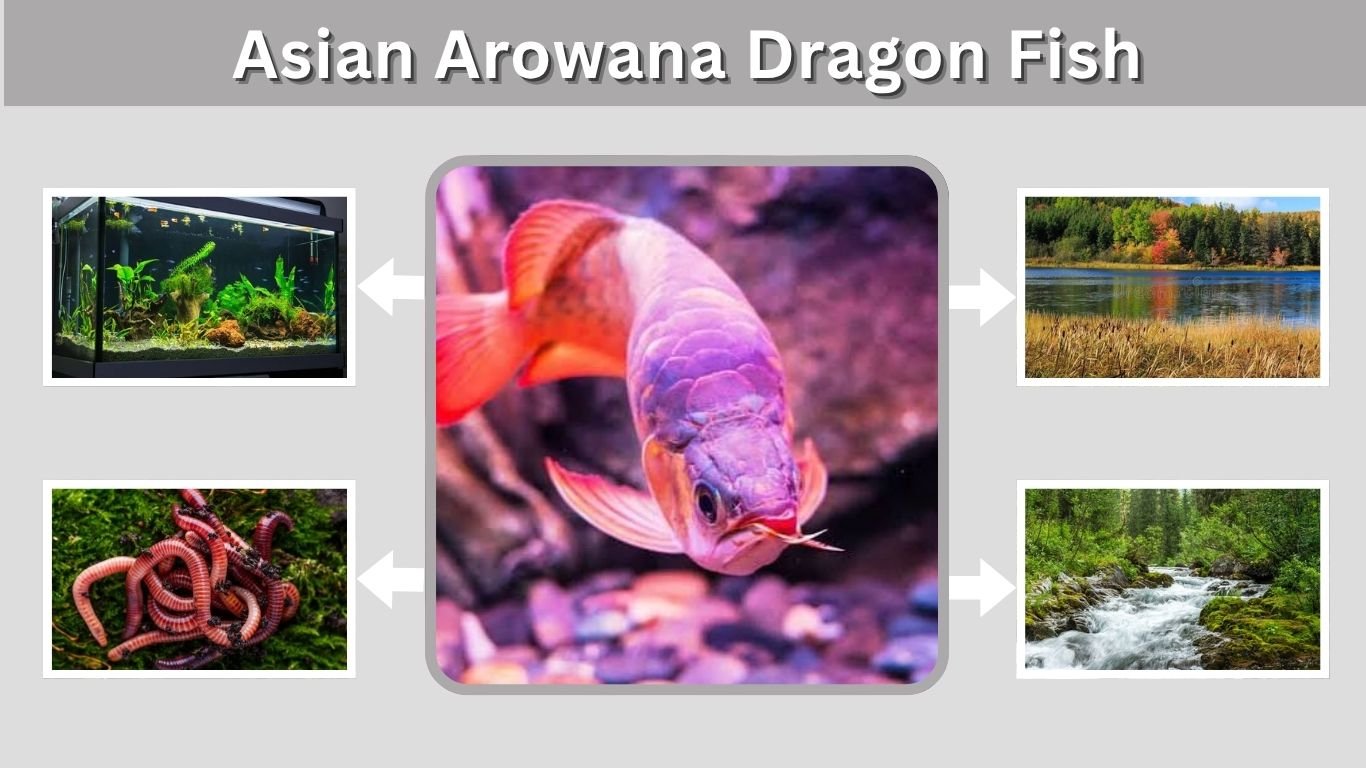
The Asian Arowana Dragon Fish (Scleropages formosus) is one of the most beautiful and valuable freshwater fish in the aquarium world. Known for its large metallic scales, elongated body, and graceful swimming style, this fish resembles the legendary Chinese dragon. Asian Arowanas come in several striking color varieties, including red, golden, and green. They are especially popular among aquarium enthusiasts who associate them with prosperity, wealth, and good fortune. However, these impressive fish require spacious tanks, specialized care, and responsible ownership. Understanding their appearance, natural habitat, diet, lifespan, and behavior is essential before keeping one.
What Is an Asian Arowana Dragon Fish?
The Asian Arowana, commonly called the Dragon Fish or Asian Bonytongue, is a tropical freshwater fish belonging to the family Osteoglossidae. It originates from Southeast Asia and is famous for its prehistoric appearance and distinctive upward-facing mouth.
The name Dragon Fish comes from its resemblance to traditional Chinese dragons. Its shiny scales, long body, and flowing movements contribute to this comparison.
Asian Arowanas are also considered symbols of good luck and financial success in some Asian cultures, particularly within Chinese communities.
| Feature | Description |
| Common Name | Asian Arowana, Dragon Fish |
| Scientific Name | Scleropages formosus |
| Family | Osteoglossidae |
| Origin | Southeast Asia |
| Maximum Length | Approximately 35 inches (90 cm) |
| Lifespan | Approximately 10–20 years |
| Diet | Carnivorous |
| Water Temperature | 75–86°F (24–30°C) |
| Conservation Status | Endangered |
| Care Level | Advanced |
Asian Arowana Dragon Fish Identification
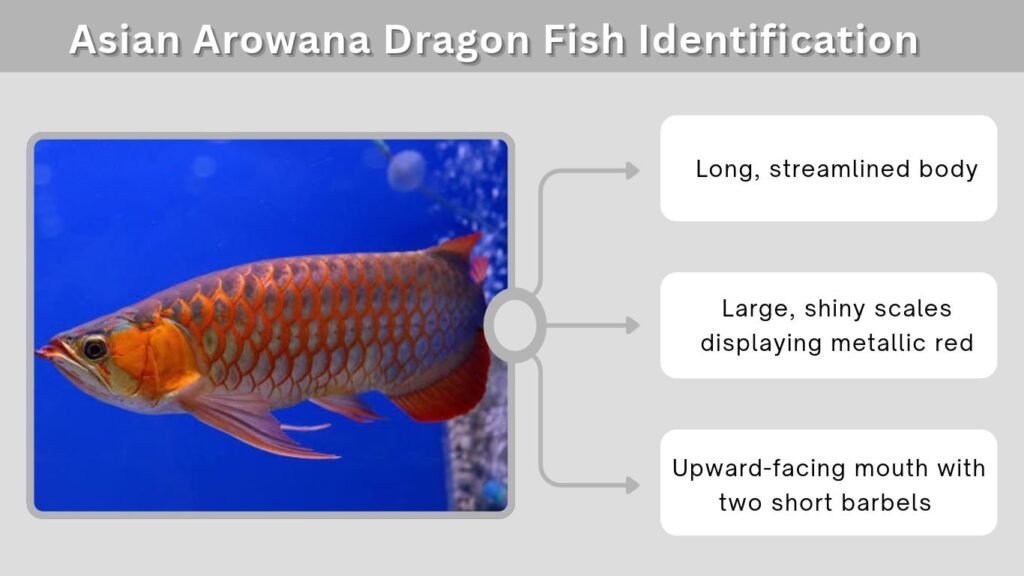
Asian Arowanas have a distinctive body structure that makes them relatively easy to recognize.
Their bodies are long, muscular, and covered with large reflective scales. Their upward-facing mouths allow them to capture insects and other prey near the water’s surface.
Key identification features include:
- Body Shape: Long, streamlined body with a slightly flattened profile.
- Scales: Large, shiny scales displaying metallic red, golden, green, or silver tones.
- Mouth: Upward-facing mouth with two short barbels extending from the lower jaw.
- Fins: Broad pectoral fins and elongated dorsal and anal fins positioned toward the tail.
- Eyes: Large eyes adapted to spotting prey near the water’s surface.
- Swimming Style: Smooth, graceful movements, usually near the upper portion of the aquarium.
Young Asian Arowanas generally have less intense coloration than mature specimens. Their colors become more noticeable as they grow, although the final appearance depends on genetics, age, health, and environmental conditions.
Types of Asian Arowana Dragon Fish
Asian Arowanas are available in several recognized aquarium color varieties. Although they share similar body structures and behaviors, their colors and patterns make them visually distinctive.
1. Red Asian Arowana
The Red Asian Arowana, often called the Super Red Arowana, is among the most sought-after varieties.
It is especially associated with parts of Indonesian Borneo, including West Kalimantan.
Young red arowanas may display orange or yellowish coloration. As they mature, their scales, fins, and bodies can develop rich red tones.
High-quality specimens are particularly valued for their vibrant appearance and uniform coloration.
Their popularity also comes from the cultural association between the color red, prosperity, and good fortune.
2. Golden Asian Arowana
Golden Asian Arowanas are famous for their metallic yellow-gold scales.
Two well-known aquarium varieties are the Malaysian Golden Crossback and Red Tail Golden Arowana.
Crossback Golden Arowanas can develop golden coloration extending across the upper back, creating an impressive metallic appearance.
Red Tail Golden Arowanas generally have golden scales combined with reddish or orange-colored fins.
The intensity and distribution of their coloration depend largely on genetics and maturity.
3. Green Asian Arowana
Green Asian Arowanas usually display olive-green, grayish-green, or silver-green coloration.
Compared with red and golden varieties, they generally have a more subtle appearance.
Their scales may show a soft green reflection under aquarium lighting, while the fins can have darker edges.
Green Arowanas are found across several parts of Southeast Asia and are often less expensive than premium red or golden specimens in markets where legal sales are permitted.
Despite their less dramatic coloration, they require the same careful aquarium maintenance.
Where Do Asian Arowana Dragon Fish Live?

Asian Arowanas naturally inhabit freshwater environments throughout parts of Southeast Asia.
Their native range includes areas of Indonesia, Malaysia, Thailand, Cambodia, and Myanmar.
They are commonly associated with slow-moving rivers, forest streams, freshwater swamps, and peatland habitats.
Many of these environments contain dark, tannin-stained water produced by decomposing leaves and other organic materials.
Asian Arowanas usually prefer calm waters with vegetation, submerged branches, and sheltered areas.
They frequently swim near the surface, where they search for insects, small fish, and other available prey.
Unfortunately, habitat destruction, wetland drainage, and historical overcollection for the aquarium trade have contributed to declining wild populations.
Asian Arowana Dragon Fish Size and Lifespan
Asian Arowanas are large fish that require considerable swimming space.
Mature individuals commonly reach approximately 20–30 inches (50–75 cm), although some can grow to around 35 inches (90 cm).
Their growth depends on genetics, nutrition, water quality, and available space.
These fish are also relatively long-lived. Under favorable conditions, an Asian Arowana may survive for approximately 10–20 years.
Because of their size and lifespan, keeping an Asian Arowana requires a long-term commitment.
| Life Stage | General Characteristics |
| Juvenile | Small body, developing coloration, rapid growth |
| Subadult | Increasing body size and more noticeable scale colors |
| Adult | Large body, mature coloration, stronger territorial behavior |
| Mature Breeder | Capable of reproduction under suitable conditions |
How to Care for an Asian Arowana Dragon Fish
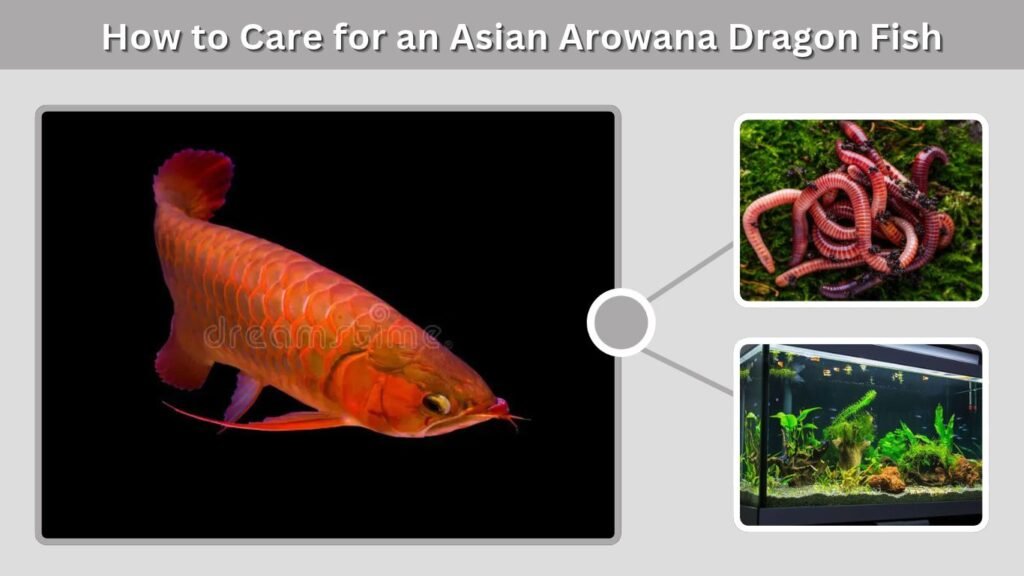
Asian Arowanas are challenging aquarium fish because of their large size, sensitivity to poor water conditions, and powerful jumping ability.
A suitable aquarium must provide clean water, sufficient swimming space, and a stable environment.
Tank Size and Setup
An adult Asian Arowana generally needs a custom-sized aquarium with approximately 250–300 gallons or more of water, depending on the fish’s size and the tank’s dimensions.
Tank length and width are especially important because the fish must be able to swim and turn comfortably.
Use a secure, tightly fitted aquarium lid. Asian Arowanas can jump forcefully when frightened or attempting to capture prey.
Avoid sharp decorations that could cause injuries.
Strong filtration, regular water changes, and adequate oxygenation are essential.
Water Temperature and Conditions
Asian Arowanas thrive in warm tropical freshwater.
A temperature of approximately 75–86°F (24–30°C) is consistent with their natural tropical environment, although stable temperatures around 79–84°F (26–29°C) are commonly suitable for aquarium care.
They generally do well in slightly acidic to neutral water, provided conditions remain stable.
Ammonia and nitrite should remain at zero, while nitrate should be controlled through appropriate maintenance.
Sudden changes in water chemistry can stress the fish and increase susceptibility to disease.
What Do Asian Arowana Dragon Fish Eat?
Asian Arowanas are primarily carnivorous predators.
In natural habitats, young fish consume insects and other small animals near the water’s surface. Adults can feed on fish and additional animal prey.
In captivity, their diet may include:
- High-quality carnivorous fish pellets
- Appropriately sized shrimp and prawns
- Crickets and other suitable feeder insects
- Earthworms
- Occasional pieces of suitable fish
A varied diet helps provide essential nutrients and supports healthy growth.
Commercially prepared arowana pellets can serve as an important dietary foundation because they are formulated to provide balanced nutrition.
Avoid relying on live feeder fish, which can introduce parasites and disease.
Feeding portions should match the fish’s size and appetite, and uneaten food should be removed promptly.
Tank Mates and Compatibility
Asian Arowanas are territorial predators and are often best kept individually.
They may attack smaller fish or compete aggressively with other large species.
Some experienced aquarists keep them with large, peaceful fish that occupy different swimming levels.
However, compatibility depends on individual temperament, tank dimensions, and feeding behavior.
Crowded aquariums can increase aggression and injury risks.
Asian Arowana Dragon Fish Behavior
Asian Arowanas are intelligent-looking, alert predators that spend much of their time swimming near the water’s surface.
Their large eyes help them detect movement, while their upward-facing mouths allow them to capture prey from above.
They can become accustomed to familiar feeding routines and may respond when their keeper approaches the aquarium.
However, sudden movement, bright reflections, and disturbances can frighten them.
Their powerful jumping behavior is especially important to consider because an uncovered aquarium can lead to serious injuries.
Asian Arowanas are generally solitary and may become increasingly territorial as they mature.
Asian Arowana Dragon Fish Breeding
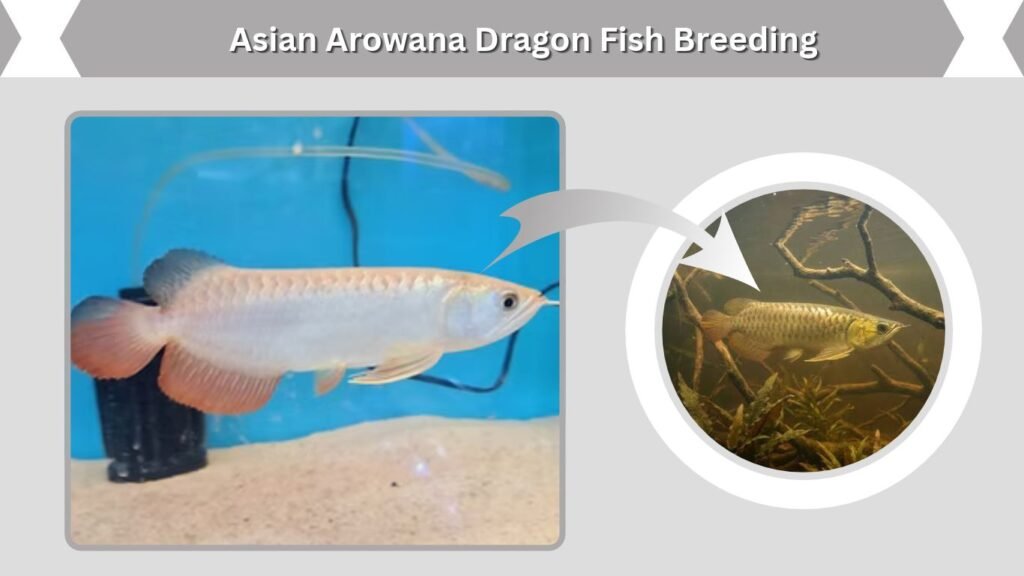
Asian Arowanas have a fascinating reproductive behavior known as mouthbrooding.
During breeding, the female releases relatively large eggs that the male fertilizes.
The male then collects the fertilized eggs in his mouth, where they remain protected during incubation and early development.
After hatching, the young fish continue developing while sheltered inside the father’s mouth.
This parental care helps protect the offspring during their most vulnerable stages.
Breeding Asian Arowanas in captivity is challenging because mature fish require significant space and compatible breeding partners.
Commercial breeding generally takes place in specialized facilities with controlled environmental conditions.
Why Are Asian Arowana Dragon Fish So Expensive?
Asian Arowanas can command high prices because of their appearance, cultural significance, breeding requirements, and regulated international trade.
Premium red and golden specimens are particularly desirable among collectors.
Several factors influence their value:
- Coloration: Intense, evenly distributed colors are highly desirable.
- Genetics: Established breeding lines may produce more predictable coloration.
- Age and Size: Mature fish with developed colors may command higher prices.
- Body Quality: Healthy scales, balanced fins, and an attractive body shape influence value.
- Documentation: Legal origin and identification records are important for regulated trade.
Prices vary greatly between countries, individual fish, and licensed sellers. Buyers should avoid assuming that a high price guarantees superior health or authenticity.
Are Asian Arowana Dragon Fish Endangered?
Yes. The Asian Arowana (Scleropages formosus) is classified as Endangered on the IUCN Red List.
Wild populations have experienced pressure from habitat loss and collection for the ornamental fish trade.
The species is also listed under CITES Appendix I, which imposes strict controls on international commercial trade.
Commercial exports of qualifying captive-bred fish may be permitted through registered breeding operations when applicable CITES requirements are satisfied.
Legally traded specimens are often individually microchipped and accompanied by documents verifying their origin.
Ownership, importation, and sale regulations vary by country, so prospective keepers must check their local laws before purchasing.
FAQs
1. Is an Asian Arowana the Same as a Dragon Fish?
Yes. Asian Arowana and Dragon Fish are common names used for Scleropages formosus. The nickname comes from its large reflective scales, long body, and resemblance to traditional Chinese dragons. However, the term Dragon Fish can also refer to unrelated fish species in other contexts.
2. What Is the Rarest Asian Arowana Color?
Premium red and golden varieties are among the most highly valued Asian Arowanas in the aquarium trade. However, rarity depends on breeding lines, regional availability, and the specific characteristics of individual fish. A particular color alone does not establish how rare a specimen is.
3. Can Asian Arowana Dragon Fish Live With Other Fish?
Asian Arowanas can sometimes live with carefully selected large tank mates, but they are territorial predators. Smaller fish may be eaten, while similarly sized fish can trigger aggression. Keeping a single Asian Arowana is often the safest option, particularly for owners without experience managing large predatory fish.
4. How Long Does an Asian Arowana Take to Reach Full Size?
Asian Arowanas grow relatively quickly during their early years, but reaching adult size and full physical maturity can take several years. Growth rates vary according to genetics, diet, water conditions, and aquarium space. Their coloration may continue developing after their fastest period of growth.
5. Is a Red Arowana the Asian Dragon Fish?
Yes. The Red Arowana, including the Super Red variety, is a recognized color form of the Asian Arowana commonly known as the Asian Dragon Fish. Its distinctive red coloration makes it especially popular among collectors, although the intensity of its coloring varies with genetics and maturity.