
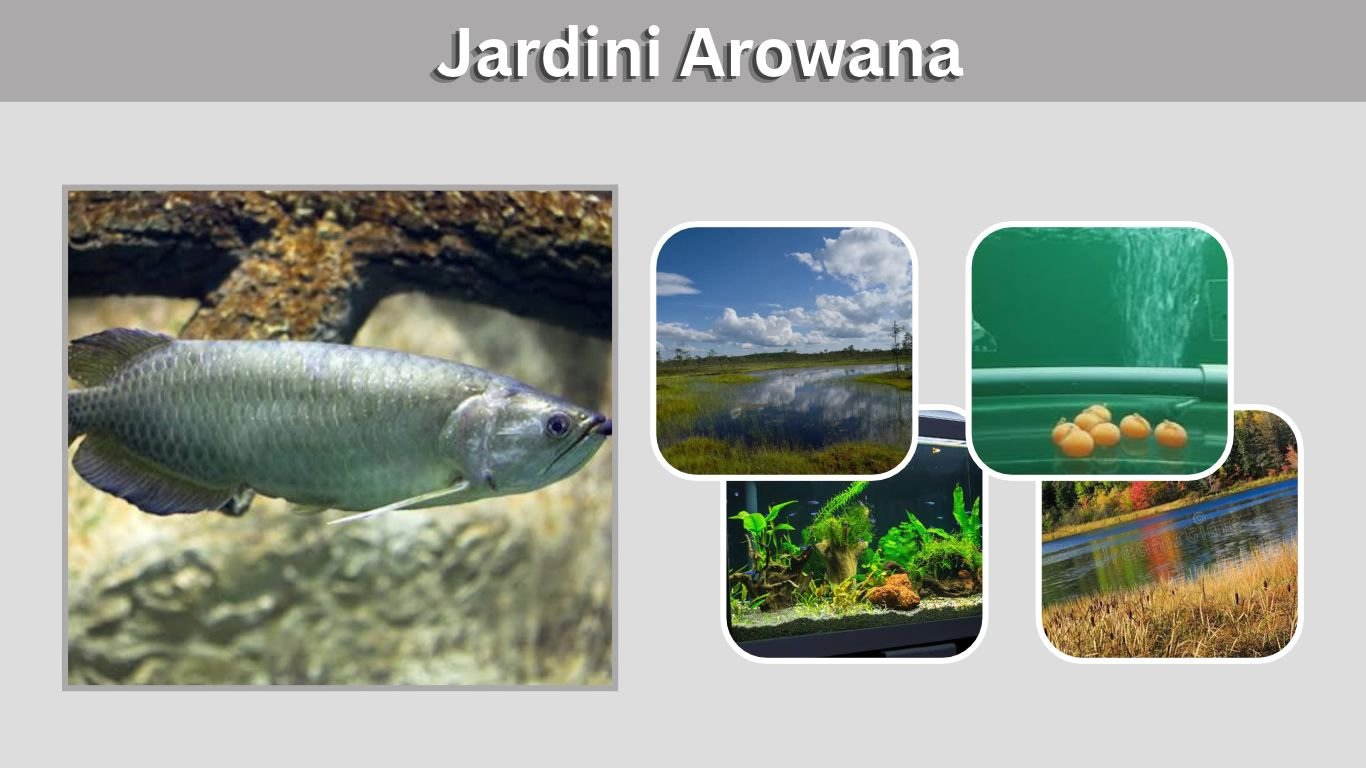
The Jardini Arowana (Scleropages jardinii) is a remarkable freshwater fish known for its powerful body, metallic scales, and distinctive reddish spots. Also called the Australian Arowana, Pearl Arowana, or Northern Saratoga, this species originates from northern Australia and New Guinea. Its prehistoric appearance, impressive size, and fascinating behavior make it popular among experienced aquarium enthusiasts. However, Jardini Arowanas are highly territorial and require spacious aquariums, carefully maintained water conditions, and appropriate feeding. Understanding their natural habitat, growth rate, adult size, diet, lifespan, and compatibility is essential before bringing one home.
What Is a Jardini Arowana?
The Jardini Arowana is a large tropical freshwater fish belonging to the family Osteoglossidae. It is closely related to other arowanas but has a distinctive pattern of reddish or pinkish crescent-shaped markings on its scales.
Unlike the Asian Arowana, which is native to Southeast Asia, Jardini Arowanas naturally occur in northern Australia and parts of New Guinea.
They are commonly found in slow-moving freshwater environments, including rivers, swamps, and floodplain wetlands.
Jardini Arowanas are powerful surface-feeding predators with an aggressive, territorial temperament.
| Feature | Description |
| Common Name | Jardini Arowana, Australian Arowana |
| Scientific Name | Scleropages jardinii |
| Family | Osteoglossidae |
| Origin | Northern Australia and New Guinea |
| Common Adult Length | Approximately 20–24 inches (50–60 cm) |
| Maximum Recorded Length | Around 39 inches (100 cm) |
| Lifespan | Often 10–20 years with suitable care |
| Diet | Primarily carnivorous |
| Water Temperature | 72–82°F (22–28°C) |
| Temperament | Aggressive and territorial |
| Care Level | Advanced |
Jardini Arowana Identification
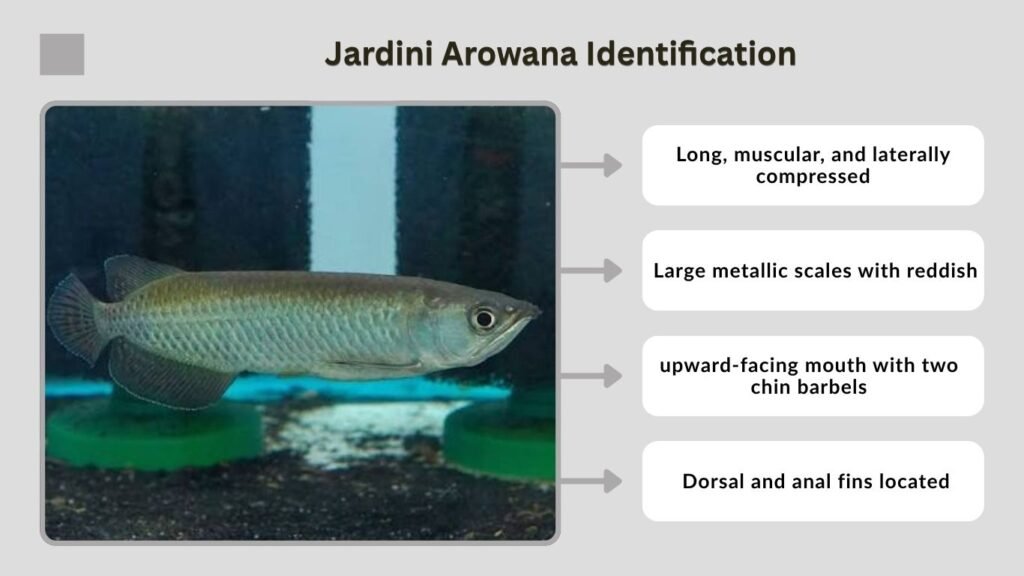
Jardini Arowanas have several distinctive physical characteristics that separate them from other freshwater aquarium fish.
Their elongated bodies are covered with large, reflective scales. Each scale typically features a reddish crescent-shaped marking, giving the fish a patterned appearance.
Key identification features include:
- Body Shape: Long, muscular, and laterally compressed.
- Scales: Large metallic scales with reddish or pinkish markings.
- Mouth: Large, upward-facing mouth with two chin barbels.
- Eyes: Prominent eyes positioned on either side of the head.
- Fins: Dorsal and anal fins located toward the rear of the body.
- Coloration: Brown, bronze, greenish, or silver tones with reddish markings.
Juvenile Jardini Arowanas may appear brighter or display more noticeable spotting than some mature individuals.
Their coloration develops with age and is influenced by genetics and environmental conditions.
Jardini Arowana Colors and Varieties
Jardini Arowanas naturally show variations in their body coloration and scale patterns.
Some sellers use descriptive names for fish displaying unusual colors. However, these names do not necessarily represent scientifically recognized varieties.
1. Golden Jardini Arowana
Golden Jardini Arowanas display bronze or gold-colored reflections across their scales.
Under suitable lighting, their metallic appearance can become particularly noticeable.
The golden coloration may vary between individuals, depending on genetics, age, and lighting.
They are sometimes advertised as Australian Gold Jardini Arowanas.
2. Red Jardini Arowana
Red Jardini Arowanas are typically distinguished by prominent reddish markings on their scales and fins.
These markings are naturally associated with the species rather than necessarily indicating a separate color variety.
Some individuals show stronger red coloration than others.
3. Platinum and Albino Jardini Arowana
Platinum and Albino Jardini Arowanas are names occasionally used for unusually pale or light-colored specimens.
True albinism involves reduced or absent melanin pigmentation and typically produces distinctive eye coloration.
Platinum is a less precisely defined aquarium trade term.
Because unusually colored fish can be misidentified or mislabeled, buyers should verify the species and coloration carefully.
Where Do Jardini Arowanas Live?
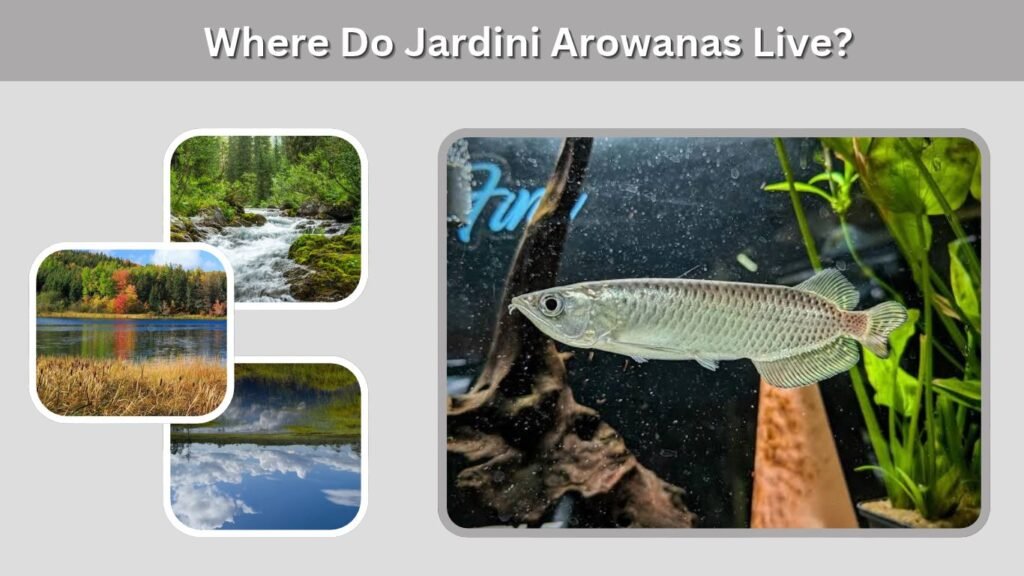
Jardini Arowanas are native to tropical freshwater environments in northern Australia and southern New Guinea.
In Australia, they occur in parts of Queensland and the Northern Territory, particularly around the Gulf of Carpentaria.
Their natural habitats include:
- Slow-moving freshwater rivers
- Floodplain wetlands
- Freshwater swamps
- Vegetated streams
- Permanent pools and billabongs
They generally occupy areas near the water’s surface or close to the shoreline.
Aquatic vegetation provides shelter and supports populations of insects, crustaceans, and smaller fish.
Jardini Arowanas are often solitary and defend their territories against other fish.
How Big Do Jardini Arowanas Get?
Jardini Arowanas commonly reach approximately 20–24 inches (50–60 cm) in length, although exceptionally large wild individuals can reach around 39 inches (100 cm).
Their final size depends on genetics, nutrition, and environmental conditions.
Young Jardini Arowanas can grow noticeably during their first few years.
However, growth rates vary considerably, and no fixed monthly growth rate applies to every fish.
A spacious aquarium and balanced nutrition support normal development.
Jardini Arowana Lifespan
Jardini Arowanas are long-lived fish.
With appropriate care, they can live for 10–20 years, and some individuals may survive longer.
Their longevity depends on water quality, diet, environmental stability, and overall health.
Keeping a Jardini Arowana is therefore a substantial long-term responsibility.
Jardini Arowana Care Guide
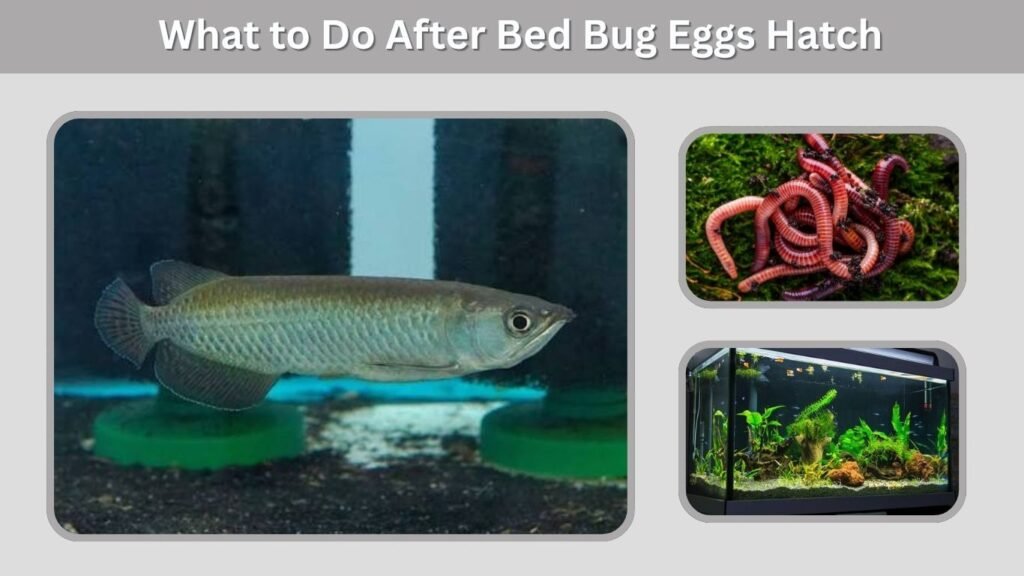
Jardini Arowanas require specialized aquarium conditions because of their adult size, territorial behavior, and sensitivity to poor water quality.
They are generally unsuitable for beginners or standard community aquariums.
Jardini Arowana Tank Size
A large adult Jardini Arowana should ideally have an aquarium of approximately 250 gallons or more, with generous length and width.
An aquarium around 8 feet (244 cm) long provides more appropriate swimming space than a smaller tank of similar volume.
The fish must have enough room to turn comfortably without constantly contacting the aquarium walls.
A 125-gallon tank may temporarily accommodate a smaller juvenile, but it is not a suitable permanent home for a large adult.
Use a strong, tightly fitted lid because Jardini Arowanas are powerful jumpers.
Water Temperature and Parameters
Jardini Arowanas thrive in stable tropical freshwater.
Recommended aquarium conditions include:
- Temperature: Approximately 72–82°F (22–28°C).
- pH: Around neutral, with stability more important than frequent adjustments.
- Ammonia: 0 ppm.
- Nitrite: 0 ppm.
- Nitrate: Kept low through regular maintenance.
Strong biological filtration and regular water changes are essential.
Sudden changes in temperature or water chemistry can cause stress and negatively affect feeding behavior.
Jardini Arowana Diet and Food
Jardini Arowanas are primarily carnivorous predators.
In the wild, they consume aquatic insects, terrestrial insects, smaller fish, frogs, and crustaceans. Some plant material may also be ingested.
In captivity, appropriate foods include:
- High-quality floating carnivore pellets
- Shrimp and prawns
- Earthworms
- Commercially raised crickets
- Suitable frozen fish-based foods
- Other appropriately sized aquatic invertebrates
A varied diet helps provide important nutrients.
Avoid relying exclusively on live feeder fish because they may introduce parasites and diseases.
Juveniles usually need smaller, more frequent meals, while adults generally require less frequent feeding.
Jardini Arowana Tank Mates
Jardini Arowanas are among the more aggressive arowanas commonly kept in aquariums.
They may attack smaller fish, compete with similarly sized species, and aggressively defend their swimming space.
Their territorial behavior often becomes more noticeable as they mature.
Some experienced aquarists attempt to house them with large bottom-dwelling fish, but compatibility is unpredictable.
Even fish that initially coexist peacefully may become aggressive toward one another later.
Keeping a single Jardini Arowana is generally the safest option.
Avoid housing them with small fish that could be swallowed or with aggressive species capable of injuring them.
Jardini Arowana vs. Silver Arowana vs. Asian Arowana
Although these fish share some physical characteristics, they differ in appearance, geographical origin, and behavior.
| Feature | Jardini Arowana | Silver Arowana | Asian Arowana |
| Scientific Name | Scleropages jardinii | Osteoglossum bicirrhosum | Scleropages formosus |
| Native Region | Australia and New Guinea | South America | Southeast Asia |
| Appearance | Reddish-spotted scales | Long, silver body | Red, golden, or green forms |
| Temperament | Highly territorial | Predatory; often less territorial | Territorial |
| Adult Size | Large | Very large | Large |
| Conservation Status | Least Concern | Least Concern | Endangered |
Jardini Arowanas are generally more compact-bodied than Silver Arowanas and have distinctive markings on individual scales.
Silver Arowanas have longer, more streamlined bodies, while Asian Arowanas are especially valued for their vibrant color varieties.
Jardini Arowana Breeding
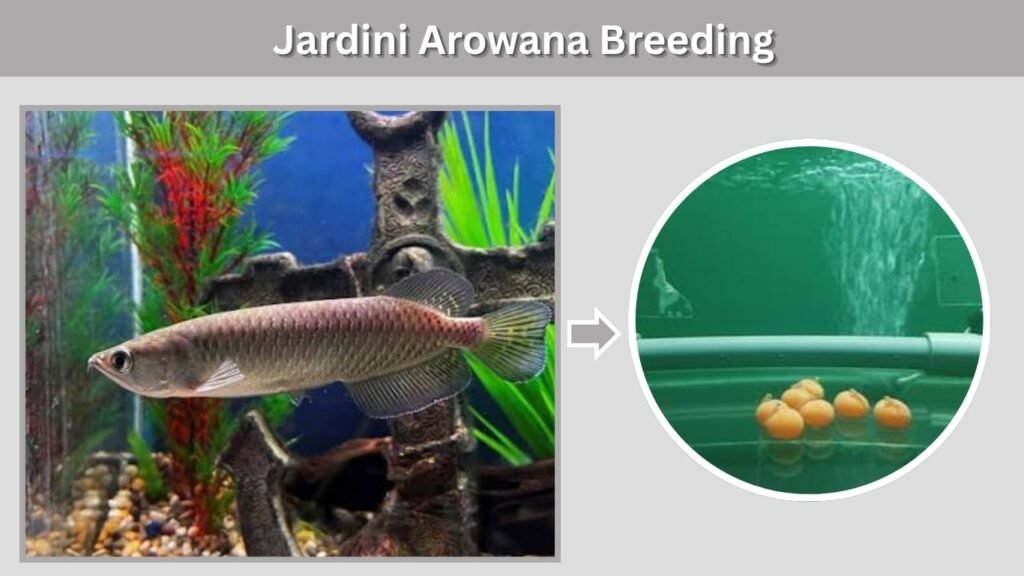
Jardini Arowanas reproduce through a behavior called mouthbrooding.
During reproduction, the female carries fertilized eggs inside her mouth, protecting them during incubation.
After the eggs hatch, the developing young remain sheltered until they can survive independently.
Breeding generally occurs around the beginning of the wet season in their native environment.
Successful reproduction requires mature fish, compatible partners, and appropriate environmental conditions.
Because Jardini Arowanas are territorial and require considerable space, captive breeding is difficult for typical home aquariums.
Jardini Arowana Price and Buying Guide
Jardini Arowana prices vary according to location, size, availability, and coloration.
Juveniles are generally less expensive than mature specimens, although unusually colored fish may command premium prices.
When purchasing a Jardini Arowana, consider:
- The fish’s overall health and swimming behavior
- Clear eyes and undamaged fins
- Healthy scales and normal body shape
- Whether the fish accepts appropriate food
- The seller’s reputation and sourcing information
- Legal requirements in your location
Buyers searching for Jardini Arowanas for sale online should also investigate shipping procedures and whether the seller provides suitable live-arrival arrangements.
Are Jardini Arowanas Legal in the USA?
Jardini Arowanas are generally available in the United States aquarium trade and are not subject to the same endangered-species restrictions as Asian Arowanas.
However, state laws, local wildlife regulations, and import requirements may apply.
Prospective owners should verify the rules in their state before purchasing, transporting, or importing a Jardini Arowana.
FAQs
1. Are Jardini Arowanas Aggressive?
Yes. Jardini Arowanas are highly territorial fish and can display aggressive behavior toward other aquarium inhabitants. Their aggression often becomes more pronounced as they mature. Keeping them individually is generally recommended.
2. How Fast Do Jardini Arowanas Grow?
Jardini Arowanas can grow relatively quickly during their juvenile stage. However, their growth rate varies depending on genetics, food quality, water conditions, and available space. They may take several years to reach mature adult size.
3. Can Jardini Arowanas Live in a 125-Gallon Tank?
A 125-gallon aquarium may temporarily accommodate a young Jardini Arowana, but it is generally unsuitable for a fully grown adult. A substantially larger, long and wide aquarium is necessary for comfortable swimming.
4. What Is the Difference Between Jardini and Pearl Arowana?
Jardini Arowana and Pearl Arowana are commonly used names for the same species, Scleropages jardinii. The Pearl Arowana name refers to its attractive reflective scales and distinctive markings.
5. Can Jardini and Silver Arowanas Live Together?
Keeping Jardini and Silver Arowanas together is risky because of their large size, territorial behavior, and potential aggression. Even in spacious aquariums, individuals may fight or injure one another. Separate housing is generally the safer approach.
