
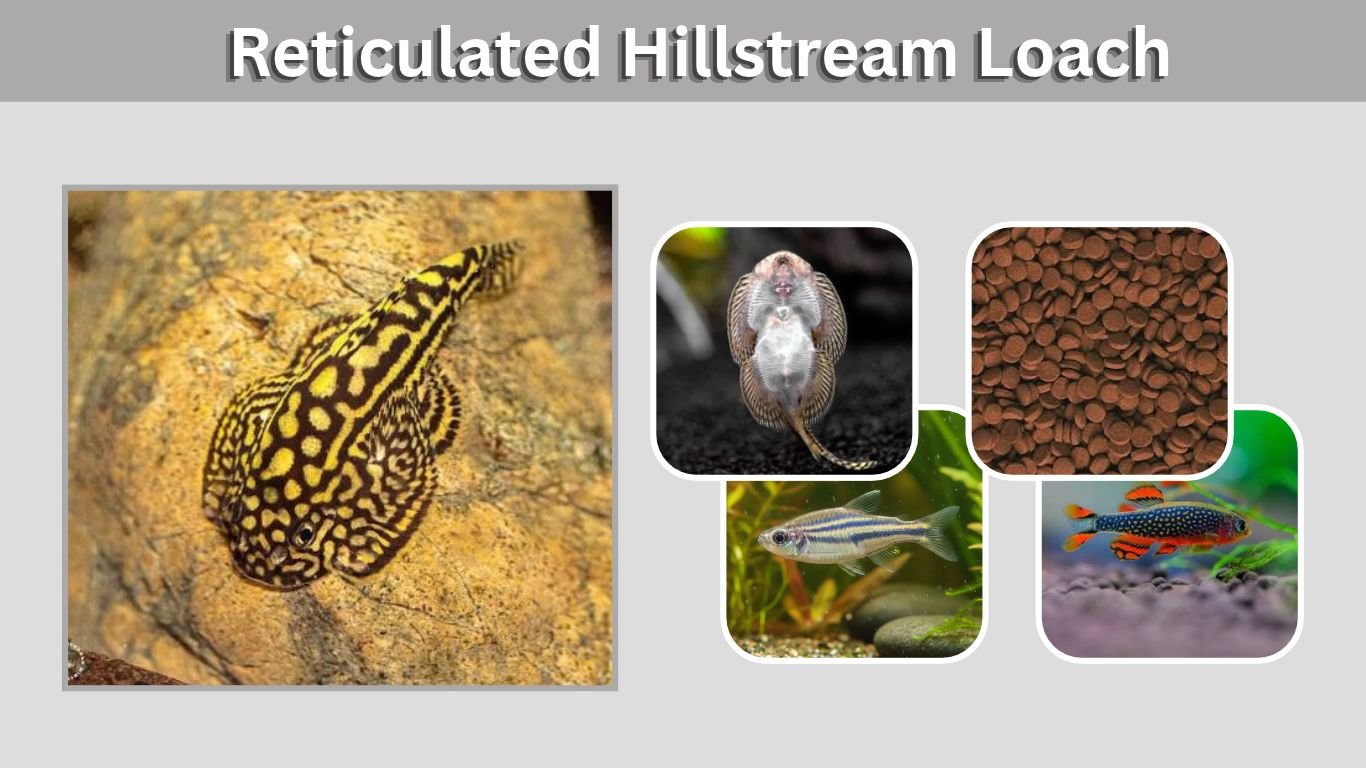
The reticulated hillstream loach (Sewellia lineolata) is a fascinating freshwater fish known for its flattened body, intricate black-and-yellow markings, and ability to cling to rocks in fast-moving water. Native to streams in Vietnam, this small fish is popular among aquarists for its unusual appearance and algae-grazing behavior. Unlike many tropical community fish, it requires cooler, oxygen-rich water with strong circulation. Proper tank conditions, suitable food, and compatible companions are essential for keeping reticulated hillstream loaches healthy.
What Is a Reticulated Hillstream Loach?
The reticulated hillstream loach is a freshwater fish belonging to the family Gastromyzontidae. Its scientific name is Sewellia lineolata, and it is also commonly called the tiger hillstream loach, Vietnamese hillstream loach, or gold ring butterfly sucker.
Its specialized body allows it to attach securely to underwater surfaces while feeding in strong currents. Despite its unusual appearance, it is a true fish rather than a stingray or freshwater suckerfish.
Reticulated Hillstream Loach Identification
Reticulated hillstream loaches possess several recognizable physical characteristics that distinguish them from ordinary bottom-dwelling aquarium fish.
- Body shape: A broad, flattened body with an elongated, tapering tail.
- Body color: Yellowish, golden, or light brown with contrasting dark markings.
- Pattern: Intricate black stripes and interconnected lines resembling a network.
- Fins: Large, rounded pectoral and pelvic fins extending outward from the body.
- Mouth: A small, downward-facing mouth adapted for grazing on submerged surfaces.
- Movement: Frequently crawls across rocks and aquarium glass instead of swimming continuously.
Viewed from above, its flattened body and extended fins resemble a miniature stingray.
However, unlike stingrays, reticulated hillstream loaches are small freshwater fish with specialized adaptations for life in flowing streams.
Natural Habitat and Distribution
Reticulated hillstream loaches are native primarily to Vietnam, where they inhabit rocky rivers and mountain streams.
These environments typically contain clear water, strong currents, and abundant dissolved oxygen.
Submerged rocks provide surfaces for algae and microorganisms to grow, creating an important natural food source.
Their specialized anatomy allows them to remain attached to rocks even when surrounding water moves rapidly.
Reticulated Hillstream Loach Size and Lifespan
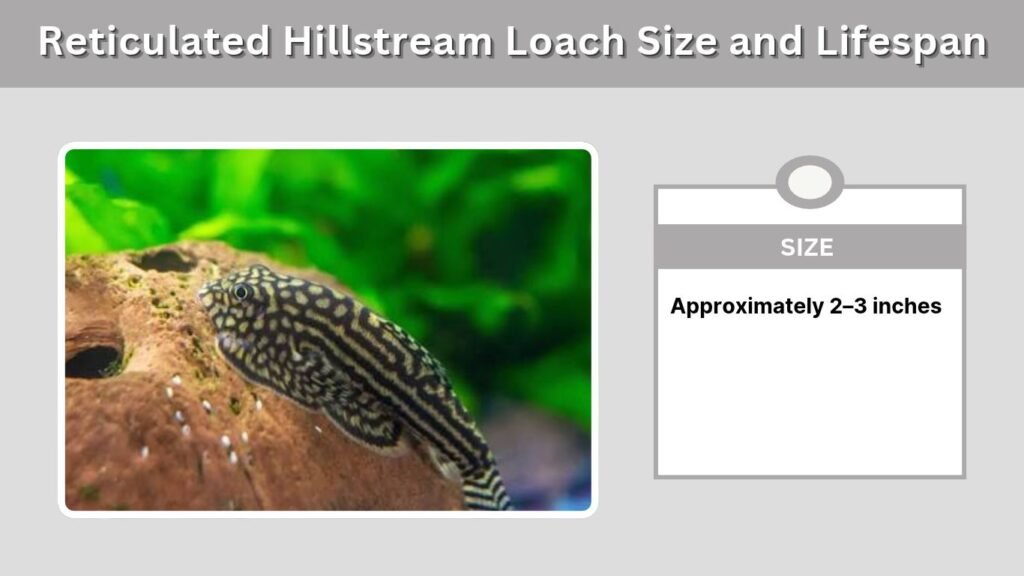
Reticulated hillstream loaches are relatively small fish, making them attractive to aquarists with limited aquarium space.
However, their environmental requirements are more important than their size alone. They need sufficient bottom space, flowing water, and established grazing surfaces.
With proper care, these fish can survive for several years in captivity.
How Big Do Reticulated Hillstream Loaches Get?
A full-grown reticulated hillstream loach usually measures approximately 2–3 inches (5–7.5 cm) in total length.
Most specimens remain near the lower end of this range.
Their flattened bodies and broad fins make them appear larger when viewed from above.
Juveniles are considerably smaller, but they gradually develop the characteristic body proportions and markings of adults.
Reticulated Hillstream Loach Lifespan
Reticulated hillstream loaches commonly live around 5–10 years in well-maintained aquariums, although individual lifespans vary.
Water quality, nutrition, oxygen availability, and stable temperature strongly influence their longevity.
Poor circulation or prolonged exposure to excessively warm water can create health problems and shorten their lifespan.
Reticulated Hillstream Loach Tank Size and Water Requirements
Reticulated hillstream loaches require a carefully maintained freshwater aquarium that resembles their natural stream habitat.
Strong water movement, high oxygen levels, and stable water chemistry are especially important.
Although they are small, these fish are not ideal for newly established or poorly filtered aquariums.
Reticulated Hillstream Loach Care Requirements
| Requirement | Recommended Conditions |
| Scientific name | Sewellia lineolata |
| Adult size | Approximately 2–3 inches |
| Minimum tank footprint | 30 × 12 inches |
| Practical aquarium size | 20 gallons or larger |
| Temperature | 68–75°F (20–24°C) |
| Water pH | 6.0–7.5 |
| Water hardness | 1–10 dGH |
| Preferred water movement | Strong |
| Social group | Ideally six or more |
| Diet | Algae, biofilm, and small invertebrates |
| Temperament | Peaceful, occasionally territorial |
| Care difficulty | Moderate |
A longer aquarium provides additional grazing surfaces and makes it easier to establish flowing and sheltered areas.
For larger groups, an aquarium exceeding the minimum dimensions is preferable.
How to Set Up a Reticulated Hillstream Loach Tank
A suitable aquarium should contain several important features.
- Powerful filtration: Use a reliable filter capable of maintaining excellent water quality.
- Strong circulation: Add a powerhead when necessary to reproduce stream-like water movement.
- Smooth rocks: Provide rounded stones that allow natural grazing behavior.
- Suitable substrate: Use sand, smooth gravel, or a combination of both.
- Bright lighting: Encourage controlled algae and biofilm development on aquarium surfaces.
- Aquatic plants: Add hardy plants such as Anubias or Java fern if desired.
- Secure cover: Prevent escapes by keeping the aquarium properly covered.
Allow the aquarium to mature before adding fish. Established algae and biofilm provide important grazing opportunities.
Water Temperature and Oxygen Requirements
Reticulated hillstream loaches generally thrive at temperatures between 68°F and 75°F (20–24°C).
They may tolerate slightly warmer conditions temporarily, but higher temperatures reduce the amount of oxygen water can hold.
Strong surface agitation, effective filtration, and good circulation help maintain suitable oxygen levels.
Important care tip: Reticulated hillstream loaches should not be introduced to uncycled aquariums. Ammonia and nitrite must remain at zero, and regular partial water changes are essential.
What Do Reticulated Hillstream Loaches Eat?

Reticulated hillstream loaches are primarily grazing fish that feed on algae and microorganisms growing on submerged surfaces.
Their natural diet also includes tiny aquatic invertebrates.
Although they are commonly sold as algae eaters, relying exclusively on aquarium algae may not provide adequate nutrition.
A varied diet helps maintain healthy growth and body condition.
Best Food for Reticulated Hillstream Loaches
Suitable foods include:
- Naturally growing soft green algae.
- Biofilm on rocks and aquarium decorations.
- High-quality sinking algae wafers.
- Spirulina-based foods.
- Small portions of blanched zucchini or spinach.
- Occasional frozen daphnia or brine shrimp.
- Suitable gel-based foods containing vegetable ingredients.
Provide small portions that the fish can consume without excessive waste accumulation.
Do Reticulated Hillstream Loaches Eat Algae?
Yes, reticulated hillstream loaches graze on several types of soft algae.
They are particularly interested in algae-covered stones and surfaces containing microorganisms.
However, they are not effective against every form of algae.
Tough varieties, such as black beard algae, are generally less suitable as food.
Do Reticulated Hillstream Loaches Eat Snails?
Reticulated hillstream loaches are not specialized snail predators.
They mainly graze on algae, biofilm, and tiny organisms rather than hunting aquarium snails.
They can usually coexist with peaceful snails, provided the animals share compatible water conditions.
These loaches should not be purchased specifically for snail control.
Reticulated Hillstream Loach Behavior and Tank Mates
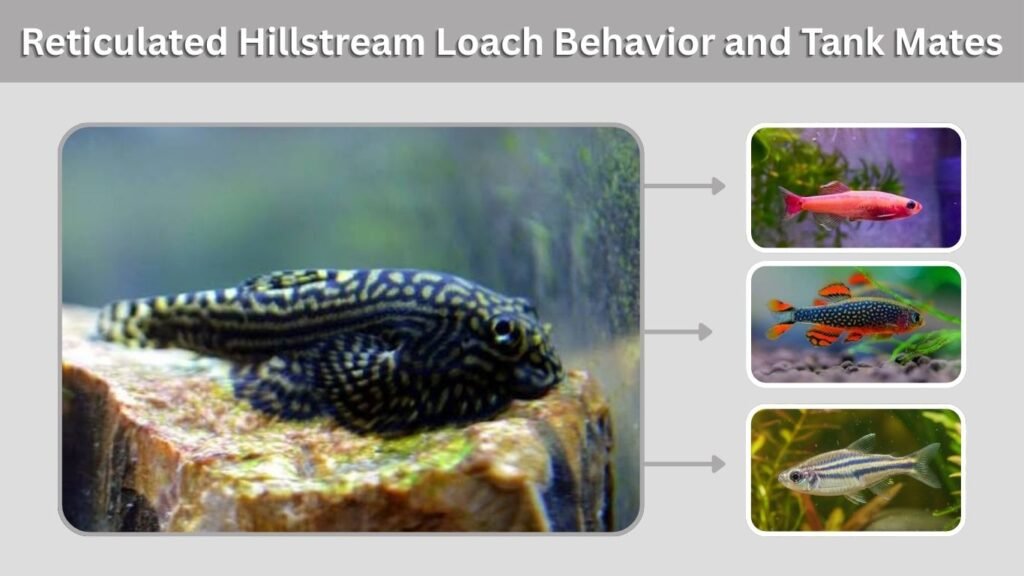
Reticulated hillstream loaches are generally peaceful fish that spend much of their time resting on rocks or grazing on submerged surfaces.
Unlike many nocturnal loaches, they are often active during daylight hours.
They may occasionally defend preferred feeding spots against other hillstream loaches.
Best Reticulated Hillstream Loach Tank Mates
Compatible companions should tolerate cooler temperatures, oxygen-rich water, and noticeable currents.
Potential tank mates include:
- White cloud mountain minnows.
- Suitable peaceful danios.
- Selected stream-dwelling rasboras.
- Compatible small freshwater gobies.
- Amano shrimp and other suitable freshwater shrimp.
- Certain peaceful hillstream species in sufficiently spacious aquariums.
Avoid aggressive fish that compete excessively for food or territory.
Slow-moving species that prefer calm, warm water are generally poor companions.
Are Reticulated Hillstream Loaches Aggressive?
Reticulated hillstream loaches are usually peaceful toward unrelated fish.
However, individuals may occasionally engage in territorial disputes, especially when competing for desirable grazing surfaces.
These interactions sometimes involve fish pushing against one another or attempting to dislodge rivals from rocks.
Maintaining adequate space and multiple feeding areas helps minimize conflicts.
How Many Reticulated Hillstream Loaches Should Be Kept Together?
Reticulated hillstream loaches naturally gather in groups and display interesting social interactions.
A group of six or more is desirable when aquarium size permits.
Smaller groups may be maintained successfully, but individuals can become more territorial when resources are limited.
Providing additional rocks and grazing surfaces encourages more balanced social behavior.
Reticulated Hillstream Loach Breeding
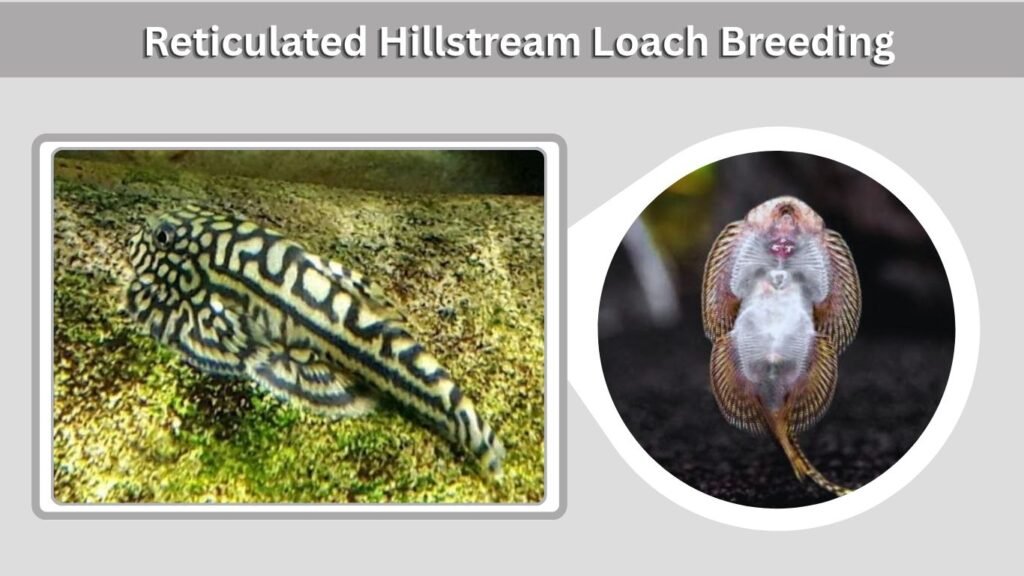
Reticulated hillstream loaches are among the hillstream loach species that have successfully reproduced in home aquariums.
However, breeding still requires suitable environmental conditions and a mature aquarium.
Healthy adults may display courtship behavior involving chasing, fin movements, and swimming together.
During spawning, a pair may rise into the water column and release eggs.
How to Breed Reticulated Hillstream Loaches
Successful breeding setups generally include:
- A mature aquarium with stable water parameters.
- Strong oxygenation and suitable water circulation.
- Rounded gravel provides protected spaces between stones.
- Established microorganisms that can support newly hatched fry.
- Healthy adult fish receive varied nutrition.
The eggs may settle between stones, where the developing young receive some protection.
Newly hatched fry initially require extremely small foods before progressing to larger live foods.
Reticulated Hillstream Loach vs. Other Hillstream Loaches
The reticulated hillstream loach is sometimes confused with other fish that have flattened bodies and similar feeding habits.
However, their markings, adult sizes, and environmental requirements can differ.
| Fish | Scientific Name | Distinguishing Feature |
| Reticulated hillstream loach | Sewellia lineolata | Intricate dark stripes on a golden body |
| Panda loach | Yaoshania pachychilus | Bold black-and-white markings in juveniles |
| Spotted hillstream loach | Various species | Predominantly spotted rather than striped patterns |
The scientific name provides the most reliable way to identify an aquarium fish when common names overlap.
Common Reticulated Hillstream Loach Care Mistakes
Even experienced aquarists can encounter difficulties when maintaining hillstream loaches.
Their specialized requirements make aquarium planning especially important.
Common mistakes include:
- Keeping them in consistently warm tropical aquariums.
- Providing insufficient water circulation.
- Introducing them before the aquarium matures.
- Allowing natural grazing surfaces to remain completely bare.
- Keeping too many competing bottom-dwelling fish.
- Failing to monitor oxygen availability during warm weather.
Avoiding these problems helps create a stable environment where reticulated hillstream loaches can display their natural behavior.
FAQs
Are reticulated hillstream loaches good for beginners?
Reticulated hillstream loaches are better suited to aquarists with some experience. Their need for strong water circulation, high oxygen levels, and established grazing surfaces can be challenging. However, beginners who carefully prepare an appropriate aquarium and maintain stable water conditions may keep them successfully.
Can reticulated hillstream loaches live with shrimp?
Yes, reticulated hillstream loaches can generally coexist with suitable freshwater shrimp, including Amano shrimp. They rarely show interest in hunting healthy adult shrimp. However, newly hatched shrimp may be vulnerable, and both species must tolerate the same temperature, water chemistry, and current.
Do reticulated hillstream loaches need a heater?
Not necessarily. Reticulated hillstream loaches prefer relatively cool water, typically between 68°F and 75°F. A heater may be unnecessary when room temperatures remain stable within this range. However, a heater can help prevent excessive cooling in colder environments or during seasonal temperature changes.
Can reticulated hillstream loaches live with bettas?
Reticulated hillstream loaches and bettas are generally unsuitable tank mates because their preferred conditions differ. Hillstream loaches require strong currents and cooler, oxygen-rich water, while bettas usually prefer warmer, calmer surroundings. A shared aquarium may force one or both species into unfavorable conditions.
Are reticulated hillstream loaches nocturnal?
No, reticulated hillstream loaches are primarily active during the day. They frequently graze on rocks, aquarium glass, and other submerged surfaces while searching for food. Their daytime activity makes them interesting aquarium inhabitants, particularly in mature tanks containing abundant natural grazing surfaces.