
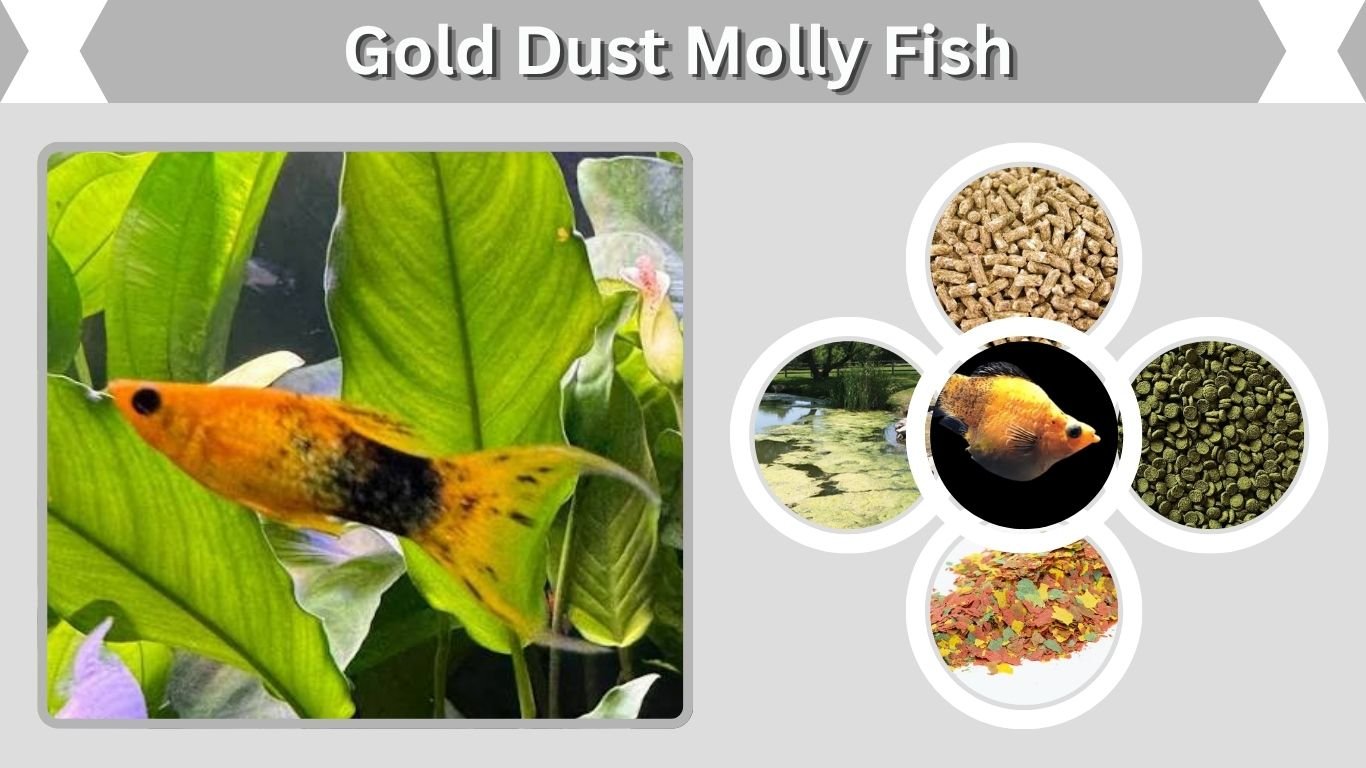
The Gold Dust Molly fish is a colorful freshwater livebearer known for its striking mix of golden-yellow and black markings. Its shimmering body makes it popular in community aquariums, while its hardy nature makes it suitable for both new and experienced fish keepers. Like other mollies, Gold Dust Mollies are active, social, and capable of producing live fry instead of laying eggs. With proper water conditions, a balanced diet, compatible tank mates, and enough swimming space, these attractive fish can thrive for several years.
What Is a Gold Dust Molly Fish?
Gold Dust Molly fish are ornamental mollies selectively bred for their distinctive yellow-gold coloration mixed with black patches or speckling. Their exact pattern varies greatly between individuals. Some fish are almost completely golden, while others have dark tails, black backs, or scattered black markings over the body. They belong to the same general livebearer group as black mollies, dalmatian mollies, and balloon mollies.
Gold Dust Molly Fish Identification
Common characteristics include:
- Color: Golden-yellow with black markings
- Adult size: Usually around 3–5 inches
- Body: Moderately elongated and laterally compressed
- Temperament: Generally peaceful and active
- Diet: Omnivorous
- Reproduction: Livebearer
- Water type: Freshwater, although mollies tolerate moderately mineral-rich water well
- Swimming level: Mostly middle and upper areas
- Social behavior: Best kept with compatible community fish
The amount of black coloring can change as individual fish mature, making each Gold Dust Molly look slightly different.
Gold Dust Molly vs Gold Molly
The terms Gold Dust Molly, Golden Molly, and Gold Molly are sometimes used loosely in the aquarium trade.
A Gold Molly may have an almost entirely yellow or golden body, while a Gold Dust Molly usually displays noticeable black coloration mixed with gold. The Gold Doubloon Molly is another closely related color variety characterized by strong yellow and black sections.
Because aquarium strains are frequently crossed, naming can vary between breeders and pet stores.
Gold Dust Molly Fish Care
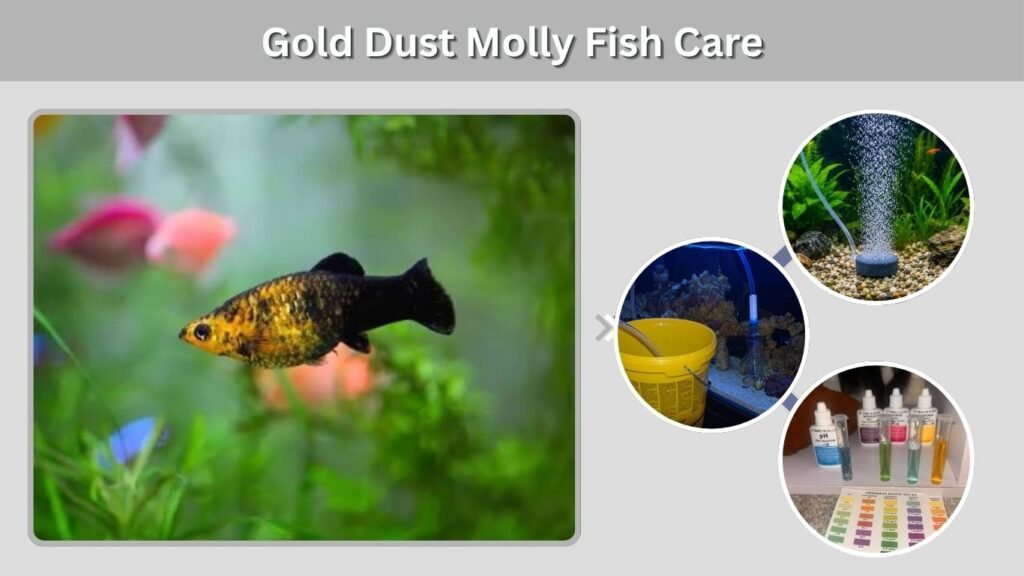
Gold Dust Mollies are relatively easy to maintain, but they perform best in stable, clean water. Poor water quality, sudden temperature changes, overcrowding, and inadequate nutrition can lead to stress and disease. Mollies generally prefer harder, more alkaline water than many soft-water tropical fish, making water chemistry an important part of successful care.
Ideal Tank Conditions
Provide the following conditions:
- Temperature: About 72–82°F
- pH: Approximately 7.0–8.5
- Water: Moderately hard to hard freshwater
- Tank size: At least 20 gallons for a small group
- Filtration: Efficient biological and mechanical filtration
- Lighting: Moderate aquarium lighting
- Plants: Live or artificial plants for shelter
- Swimming space: Leave open areas in the middle of the tank
A larger aquarium is preferable when keeping several mollies because they are active swimmers and reproduce quickly.
Do Gold Dust Mollies Need Salt?
Gold Dust Mollies do not require aquarium salt in every setup.
They can live perfectly well in freshwater when the water is sufficiently hard and alkaline. Some keepers add a small amount of marine or aquarium salt because mollies naturally tolerate brackish conditions, but adding salt unnecessarily can harm plants and tank mates that are sensitive to elevated salinity.
Stable water chemistry is more important than routinely adding salt.
Gold Dust Molly Tank Mates
Suitable companions can include guppies, platies, swordtails, peaceful tetras that tolerate similar water conditions, certain rainbowfish, and peaceful bottom-dwelling species.
Avoid highly aggressive fish and species that constantly nip fins.
Mollies are social, but males may repeatedly chase females. Keeping more females than males usually reduces pressure on individual females.
Gold Dust Molly Fish Diet
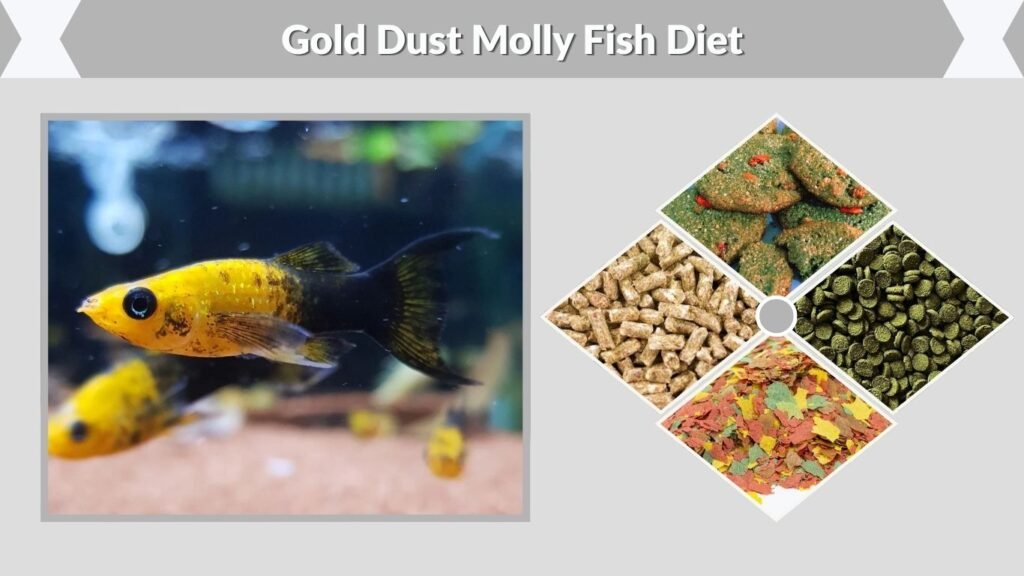
Gold Dust Mollies are omnivores with a strong preference for plant material. A varied diet helps maintain their coloration, activity level, immune function, and reproductive health. In aquariums, they often graze on algae throughout the day while also accepting most prepared fish foods.
What Do Gold Dust Molly Fish Eat?
Good foods include:
- High-quality tropical flakes
- Small pellets
- Spirulina-based foods
- Algae wafers
- Blanched spinach
- Blanched zucchini
- Peas
- Brine shrimp
- Daphnia
- Bloodworms in moderation
- Mosquito larvae from safe sources
Feeding small portions once or twice daily is generally sufficient. Avoid overfeeding because excess food quickly reduces water quality.
Why Plant-Based Foods Matter
Mollies naturally consume significant amounts of algae and plant material.
Including spirulina and vegetables helps support digestion and reduces the risk of nutritional problems caused by an overly protein-heavy diet.
Animal-based foods can still be offered as supplements, especially for breeding females and growing juveniles, but they should not be the only food source.
Gold Dust Molly Male and Female Differences
Determining the sex of adult Gold Dust Mollies is relatively easy once you know what to examine. Body coloration alone is unreliable because both sexes can display gold and black patterns. Instead, the anal fin provides the clearest indication of sex.
How to Tell Male and Female Apart
Look for these differences:
- Male anal fin: Narrow and pointed, forming a reproductive organ called a gonopodium
- Female anal fin: Broad and fan-shaped
- Male body: Usually slimmer
- Female body: Often larger and rounder
- Male behavior: Frequently chases females
- Female abdomen: Becomes noticeably enlarged during pregnancy
Females may also appear less streamlined, particularly after reaching reproductive maturity.
Best Male-to-Female Ratio
A ratio of approximately one male to two or three females works well in many community aquariums.
Male mollies can be persistent when attempting to mate. Keeping multiple females distributes attention and helps reduce stress.
A female-only group can also work if breeding is not desired, although females purchased from stores may already be pregnant.
Pregnant Gold Dust Molly Fish
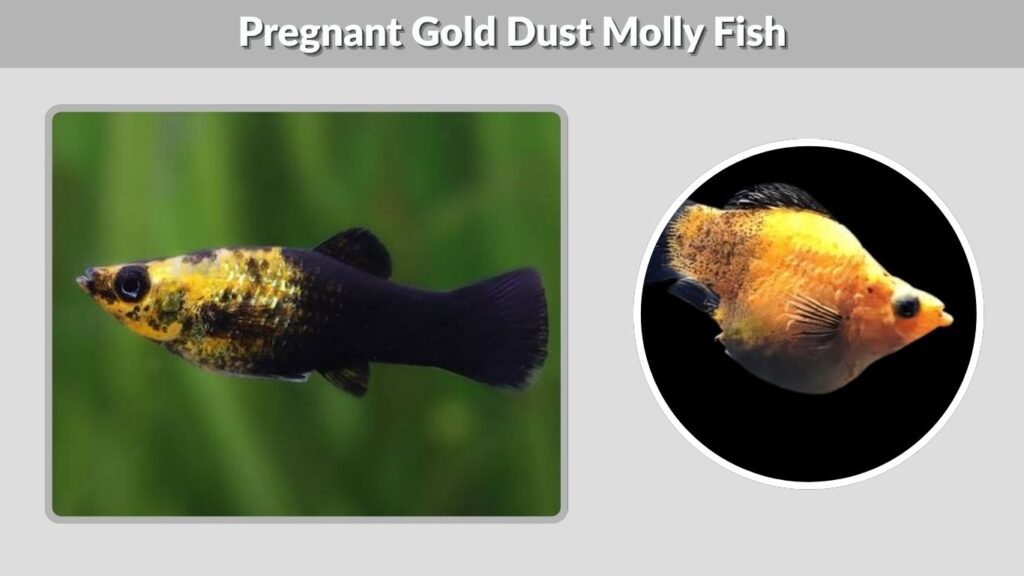
Gold Dust Mollies are livebearers, meaning females give birth to free-swimming baby fish rather than laying eggs. They reproduce easily, and females can store sperm after mating. As a result, one female may produce several batches of fry even when a male is no longer present.
Signs of a Pregnant Gold Dust Molly
Common signs include:
- Increasingly swollen abdomen
- Belly becoming more squared near birth
- Increased appetite early in pregnancy
- Reduced activity close to delivery
- Seeking plants or secluded areas
- Darkened gravid area near the rear abdomen
- Spending more time away from other fish
- More noticeable breathing shortly before birth
The gravid spot may be difficult to see in Gold Dust Mollies because dark body markings can hide it.
How Long Are Gold Dust Mollies Pregnant?
Pregnancy generally lasts around four to six weeks, although temperature, health, genetics, and environmental conditions can affect timing.
A healthy female may produce dozens of fry in one delivery. Large mature females sometimes produce considerably more than young females.
Gold Dust Molly Fish Giving Birth
As delivery approaches, a female may hide among plants or remain close to a quiet corner of the aquarium.
After birth, the fry are able to swim immediately.
Adult mollies may eat their babies, so dense live plants such as Java moss, guppy grass, or floating plants provide valuable hiding places. A separate nursery aquarium is another option when the goal is to raise as many fry as possible.
Gold Dust Molly Fry and Baby Care
Baby Gold Dust Mollies are fairly large compared with many egg-laying fish fry and can usually eat finely crushed prepared food soon after birth. Good water quality is especially important because young fish are sensitive to accumulated waste.
Feeding Gold Dust Molly Babies
Suitable foods include:
- Finely crushed flakes
- Powdered fry food
- Baby brine shrimp
- Microworms
- Finely crushed spirulina food
- Small amounts of daphnia
Feed very small portions several times per day when actively raising fry.
Frequent partial water changes help support steady growth without exposing young fish to excessive ammonia or nitrate.
When Do Babies Develop Their Colors?
Newborn mollies may initially appear pale, gray, yellowish, or lightly patterned.
Gold and black coloration becomes more noticeable as they mature. The final pattern depends heavily on genetics, so fry produced from mixed-color parents may not look exactly like either adult.
Some individuals continue changing coloration for several months.
Gold Dust Molly Fish Health and Color Changes
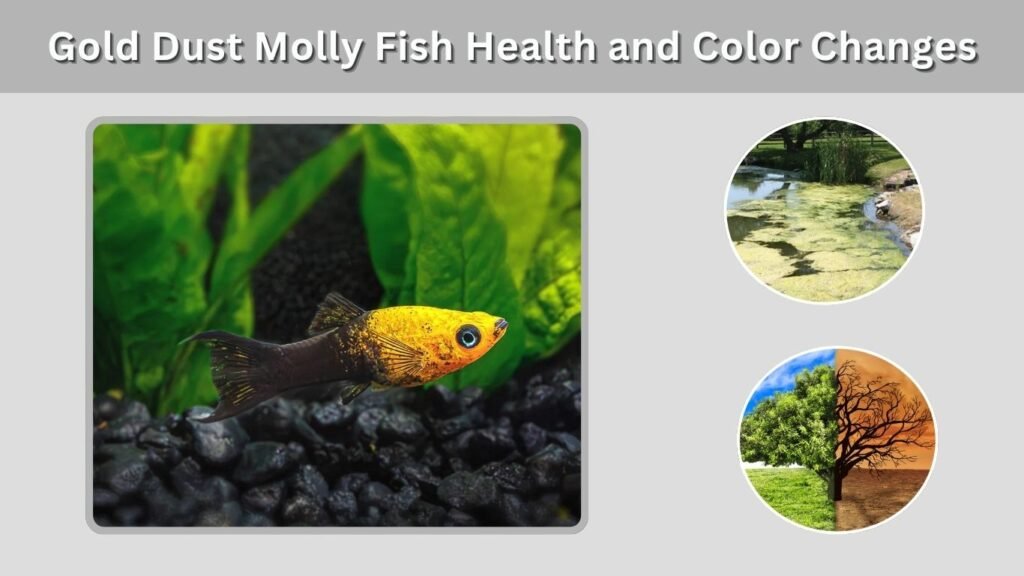
Color changes are not always a sign of disease. Young fish naturally develop new markings as they mature, and genetic color patterns may expand over time. However, sudden fading combined with abnormal behavior can indicate stress, illness, or poor water conditions.
Why Is My Gold Molly Turning White?
Possible causes include:
- Stress
- Poor water quality
- Sudden temperature changes
- Natural color development
- Skin infections
- Parasites
- Injury
- Excessive aggression from tank mates
Check ammonia, nitrite, nitrate, temperature, and pH whenever unexplained color changes occur.
White spots resembling grains of salt may indicate ich, while fuzzy white growth can suggest fungal or bacterial problems requiring closer diagnosis.
Why Is a Black Molly Turning Gold?
Some mollies naturally change their pigmentation as they mature.
A fish sold as a black molly may carry genes for gold, silver, or mixed coloration that gradually become visible. This can be particularly noticeable in hybrid strains.
If the fish is active, eating normally, and has smooth skin without sores or unusual patches, gradual color change may simply be genetic.
Gold Dust Molly Fish Lifespan
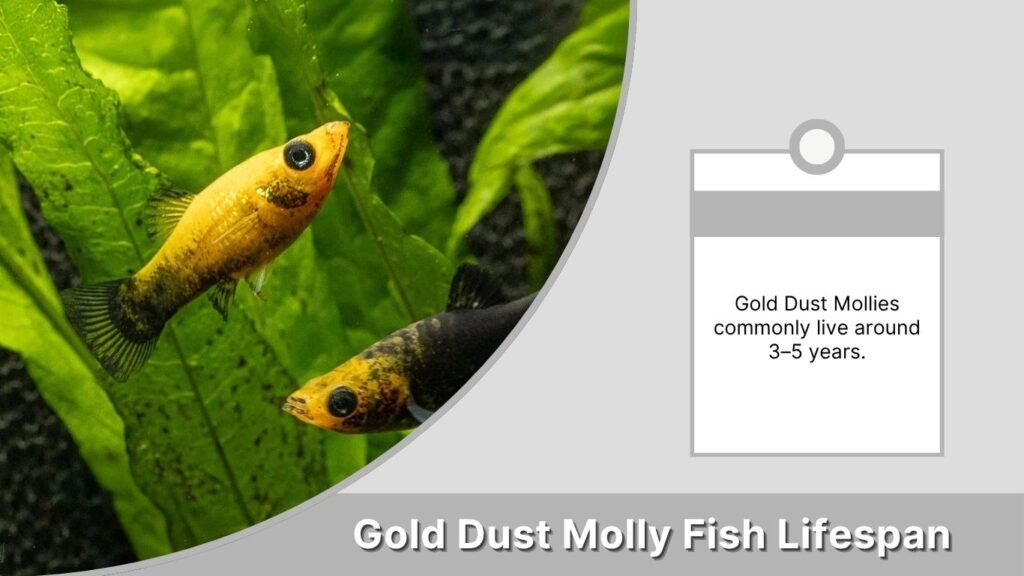
Gold Dust Mollies commonly live around 3–5 years under good aquarium conditions. Genetics, diet, tank size, water quality, disease prevention, and reproductive stress can influence lifespan.
Regular water changes, stable temperatures, suitable mineral levels, and a varied diet give mollies the best opportunity to remain healthy throughout adulthood.
How to Help Gold Dust Mollies Live Longer
For better long-term health:
- Maintain stable water parameters.
- Avoid overcrowding.
- Perform regular partial water changes.
- Feed a varied omnivorous diet.
- Keep compatible tank mates.
- Avoid repeated sudden temperature changes.
- Provide hiding places.
- Watch for signs of illness early.
- Maintain an appropriate male-to-female ratio.
Good preventive care is usually much easier than treating disease after fish become severely stressed.
FAQs
1. How big do Gold Dust Molly fish get?
Most Gold Dust Mollies grow to approximately 3–5 inches long. Females are often larger and fuller-bodied than males.
2. Are Gold Dust Mollies easy to care for?
Yes. They are generally hardy beginner-friendly fish when kept in clean, moderately hard, alkaline water with stable temperatures and a balanced diet.
3. How can I tell if my Gold Dust Molly is pregnant?
A pregnant female develops a swollen abdomen that becomes increasingly box-shaped near delivery. She may also hide more often and reduce activity shortly before giving birth.
4. Can Gold Dust Mollies breed with black mollies?
Yes. Many common molly color varieties are compatible and can interbreed. Their fry may display combinations of black, gold, silver, or other inherited patterns.
5. Can Gold Dust Molly fish live with goldfish?
It is generally better not to keep them together. Gold Dust Mollies are tropical fish that prefer warmer temperatures and different water conditions than most common goldfish, making long-term compatibility difficult.