
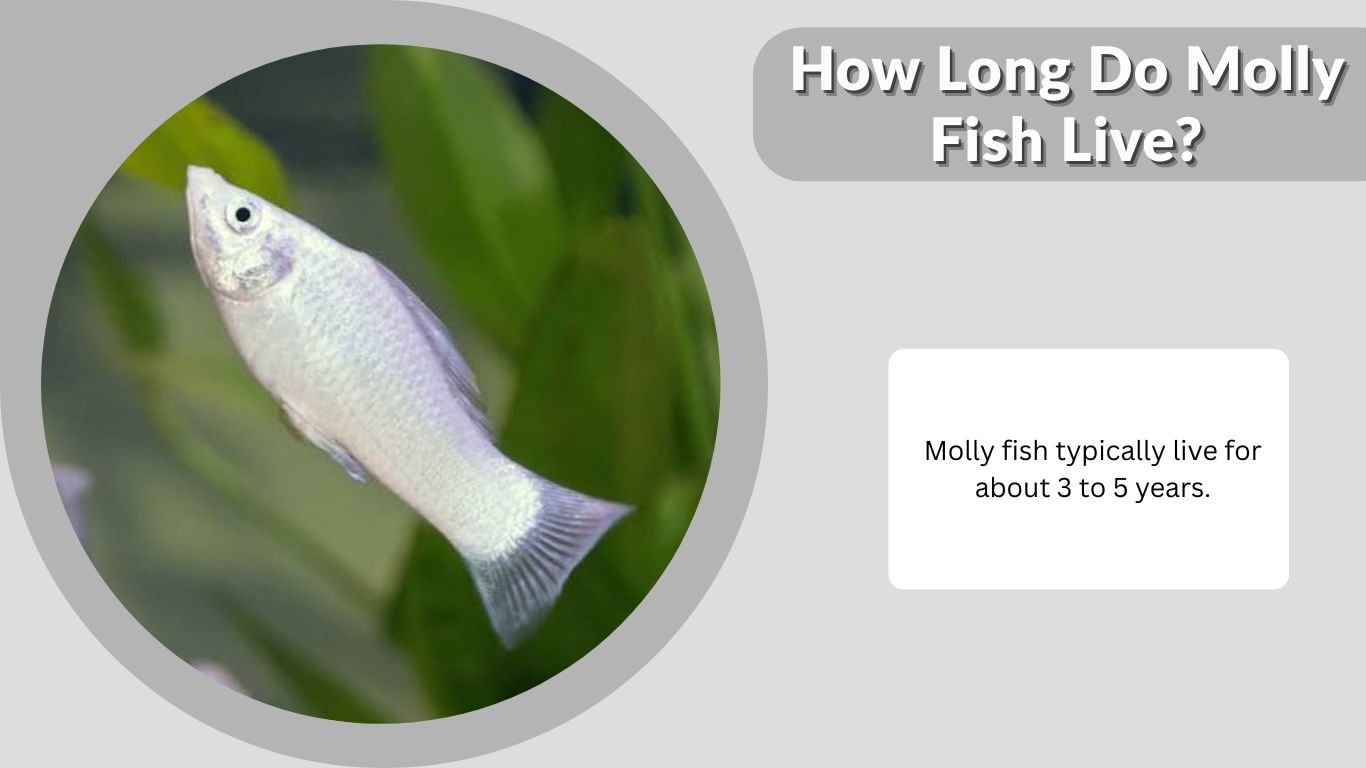
Molly fish typically live for about 3 to 5 years in a well-maintained aquarium. Their actual lifespan depends heavily on genetics, water quality, diet, tank size, stress, disease prevention, and compatibility with other fish. Black Mollies and Dalmatian Mollies commonly reach the typical 3–5-year range, while Balloon Mollies may have somewhat shorter lives because of their compact body shape. Providing warm, clean, mineral-rich water, proper filtration, nutritious food, and peaceful tank mates gives mollies their best chance of living a long and healthy life.
How Long Do Molly Fish Live?
Most aquarium mollies live approximately 3 to 5 years, although individual fish may live shorter or longer lives. Fish purchased as adults have already spent part of their lifespan before entering your aquarium, so they may not remain with you for the full expected period.
Molly Fish Lifespan by Type
- Black Molly: About 3–5 years
- Dalmatian Molly: About 3–5 years
- Sailfin Molly: Around 3–5 years, sometimes longer with excellent care
- Lyretail Molly: Approximately 3–5 years
- Silver Molly: Around 3–5 years
- Balloon Molly: Often around 2–3 years, although some live longer
Balloon Mollies have selectively bred rounded bodies. Their compressed internal anatomy can make some individuals more vulnerable to health problems than traditionally shaped mollies.
How Long Do Molly Fish Live in a Tank?
A properly maintained aquarium can allow mollies to reach the upper end of their expected lifespan.
An established tank with stable temperature, effective biological filtration, appropriate mineral content, regular water changes, and adequate swimming space is considerably healthier than a small, unstable aquarium.
Sudden fluctuations in ammonia, nitrite, temperature, or pH can shorten a molly’s life even when the fish initially appears healthy.
How to Help Molly Fish Live Longer
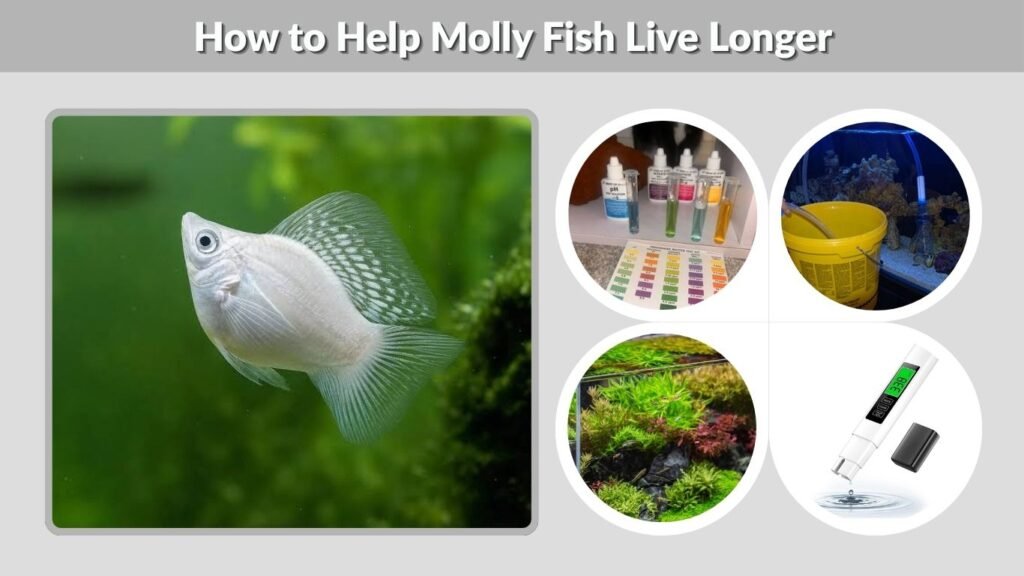
Mollies are often described as beginner-friendly fish, but they are not completely maintenance-free. One of the biggest mistakes is placing them in soft, unstable water or undersized aquariums. Mollies generally perform best in relatively hard, alkaline water with consistent conditions.
Best Conditions for a Long Lifespan
Aim to provide:
- Temperature: About 75–80°F (24–27°C)
- pH: Approximately 7.5–8.5
- Water: Moderately hard to hard
- Ammonia: 0 ppm
- Nitrite: 0 ppm
- Nitrate: Kept low through maintenance
- Tank size: At least around 20 gallons for a small group, with larger tanks preferable
- Filtration: Reliable biological and mechanical filtration
- Water changes: Regular partial water changes
- Plants: Live plants for cover and grazing
Avoid overcrowding because mollies are active fish and can produce a significant amount of waste.
Diet and Lifespan
Mollies are omnivores with a strong appetite for plant matter and algae. A varied diet can support coloration, immune function, growth, and reproduction.
Good foods include quality tropical flakes or pellets, spirulina-based foods, algae wafers, blanched vegetables, frozen brine shrimp, daphnia, and occasional live foods.
Feed small portions rather than large amounts. Excess food decomposes and harms water quality, which can ultimately shorten the fish’s lifespan.
What Fish Can Live With Mollies?
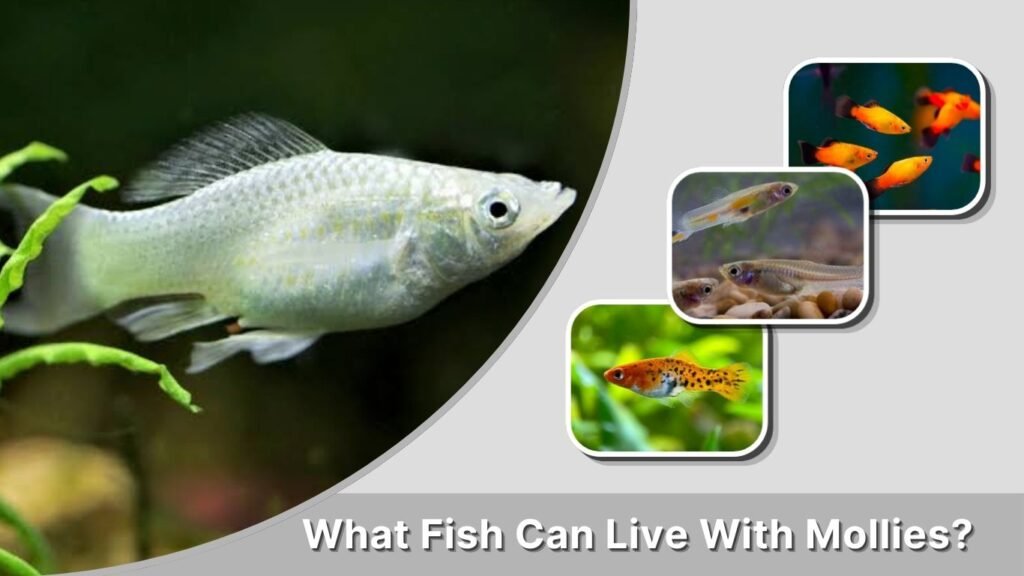
Mollies are social community fish, but compatible tank mates should have similar water and temperature requirements. They generally do best with peaceful or moderately active species that will not constantly chase or injure them.
Good Molly Fish Tank Mates
Suitable choices can include:
- Guppies
- Platies
- Swordtails
- Other mollies
- Some Corydoras species where water conditions overlap
- Some peaceful rainbowfish
- Certain peaceful gouramis
- Larger peaceful snails
Guppies and mollies can live together particularly well because both are livebearers and generally appreciate warm, mineral-rich water.
Platies are another excellent choice because their temperament, diet, and water preferences are similar.
Can Mollies Live With Angelfish?
Mollies and angelfish can sometimes live together, but compatibility depends on aquarium size, individual temperament, and water conditions.
Angelfish may become territorial, particularly during breeding. A spacious tank with plants and visual barriers reduces confrontation.
Their preferred water chemistry is not identical, so the aquarium should be maintained within a range that both species can tolerate rather than pushing conditions to either extreme.
Can Molly Fish Live With Bettas?
Mollies and bettas are not ideal tank mates.
Mollies are active and sometimes pushy, while bettas may become territorial. Long-finned male mollies may also trigger aggression from some bettas.
Their preferred water chemistry can differ as well, since mollies generally favor harder, more alkaline water.
Some carefully planned community tanks may work, particularly with calmer female bettas, but compatibility cannot be guaranteed.
Can Molly Fish Live With Goldfish or Koi?
Mollies should generally not live with goldfish or koi.
Goldfish and koi usually prefer cooler water and have very different space, feeding, and waste-management requirements. Koi become far too large for a standard molly aquarium.
Combining these species forces at least one of them to live outside its ideal conditions.
Can Molly Fish Live Alone?
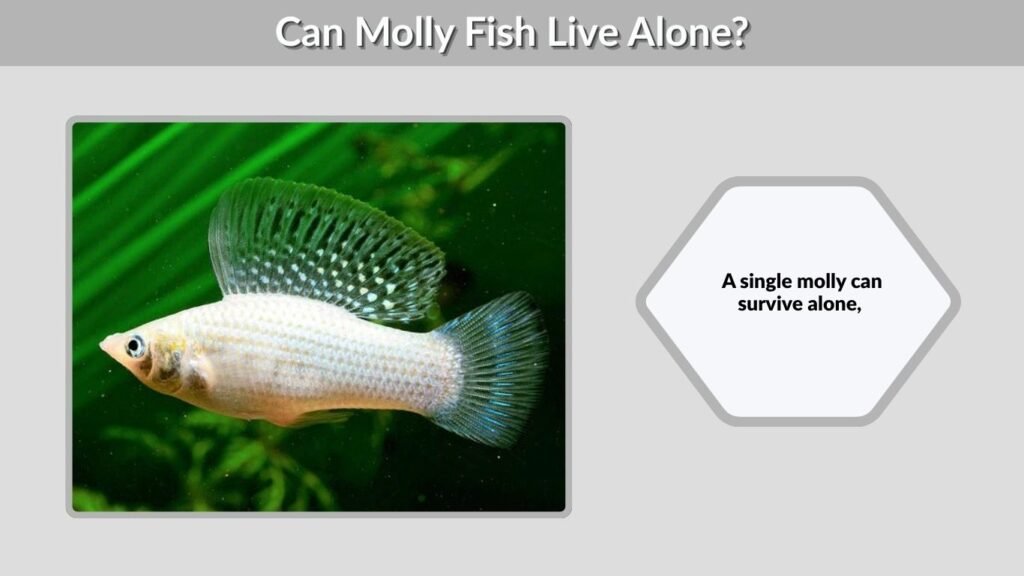
A single molly can survive alone, but mollies are social fish and usually behave more naturally when kept with compatible companions. A small group also gives owners a better opportunity to observe normal swimming, feeding, and social behavior.
Keeping Mollies in Groups
When keeping males and females together, a common strategy is:
- One male with two or three females
- Provide plenty of swimming space
- Add plants and hiding areas
- Avoid keeping too many males together in a small aquarium
Male mollies frequently pursue females during courtship. Keeping multiple females can distribute this attention and reduce stress on one individual.
An all-female group can also work well.
Can Molly Fish Live in a Bowl or Small Tank?
Mollies should not be kept permanently in traditional fish bowls. Small volumes of water change temperature quickly and allow toxic waste to accumulate rapidly. Mollies are active swimmers and benefit greatly from horizontal swimming space.
Can Molly Fish Live in a 5-Gallon Tank?
A 5-gallon tank is generally too small for adult mollies.
A 10-gallon aquarium is also restrictive for a group, particularly because mollies reproduce readily and create considerable waste.
For most situations, starting with approximately 20 gallons or more provides much greater stability and swimming room. Sailfin Mollies particularly benefit from larger aquariums.
Can Molly Fish Live Without a Filter or Oxygen Pump?
Mollies need oxygenated, clean water, but an air pump and a filter perform different jobs. A filter is far more important because it provides biological filtration that helps process toxic fish waste.
Filter, Oxygen and Air Pumps
Mollies should normally be kept with:
- An established aquarium filter
- Adequate water movement
- Good surface agitation
- Regular water changes
- Suitable stocking levels
An air pump is not always necessary if the filter creates enough surface movement for gas exchange.
However, mollies cannot live without dissolved oxygen. How quickly fish develop problems in poorly oxygenated water depends on temperature, stocking density, plant activity, and surface movement, so there is no safe fixed period.
Keeping mollies permanently without filtration is risky because ammonia and nitrite can rapidly become dangerous.
Can Molly Fish Live in Cold Water or Saltwater?
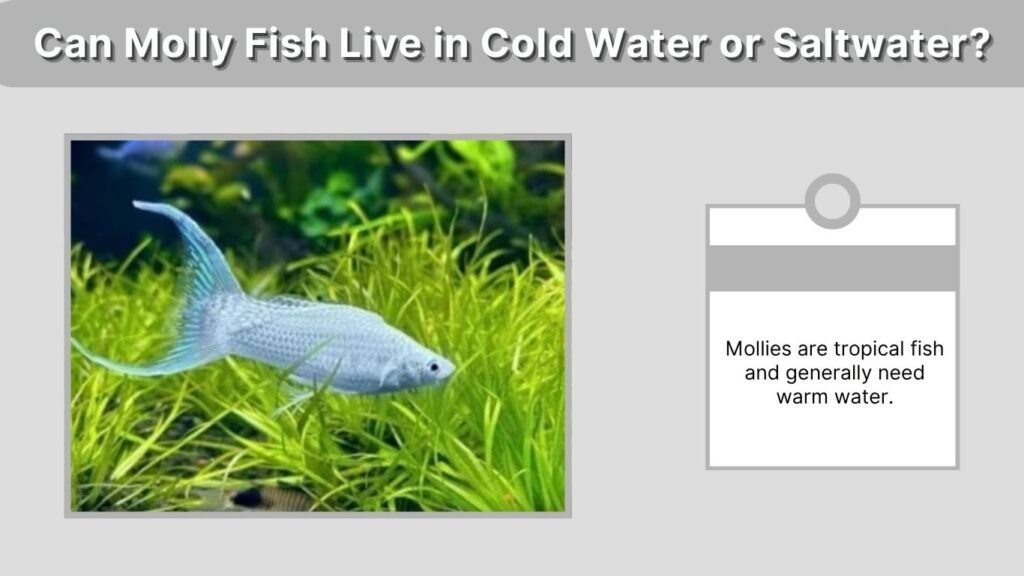
Mollies are tropical fish and generally need warm water. They are also unusual because they can tolerate a broad range of salinities, but that does not mean aquarium mollies automatically require salt.
Freshwater, Brackish and Saltwater
Mollies should normally be maintained in hard freshwater unless the aquarium is specifically designed for brackish or marine conditions.
Some mollies can gradually adapt to brackish water and even marine-level salinity because they are naturally tolerant of changing salinity. However, suddenly moving a freshwater-acclimated molly into saltwater can cause severe stress.
They should also not be treated as cold-water fish. If room temperature cannot consistently maintain an appropriate tropical range, an aquarium heater is recommended.
Are Molly Fish Live-Bearing Fish?
Yes. Mollies are livebearers, meaning females give birth to free-swimming babies instead of laying ordinary external eggs. This reproductive strategy is shared with familiar aquarium fish such as guppies, platies, and swordtails.
Molly Fish Live Birth
A pregnant molly usually carries developing young for approximately four to six weeks, depending on temperature and other conditions.
A female may give birth to dozens of fry at once. Larger, mature females can sometimes produce particularly large broods.
Newborn fry can swim and feed almost immediately. Dense live plants such as Java moss, guppy grass, or floating plants provide hiding areas because adult fish may eat the babies.
Females can also store sperm after mating, meaning one female may produce multiple broods even when a male is no longer present.
FAQs
1. How long can Molly fish live?
Most mollies live around 3–5 years when provided with good genetics, proper food, stable water chemistry, filtration, and enough aquarium space.
2. How long can Molly fish live without food?
A healthy adult molly may survive several days without food, and some can potentially manage around a week. However, intentionally leaving fish unfed for extended periods is not recommended.
3. Can Molly fish live with neon tetras?
They can sometimes coexist peacefully, but their ideal water chemistry differs. Mollies generally prefer harder, more alkaline water, while neon tetras usually favor softer water. Therefore, they are not one of the best combinations.
4. Can Molly fish live with shrimp?
Yes, but there is a risk. Adult shrimp may coexist with mollies, while small shrimp and newly hatched shrimplets can be eaten. Dense plants and hiding places improve the shrimp’s chances of survival.
5. Do Molly fish give live birth?
Yes. Mollies are live-bearing fish. Females retain developing young inside their bodies and give birth to free-swimming fry rather than laying typical aquarium fish eggs.