
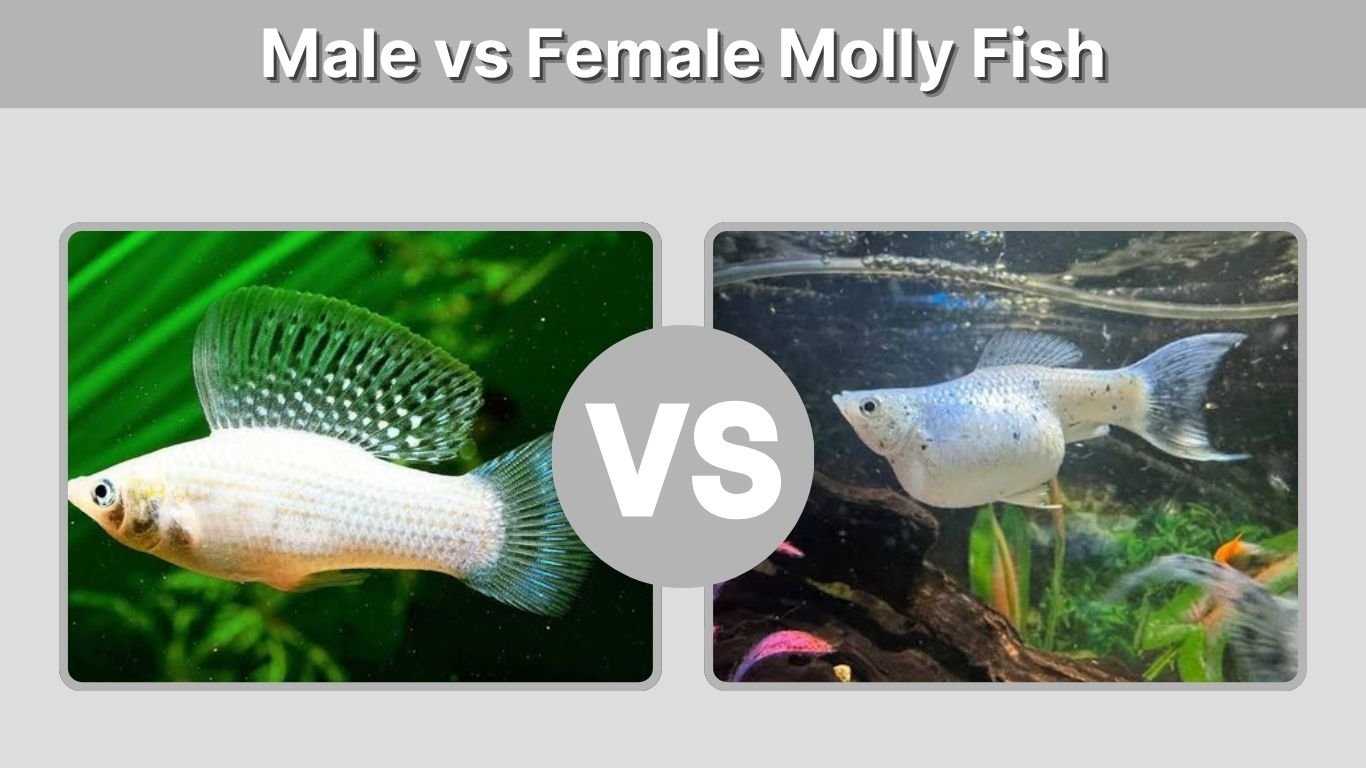
Male and female molly fish may look similar at first, but several physical and behavioral traits make them easy to tell apart. The most reliable difference is the anal fin: males have a narrow, pointed gonopodium, while females have a broad, fan-shaped anal fin. Females are also usually larger and rounder, especially when pregnant, while males tend to be slimmer and more active around potential mates. Understanding these differences helps with breeding, choosing tank ratios, identifying pregnancy, and reducing aggression in a community aquarium.
Male vs Female Molly Fish: Quick Comparison
The easiest way to determine whether a molly fish is male or female is to examine its anal fin and overall body shape. Adult mollies become easier to sex as they mature, while juveniles can be more difficult to identify accurately.
| Feature | Male Molly Fish | Female Molly Fish |
| Anal fin | Pointed gonopodium | Fan-shaped anal fin |
| Body size | Usually smaller | Usually larger |
| Body shape | Slimmer | Fuller and rounder |
| Behavior | More active and persistent | Usually calmer |
| Dorsal fin | Often larger | Often smaller |
| Pregnancy | Cannot become pregnant | Can carry and give birth to fry |
| Breeding role | Fertilizes female | Gives birth to live fry |
1. Anal Fin Is the Best Way to Tell Male vs Female Molly Fish
The anal fin is the most reliable feature for identifying the sex of an adult molly. It is located underneath the fish, behind the belly and before the tail.
Male Molly Fish Anal Fin
Male mollies have a modified anal fin known as a gonopodium. Instead of looking like a normal fan-shaped fin, it appears narrow, elongated, and pointed.
The gonopodium is used to transfer sperm to the female during mating. Once this structure is clearly developed, identifying an adult male is usually straightforward.
Female Molly Fish Anal Fin
Female mollies have a broad, triangular or fan-shaped anal fin. It spreads outward instead of pointing backward like the male gonopodium.
Checking this fin is generally more accurate than relying on color, body size, or behavior alone.
2. Female Mollies Are Usually Larger Than Males
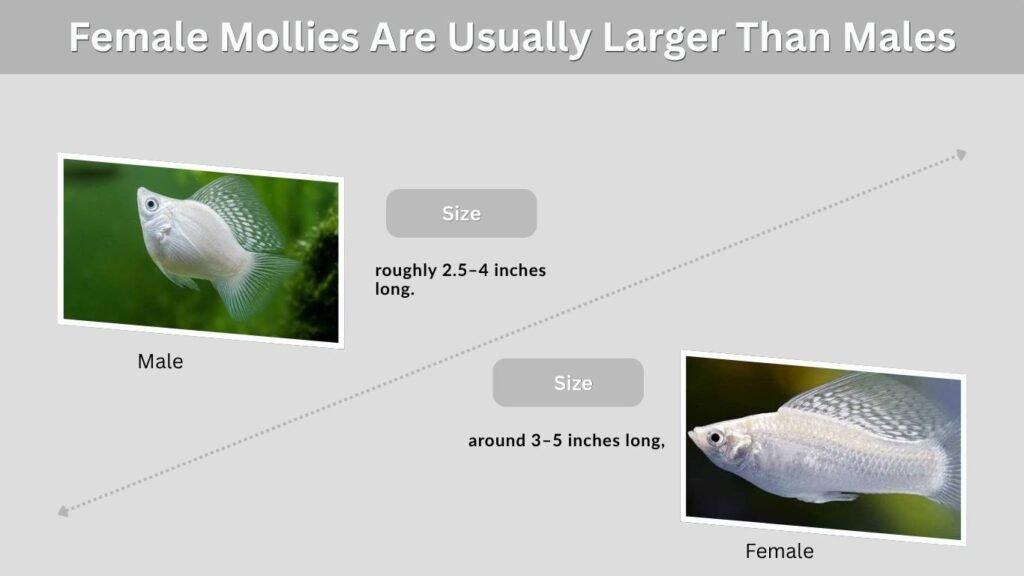
Body size can also help distinguish male and female molly fish, although size alone should not be used for identification.
Male Molly Fish Size
Males are generally smaller, slimmer, and more streamlined. Depending on the molly variety, a mature male may reach roughly 2.5–4 inches long.
They often maintain a narrow body even when well-fed.
Female Molly Fish Size
Females are usually larger and heavier-bodied. Many mature females grow around 3–5 inches long, although exact size depends on the variety, genetics, and aquarium conditions.
Their larger body provides space for developing fry during pregnancy.
3. Male vs Female Molly Fish Body Shape
Body shape becomes particularly useful when observing mature fish side by side. Females generally appear wider through the abdomen, while males remain relatively slender.
Male Body Shape
Male mollies normally have:
- Slimmer abdomen
- Narrower body
- More streamlined appearance
- Less abdominal expansion
A healthy male may develop a slightly rounded belly after feeding, but he should not develop the broad pregnancy-related abdomen seen in females.
Female Body Shape
Adult females naturally have fuller bodies. Their abdomen becomes especially noticeable when they are carrying developing fry.
As birth approaches, a pregnant female’s belly may become very large and sometimes appear slightly squared near the rear.
4. Male and Female Molly Fish Behavior
Behavior provides additional clues, especially in groups containing several adult mollies. However, behavior varies between individuals and should be combined with physical identification.
Male Molly Fish Behavior
Males are often more energetic around females. They may repeatedly follow them through the aquarium and attempt to position their gonopodium during mating.
Males may also chase other males, especially when competing for females.
Typical male behavior includes persistent following, displaying, short chases, and increased activity around female mollies.
Female Molly Fish Behavior
Females are often somewhat calmer, although they remain active community fish.
Pregnant females may behave differently. Near birth, a female may spend more time around plants, decorations, or quieter sections of the aquarium.
If males constantly chase her, she may also hide more frequently due to stress.
5. Male vs Female Molly Fish Dorsal Fin

The dorsal fin can sometimes help identify males, particularly in sailfin molly varieties.
Male mollies frequently develop larger and more impressive dorsal fins. Mature male sailfin mollies may raise their fins during courtship or when displaying toward rivals.
Females usually have smaller or less dramatic dorsal fins.
However, fin appearance varies among black mollies, dalmatian mollies, balloon mollies, lyretail mollies, and other selectively bred varieties. Therefore, the anal fin remains a more dependable indicator.
6. Male vs Female Molly Fish During Breeding
Mollies are livebearing fish, meaning females give birth to free-swimming babies rather than depositing eggs in the aquarium.
How Male Mollies Mate
The male uses his gonopodium to transfer sperm to the female during brief mating attempts.
Male mollies can be persistent breeders and may repeatedly chase females throughout the day. This is one reason keeping an appropriate male-to-female ratio is important.
How Female Mollies Reproduce
After mating, the female carries developing fry inside her body. Pregnancy commonly lasts approximately four to six weeks, depending on water temperature, health, age, and other conditions.
Females can also store sperm after mating. As a result, a female may produce multiple broods even when she is no longer housed with a male.
How to Tell if a Female Molly Fish Is Pregnant

Pregnancy is another clear indication that a mature molly is female. However, beginners sometimes confuse a well-fed or bloated fish with a pregnant female.
Common signs of pregnancy include:
- Enlarging abdomen
- Increasingly rounded body
- Squarer belly near birth
- Increased hiding
- Changes in appetite
- Spending time near plants
- Reduced activity shortly before delivery
A gravid spot may also become noticeable near the rear of the abdomen in some light-colored mollies. It can be difficult to see in black mollies because their dark pigmentation hides the area.
Black Molly Fish Male vs Female
Black mollies can be slightly harder to sex using coloration because both males and females may be almost completely black.
The anal fin remains the easiest identification method.
A male black molly has a pointed gonopodium, while a female black molly has a broad, fan-shaped anal fin. Females also tend to have larger, rounder bodies.
Pregnancy can be more difficult to recognize in black mollies because the gravid spot is usually hidden by their dark coloration. Instead, watch for increasing belly size and changes in body shape.
Dalmatian Molly Fish Male vs Female
Male and female dalmatian mollies can also be identified primarily by their anal fins.
Male dalmatian mollies have a narrow gonopodium and often appear slimmer. Females have a fan-shaped anal fin and generally develop a broader abdomen.
The black-and-white spotted coloration itself does not reliably indicate sex. Both males and females can have similar patterns.
During pregnancy, female dalmatian mollies may develop a noticeably enlarged abdomen, making sex identification easier.
How Many Male and Female Mollies Should You Keep?

Maintaining the correct sex ratio can reduce stress and excessive mating behavior.
A commonly recommended arrangement is approximately one male for every two or three females.
Keeping one male with several females spreads his attention among multiple fish instead of allowing him to continuously chase one female.
Avoid keeping several males with only one female, particularly in a small aquarium. The female may experience constant harassment and stress.
Multiple males can sometimes live together successfully when the tank is spacious, there are enough females, and plants or decorations provide visual barriers.
Can You Keep Only Male or Only Female Mollies?
Yes, same-sex groups can sometimes work well.
An all-female group usually avoids most mating-related chasing, although females purchased from stores may already be pregnant or may have stored sperm.
An all-male group can also work, but males may establish dominance and chase each other. Providing sufficient swimming room, hiding places, and multiple visual barriers can reduce conflict.
Remember that young mollies may be difficult to sex accurately, so a supposedly same-sex group can occasionally contain an incorrectly identified fish.
FAQs
How can I tell if my molly fish is male or female?
Look at the anal fin underneath the fish. A male has a narrow, pointed gonopodium, while a female has a broader, fan-shaped anal fin.
Are female mollies bigger than males?
Usually, yes. Adult females are generally larger, wider, and more rounded than males, particularly when pregnant.
Can female mollies give birth without a male in the tank?
Yes. Female mollies can store sperm from previous mating and may produce several broods after being separated from males.
Are male mollies more aggressive than females?
Males are often more persistent and may chase females or compete with other males. Serious aggression is less likely when the aquarium is spacious and the sex ratio is appropriate.
What is the best male-to-female molly ratio?
A ratio of about one male to two or three females is commonly recommended. This helps distribute mating attention and reduces stress on individual females.