
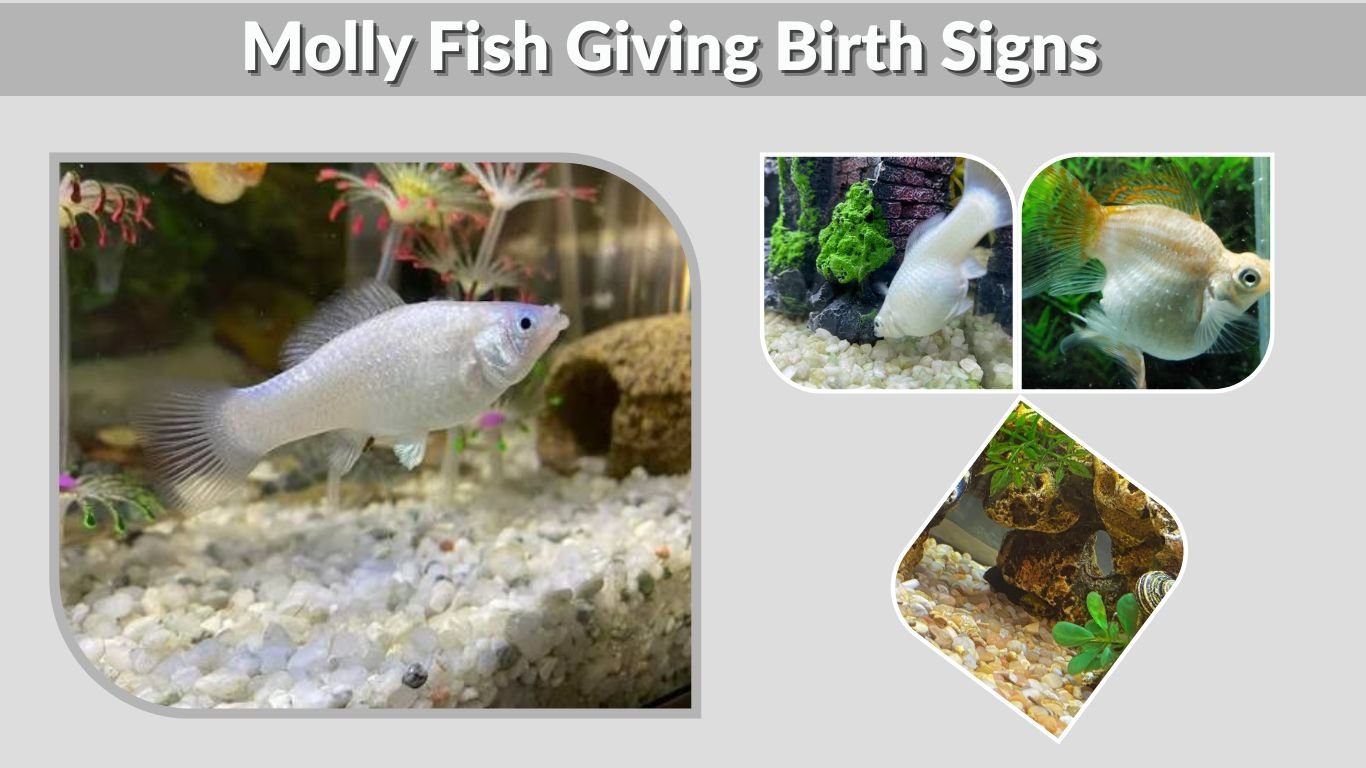
Molly fish are livebearers, so pregnant females give birth to free-swimming fry instead of laying eggs. As delivery approaches, a pregnant molly often shows noticeable changes in body shape, appetite, activity, and social behavior. Her belly may become larger and more squared, she may hide around plants, and she may separate herself from other fish. Recognizing these molly fish giving birth signs can help you prepare a safe environment, reduce stress on the mother, and improve the survival rate of newborn fry.
10 Common Molly Fish Giving Birth Signs

The signs of labor are not exactly the same in every molly. Some females continue swimming and eating normally until shortly before birth, while others become noticeably withdrawn. Watching several signs together is more reliable than relying on one behavior alone.
1. Belly Becomes Large and Square
One of the clearest signs that a molly is approaching delivery is a change in belly shape.
Earlier in pregnancy, the abdomen usually looks rounded. As the fry develop and birth gets closer, the rear portion of the belly may appear more boxy or squared-off.
This squared appearance is often easier to recognize when viewing the fish from the side.
A large belly alone does not guarantee that birth is imminent, because overeating, constipation, or illness can also cause abdominal swelling. Pregnancy should be confirmed by considering body shape together with other signs.
2. She Starts Hiding More Often
A pregnant molly may begin spending more time in quiet sections of the aquarium.
She may hide:
- Behind plants
- Near decorations
- Around rocks
- In aquarium corners
- Close to floating plants
This behavior can become more noticeable as labor approaches.
Providing natural hiding places is better than repeatedly moving the fish, because frequent handling can increase stress.
3. The Female Separates From Other Fish
A female nearing birth may stop swimming with the rest of the group and isolate herself.
She may choose a sheltered area where other fish do not constantly approach her. This can be especially noticeable if she is normally social and suddenly becomes withdrawn.
Isolation combined with a large, squared belly can indicate that delivery is getting close.
4. Appetite May Decrease
Pregnant mollies generally continue eating during much of their pregnancy. However, some females show less interest in food shortly before giving birth.
A molly that normally rushes toward food may:
- Eat smaller amounts
- Ignore certain foods
- Approach food and swim away
- Stop eating temporarily
A brief appetite change near delivery can be normal. However, prolonged refusal to eat can also be associated with stress, poor water conditions, or illness.
5. She Becomes Restless
Some mollies become restless rather than inactive.
The female may swim repeatedly between different areas of the tank, move up and down the glass, or frequently change hiding spots.
She may appear unable to settle in one location.
Restlessness can occur as she searches for a quiet place to release her fry.
6. She May Stay Near the Bottom
A pregnant molly close to labor sometimes spends more time resting or hovering near the bottom of the aquarium.
She may remain behind decorations or plants with limited movement.
However, sitting on the bottom is not always a pregnancy sign. Poor water quality, low oxygen, temperature problems, and disease can cause similar behavior.
If several fish are staying at the bottom or breathing rapidly, check the aquarium conditions immediately.
7. Gravid Spot May Become More Noticeable
The gravid spot is a darker area near the rear of a female livebearer’s abdomen, close to the anal fin.
In lighter-colored mollies, the spot may become darker or more noticeable as pregnancy progresses.
It can sometimes appear especially pronounced shortly before delivery.
However, the gravid spot is much harder to see in darker varieties such as black mollies. In these fish, belly shape and behavior are usually more useful indicators.
8. Reduced Activity
Some pregnant mollies become less active shortly before giving birth.
Instead of constantly exploring the aquarium, the female may hover quietly near plants or stay in one location for extended periods.
Reduced activity can occur because her enlarged abdomen makes swimming more difficult and because she may be preparing for labor.
9. Rapid or Unusual Breathing
A female may occasionally breathe somewhat faster during the final stages of pregnancy.
Labor can be physically demanding, so temporary changes may occur around delivery.
However, persistent rapid breathing should never automatically be assumed to be a pregnancy sign. Ammonia, nitrite, inadequate oxygen, stress, and illness can also cause heavy breathing.
Check water quality if breathing appears abnormal.
10. Repeated Body Contractions
When actual birth begins, you may notice subtle contractions or body movements.
The female may briefly stiffen, shake, or make short movements as fry are delivered.
Mollies generally release babies gradually rather than producing the entire brood at exactly the same moment.
Once you see fry swimming around the aquarium, delivery is underway or has recently occurred.
How Long Are Molly Fish Pregnant Before Giving Birth?

Molly pregnancy commonly lasts around four to six weeks, although the exact period can vary.
Water temperature, genetics, female age, health, and environmental conditions may influence gestation length.
It can also be difficult to determine the exact start of pregnancy because female mollies can store sperm after mating.
This means a female may give birth even if no male is currently present in the aquarium.
What to Do When a Molly Fish Is About to Give Birth
Preparing the tank before labor can reduce stress and give newborn fry better protection.
Provide Plenty of Hiding Places
Dense live plants are one of the easiest ways to protect newborn mollies.
Floating plants, mosses, and fine-leaved plants give fry places where adult fish cannot easily reach them.
Artificial plants can also provide shelter when live plants are unavailable.
Keep Water Conditions Stable
Avoid major changes immediately before delivery.
Maintain stable temperature and clean water, and make sure ammonia and nitrite remain at safe levels.
Sudden temperature or chemistry changes can stress an already heavily pregnant female.
Avoid Constantly Moving the Female
Moving a pregnant molly repeatedly between tanks or containers can create unnecessary stress.
If you plan to use a separate maternity aquarium, it is generally better to prepare it in advance rather than moving the female at the last possible moment.
Protect the Fry After Birth
Adult mollies, including the mother, may eat newborn fry.
If you want to raise a large number of babies, provide dense cover or move the fry to a properly cycled nursery tank after birth.
Black Molly Fish Giving Birth Signs

Giving birth signs in black mollies are generally the same as in other molly varieties, but some visual clues can be harder to see.
Because of their dark coloration, the gravid spot may be nearly invisible.
Instead, watch for:
- A noticeably enlarged abdomen
- Squared belly near the rear
- Increased hiding
- Separation from tank mates
- Reduced appetite
- Restlessness
- Quiet behavior shortly before delivery
Observing the female’s body from the side can make the changing belly shape easier to recognize.
Balloon Molly Fish Giving Birth Signs
Pregnancy can be particularly difficult to judge in balloon mollies because they naturally have short, rounded bodies.
Rather than relying only on abdominal size, look for behavioral changes.
A pregnant balloon molly close to birth may hide more frequently, isolate herself, become restless, eat less, or spend more time in sheltered areas.
Her abdomen may still become noticeably fuller, but the characteristic squared appearance can be less obvious than in standard-bodied mollies.
Dalmatian Molly Fish Giving Birth Signs
Dalmatian mollies usually show the same pregnancy and labor signs as other mollies.
Their lighter coloration may make the gravid area somewhat easier to notice in some individuals.
Watch for increasing abdominal size, a more squared belly, hiding behavior, reduced appetite, and separation from other fish.
Because dalmatian coloration varies widely, the gravid spot should not be used as the only indicator.
How Many Babies Do Molly Fish Give Birth To?

A female molly may produce anywhere from a relatively small brood to dozens of fry in a single pregnancy.
Larger, mature females often produce more fry than young females experiencing their first pregnancies.
Brood size is influenced by age, health, genetics, species, body size, and environmental conditions.
Some babies may be eaten quickly in a community aquarium, which can make the original brood appear smaller than it actually was.
Signs That a Molly Fish Has Finished Giving Birth
After delivery, the female’s abdomen usually becomes noticeably smaller.
She may gradually resume normal swimming and feeding behavior.
Signs that birth has finished can include:
- Reduced belly size
- No additional contractions
- Return of normal swimming
- Renewed interest in food
- Less hiding or restlessness
Delivery may occur over a period of time, so avoid assuming labor is finished immediately after seeing the first few fry.
FAQs
What is the clearest sign a molly fish is about to give birth?
A very large belly that becomes more squared toward the rear is one of the most useful physical signs, especially when combined with hiding and behavioral changes.
Do molly fish stop eating before giving birth?
Some females eat less or temporarily lose interest in food shortly before delivery, although others continue eating normally.
Do pregnant mollies hide before giving birth?
Yes. Many females seek quiet areas near plants, decorations, or aquarium corners as labor approaches.
Can a black molly’s gravid spot be seen?
It is often difficult to see because black pigmentation hides the darker gravid area. Belly shape and behavior are usually more reliable signs.
How long does it take a molly fish to give birth?
The actual delivery period varies. Some females release fry relatively quickly, while others may deliver babies gradually over several hours.