
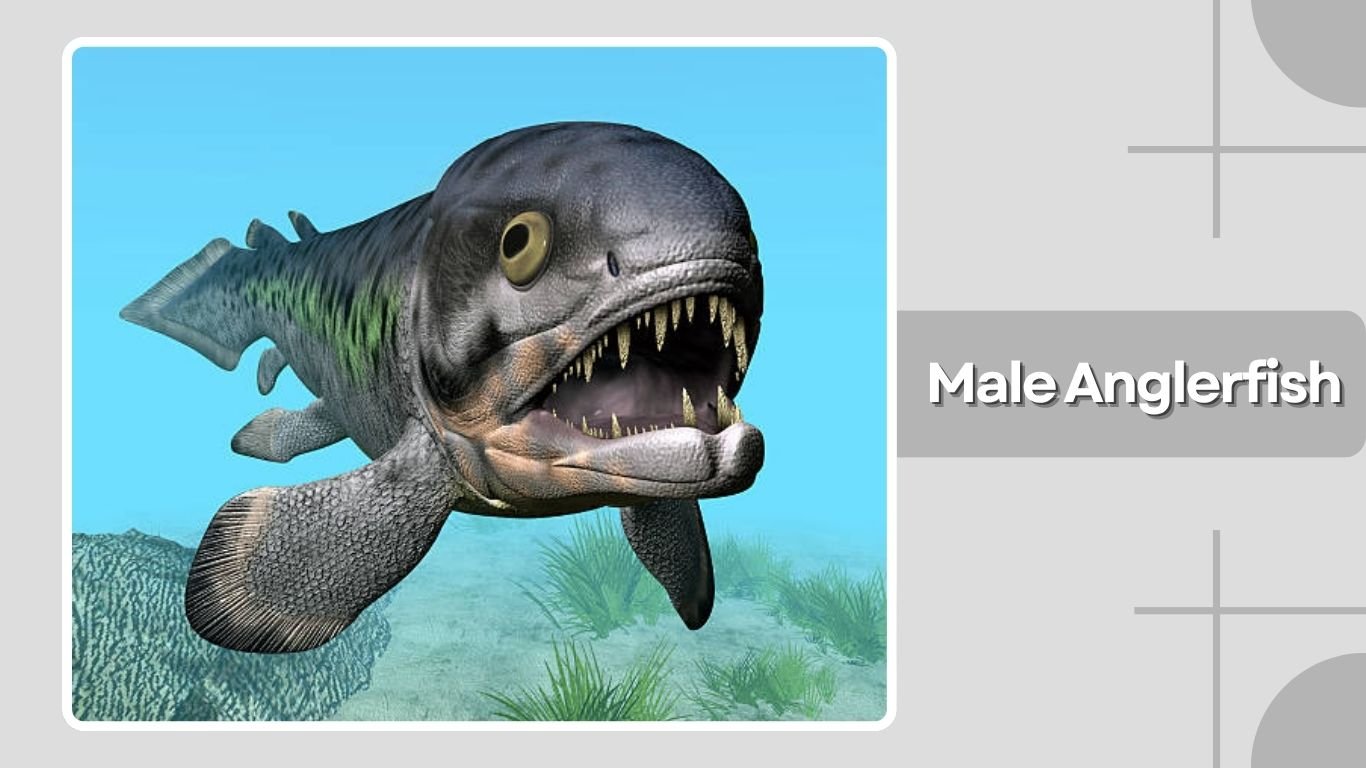
Male anglerfish are among the most unusual animals living in the deep ocean. Unlike the large, toothy females commonly shown in photographs, males of many deep-sea species are tiny and lack the famous glowing lure. Their main biological purpose is to locate a female in the darkness and reproduce. In some species, the male temporarily bites the female, while in others, his body permanently fuses with hers. This remarkable reproductive strategy helps anglerfish survive where finding a mate can be extremely difficult.
What Does a Male Anglerfish Look Like?
A male deep-sea anglerfish usually looks very different from a mature female. Instead of having a large mouth, rounded body, sharp teeth, and glowing lure, the male tends to have a smaller and more streamlined body.
Many males possess relatively well-developed sensory organs that help them search for females in the vast deep-sea environment. Their appearance may vary between species, but their reproductive role is generally more important than their ability to capture large prey.
Male Anglerfish Identification
Common characteristics of a male deep-sea anglerfish include:
- A body significantly smaller than the female’s
- No glowing fishing-rod-like lure
- A relatively streamlined shape
- Sensory organs adapted for finding females
- Jaws and teeth capable of gripping a mate
- Reproductive organs that mature at a small body size
It is important to understand that extreme differences between the sexes are primarily associated with deep-sea ceratioid anglerfish. Many shallow-water anglerfish, including frogfish and goosefish, do not follow the same permanent attachment strategy.
Male vs Female Anglerfish
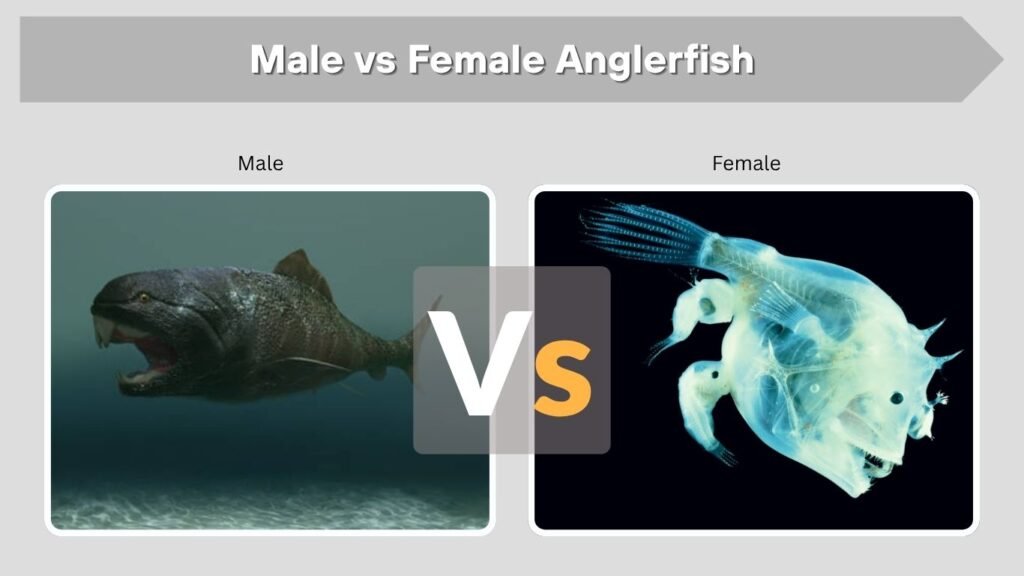
Male and female deep-sea anglerfish can look so different that early scientists sometimes believed they were separate kinds of animals. The female is built to hunt, eat, grow, and produce eggs, while the male is specialized mainly for locating and fertilizing a female.
| Feature | Male Anglerfish | Female Anglerfish |
| Body size | Very small in many species | Much larger |
| Glowing lure | Generally absent | Present in many deep-sea species |
| Main role | Finding a mate and supplying sperm | Hunting, growing, and producing eggs |
| Feeding | May feed independently before attachment | Captures prey with its lure and mouth |
| Mating behavior | May bite, attach, or fuse | Carries attached male in some species |
| Appearance | Slimmer and less threatening | Large mouth, teeth, and rounded body |
The dramatic size and appearance differences are known as sexual dimorphism. In some deep-sea species, a mature male may measure only a few centimeters, while the female can be many times larger.
How Big Is a Male Anglerfish?
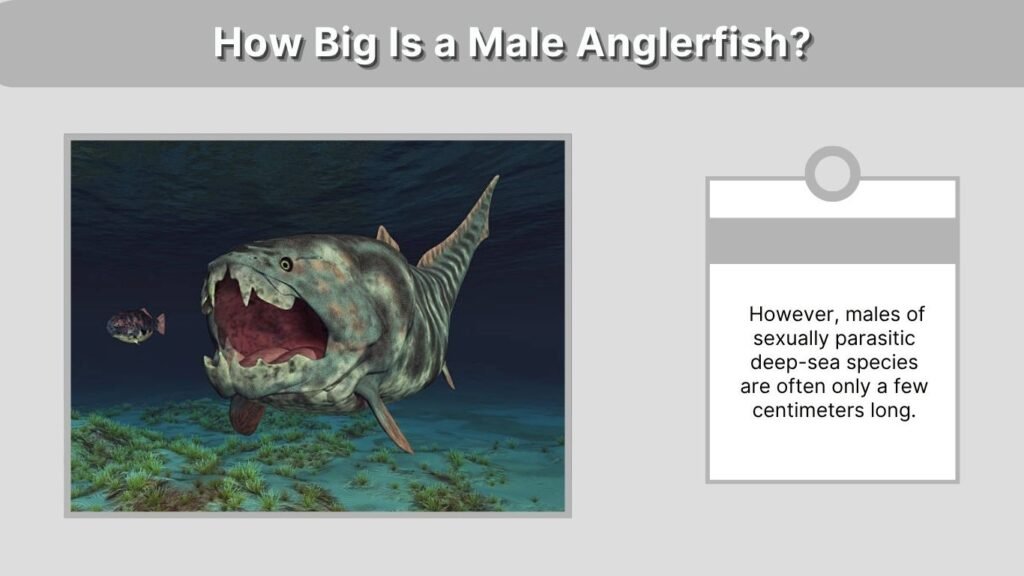
There is no single size for every male anglerfish because the anglerfish group contains hundreds of species. However, males of sexually parasitic deep-sea species are often only a few centimeters long.
Some sources describe males as roughly one-tenth the size of females. The exact difference depends on the species, age, and reproductive system. A free-swimming male must be large enough to locate a female but small enough to survive while using limited food and energy.
Why Are Male Anglerfish So Small?
Their small size is closely connected to life in the deep sea. Food and potential mates can be widely scattered, making it inefficient for both sexes to develop large, energy-demanding bodies.
The female needs a larger body to capture prey and produce eggs. The male mainly needs to mature, swim through the water, identify a compatible female, and provide sperm. Remaining small reduces the energy he requires and makes permanent attachment less physically demanding for the female.
Do Male Anglerfish Have a Light?
Male deep-sea anglerfish generally do not possess the glowing lure seen on females. The light-producing structure is called an esca and is located at the end of a modified dorsal spine known as the illicium.
Females use this structure to attract prey toward their mouths. In some species, bacteria living inside the esca produce the light. Because males are not built to capture large prey in the same manner, they lack this elaborate fishing apparatus.
Male anglerfish should not be confused with lanternfish. Lanternfish are a separate group of small deep-sea fish that have light-producing organs along their bodies.
How Does a Male Anglerfish Find a Female?
Finding a mate may be one of the greatest challenges faced by a male anglerfish. The deep ocean is enormous, dark, and sparsely populated, so males cannot depend on frequent encounters.
Researchers believe that males use highly developed sensory abilities to locate females. A strong sense of smell may help them detect chemical signals released into the water. Their swimming ability and sensory adaptations allow them to search across considerable distances.
Once a male encounters a suitable female, he may bite her skin and hold on. What happens afterward depends on the species.
Why Do Male Anglerfish Attach to Females?
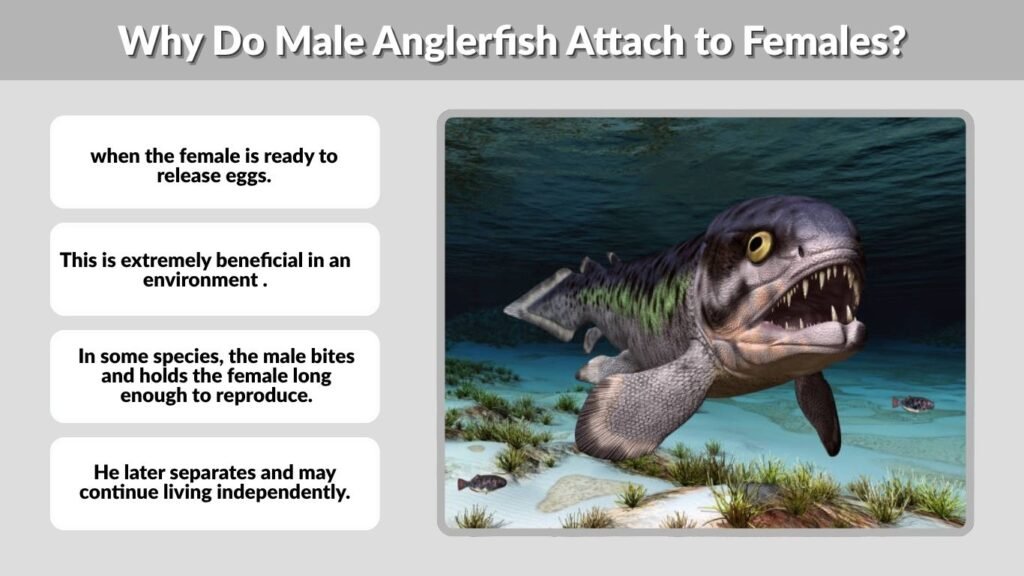
Attaching to a female ensures that the pair will remain together when the female is ready to release eggs. This is extremely beneficial in an environment where the same two fish might never encounter each other again.
There are several mating arrangements among deep-sea anglerfish:
Temporary Attachment
In some species, the male bites and holds the female long enough to reproduce. He later separates and may continue living independently.
Facultative Parasitism
A male may attach for an extended period, but attachment is not necessarily required for every individual to survive or reproduce.
Permanent Fusion
In species with permanent sexual parasitism, the male’s tissues gradually join with the female’s body. Their circulatory systems become connected, allowing him to receive nutrients from her bloodstream.
Permanent attachment is therefore not a feature of every anglerfish. It occurs within particular lineages of deep-sea ceratioid anglerfish.
What Happens When a Male Fuses With a Female?
The male begins the process by biting the female. Over time, the tissues around the attachment point grow together. Their skin and blood vessels connect, creating a shared circulatory relationship.
As the fusion progresses, the male becomes dependent on the female for oxygen and nutrients. In permanently parasitic species, some of his organs and independent bodily functions may deteriorate. However, his reproductive tissue remains active, allowing him to supply sperm when the female produces eggs.
This joining of two genetically different individuals presents an unusual immune-system challenge. Research indicates that sexually parasitic anglerfish have evolved major changes in immune functions that would normally cause one animal’s body to reject another animal’s tissue.
Can Multiple Males Attach to One Female?
Females of some anglerfish species can carry more than one male. Each attached male may remain reproductively functional and participate in multiple spawning events.
Having several males available increases the likelihood that the female’s eggs will be fertilized whenever conditions are suitable. However, the number of attached males varies between individuals and species, and many females carry only one or none.
Do Male Anglerfish Die After Mating?
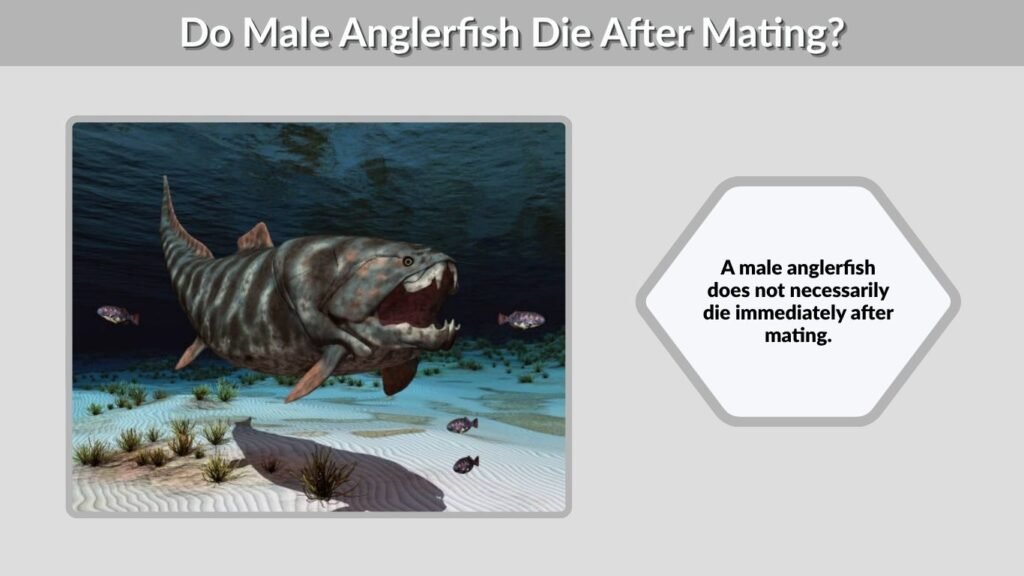
A male anglerfish does not necessarily die immediately after mating. In species that reproduce through temporary attachment, the male may release the female and continue swimming independently.
In permanently parasitic species, the male remains alive as part of the reproductive partnership. He becomes physically dependent on the female and may remain functional for multiple spawning events. Therefore, describing the male as being “eaten” or instantly killed by the female is inaccurate.
FAQs
Are male anglerfish parasites?
Males of certain deep-sea species are described as sexual parasites because they permanently attach to females and receive nutrients from their blood. However, not every male anglerfish behaves this way. Some attach temporarily, while males of other anglerfish groups remain completely independent.
Can a male anglerfish live without a female?
A young male lives independently while searching for a mate. In species with permanent fusion, he loses the ability to live separately after becoming fully attached. Males belonging to nonparasitic species can continue feeding and swimming independently throughout their lives.
Does the female anglerfish absorb the male?
The female does not digest the male as food. Instead, their tissues and blood vessels gradually connect. The male becomes physically dependent on her while retaining functioning reproductive tissue that can provide sperm during future spawning events.
How many males can attach to a female anglerfish?
The number varies by species and individual. Some females have one attached male, while others may carry several. Multiple attachments give a female access to sperm when she releases eggs, which can improve reproductive success in the sparsely populated deep sea.
Is the famous anglerfish usually male or female?
The large, frightening anglerfish commonly shown with sharp teeth and a glowing lure is female. Males are generally much smaller and lack the recognizable luminous fishing rod used by females to attract prey.