
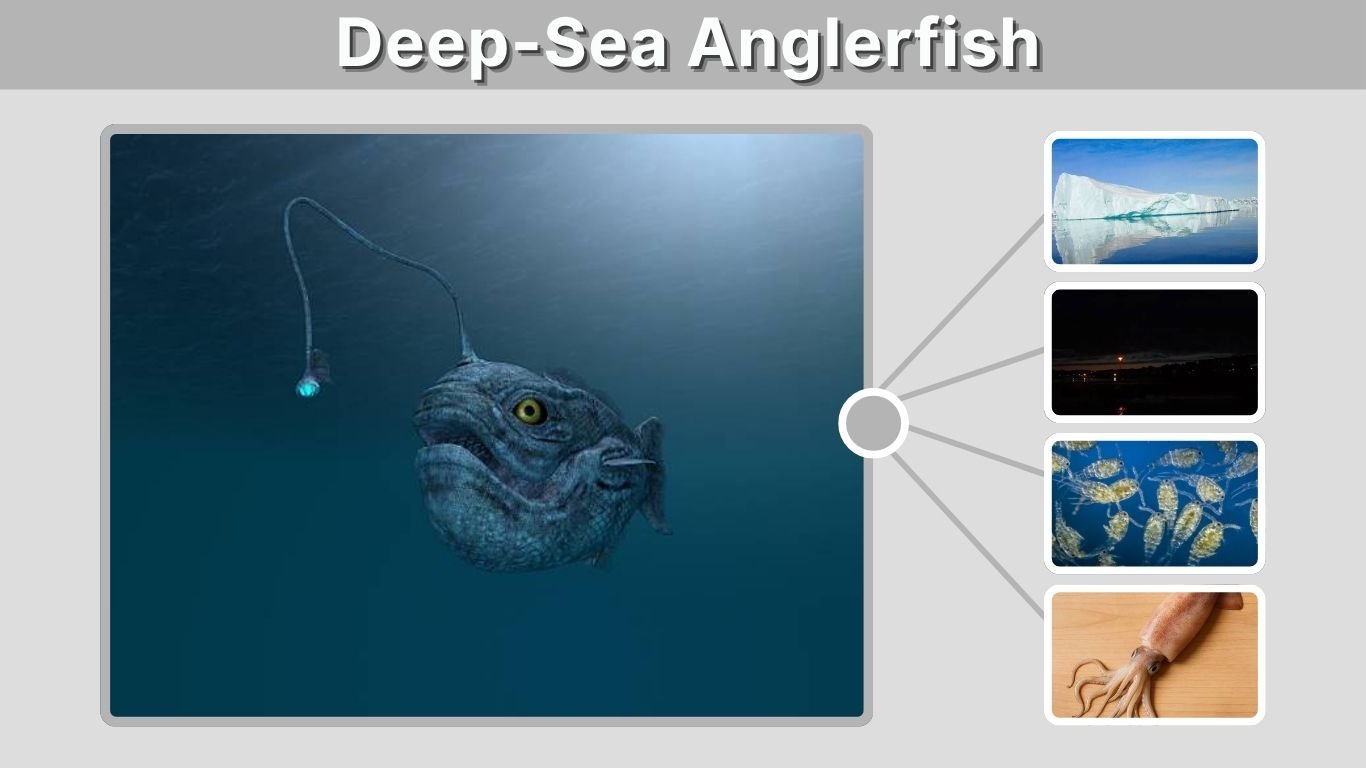
The deep-sea anglerfish is famous for its enormous mouth, needle-like teeth, dark body, and glowing lure. However, the name does not describe one species. It refers to a diverse group of anglerfishes adapted to the cold, dark waters far below the ocean’s surface. Most are much smaller than movies suggest, and their unusual appearance helps them conserve energy, capture scarce prey, and find mates in one of Earth’s most challenging habitats.
Deep-Sea Anglerfish Quick Facts
| Feature | Information |
| Scientific group | Ceratioidei |
| Order | Lophiiformes |
| Habitat | Deep waters of every ocean |
| Typical depth | Commonly hundreds to thousands of meters |
| Diet | Small fish and crustaceans |
| Main adaptation | Bioluminescent fishing lure |
| Female size | Usually larger than males |
| Male size | Often only a few centimeters |
| Danger to humans | No meaningful threat |
| Lifespan | Not well established |
What Is a Deep-Sea Anglerfish?
“Deep-sea anglerfish” generally refers to the specialized anglerfishes classified within Ceratioidei. They belong to the order Lophiiformes, which also includes shallow-water frogfishes, handfishes, batfishes, goosefishes, and sea toads.
There is therefore no single scientific name for every deep-sea anglerfish. Well-known species include:
- Black seadevil — Melanocetus johnsonii
- Krøyer’s deep-sea anglerfish — Ceratias holboelli
- Fanfin seadevil — Caulophryne jordani
- Common black devil — Melanocetus murrayi
- Triplewart seadevil — Cryptopsaras couesii
These fishes vary considerably in size and appearance, but females commonly have rounded bodies, large mouths, long teeth, and a modified dorsal spine used as a fishing rod.
Where Do Deep-Sea Anglerfish Live?
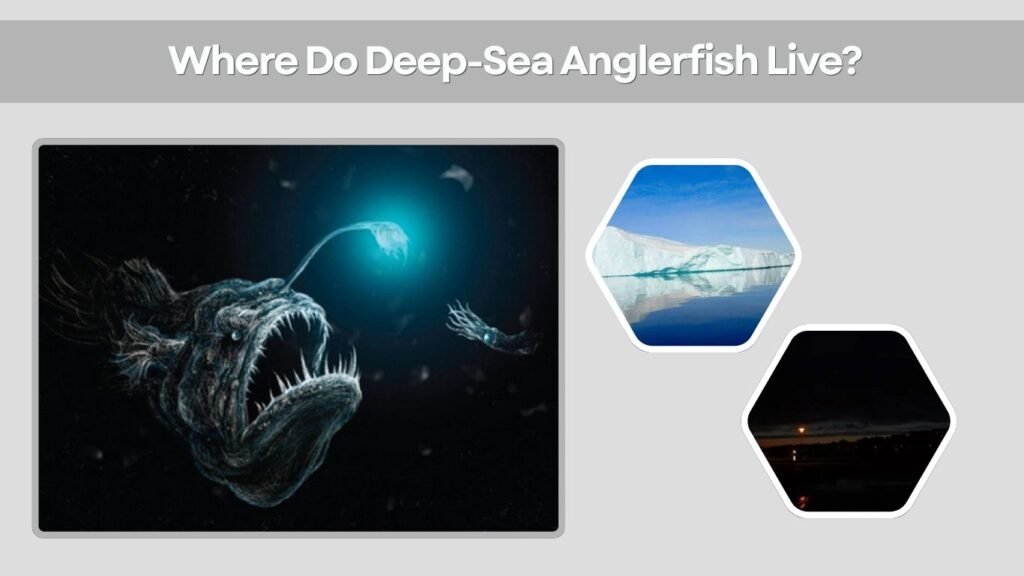
Deep-sea anglerfishes occur in oceans worldwide. Many live suspended in the water column rather than resting on the ocean floor. They occupy mesopelagic and bathypelagic zones where sunlight is weak or completely absent.
How Deep Do They Live?
Depth varies among species. Many are encountered several hundred to several thousand meters below the surface. The black seadevil, for example, has been recorded from approximately 100 to 4,500 meters, although it is more commonly associated with depths between about 100 and 1,500 meters.
At these depths, anglerfish face:
- Near-total darkness
- Cold temperatures
- Enormous water pressure
- Limited food
- Few opportunities to encounter mates
Their soft bodies, slow movements, sensitive sensory organs, and efficient hunting strategies allow them to survive without wasting much energy.
How Big Is a Deep-Sea Anglerfish?
Most deep-sea anglerfish are considerably smaller than their frightening appearance suggests. Most are less than one foot long, although a few species can reach approximately one meter or more.
Actual Size of Different Species
Female black seadevils are often only about the size of a grapefruit or smaller. The individual filmed by MBARI in Monterey Canyon measured approximately nine centimeters long.
Krøyer’s deep-sea anglerfish is one of the largest species. Female Ceratias holboelli have a reported maximum total length of approximately 1.2 meters, although a more common recorded female length is around 77 centimeters. Free-swimming males may measure only about 1.3 centimeters before attachment.
The dramatic photographs commonly seen online are taken at close range. Their sharp teeth and oversized heads can make these fish look several feet long even when the animal could fit in a person’s hand.
Why Does an Anglerfish Have a Light?
Female deep-sea anglerfish possess a modified dorsal-fin spine called an illicium. Its glowing tip is known as the esca. Together, these structures function like a fishing rod and bait.
How the Bioluminescent Lure Works
The anglerfish moves its lure near its mouth. A curious fish or crustacean approaches the light, and the anglerfish suddenly opens its large jaws and captures the animal.
In many species, the glow is produced by symbiotic bacteria living inside the esca. The bacteria receive nutrients and shelter, while the fish gains a dependable source of light in a habitat where sunlight cannot reach.
Blue light travels particularly well through seawater, so the lure is usually blue or blue-green. The anglerfish’s dark skin also absorbs light, helping conceal the mouth and body behind the glowing bait.
What Do Deep-Sea Anglerfish Eat?
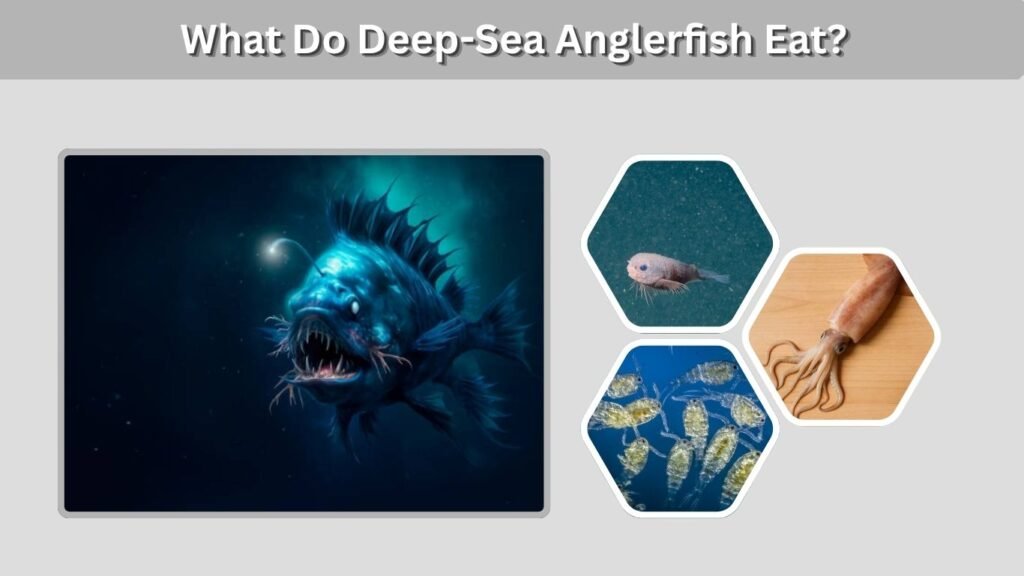
Deep-sea anglerfish are carnivorous ambush predators. Instead of actively chasing prey over long distances, they wait quietly and use their glowing lure to bring food within striking range.
Their diet commonly includes:
- Small deep-sea fish
- Shrimp and other crustaceans
- Squid
- Zooplankton
- Other available midwater animals
When prey approaches, the anglerfish opens its wide mouth and closes its inward-pointing teeth around the victim. The flexible mouth and body allow some species to consume surprisingly large meals. This is valuable in the deep sea, where the next feeding opportunity may not arrive for a long time.
Male vs. Female Deep-Sea Anglerfish
Deep-sea anglerfish display some of the most extreme differences between males and females found among vertebrates.
Female Deep-Sea Anglerfish
The familiar large-mouthed anglerfish shown in photographs is usually female. Females must grow large enough to produce eggs, capture prey, and carry one or more attached males.
They commonly have:
- A glowing lure
- A large head and mouth
- Long, curved teeth
- A rounded or swollen body
- Dark skin
- Relatively small fins
Male Deep-Sea Anglerfish
Males may be dozens of times smaller than females. They generally lack the female’s prominent lure and powerful feeding structures. Instead, they have highly developed sensory organs that help them locate females in the dark.
Male dreamer anglerfish can measure only about 16.5 millimeters. Their small size reduces the amount of food needed while they search through the enormous deep-sea environment for a mate.
How Do Deep-Sea Anglerfish Mate?
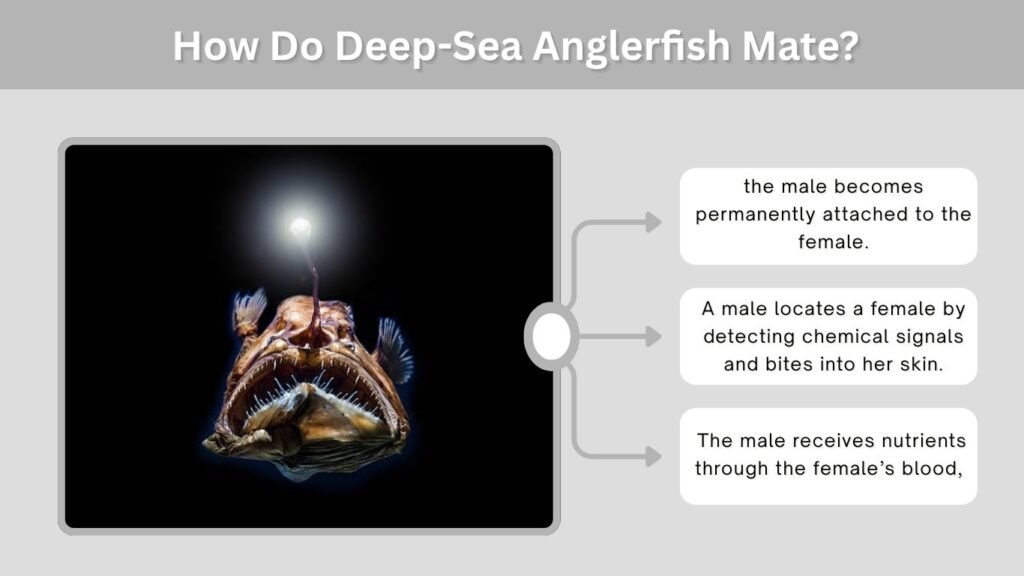
In some—but not all—deep-sea anglerfish species, the male becomes permanently attached to the female.
A male locates a female by detecting chemical signals and bites into her skin. In species with permanent attachment, their tissues and circulatory systems gradually fuse. The male receives nutrients through the female’s blood, while remaining available to supply sperm when she produces eggs.
Over time, the attached male may lose much of his independent function. A single female can sometimes carry multiple males. This arrangement ensures that the pair does not have to find each other again whenever reproduction becomes possible.
However, sexual parasitism should not be applied to every deep-sea anglerfish. Some males attach temporarily, mate without permanent fusion, or use reproductive strategies that remain poorly understood.
Deep-Sea Anglerfish Adaptations
The anglerfish’s strange characteristics are practical adaptations rather than random deformities.
Large Mouth and Teeth
A wide mouth increases the range of prey that can be captured. The long teeth angle inward, reducing the chance that a struggling fish will escape.
Dark Coloration
Black or extremely dark skin makes an anglerfish difficult to detect. It also prevents its own bioluminescent lure from illuminating the rest of its body.
Slow, Energy-Efficient Movement
Food is scarce in the deep sea. Waiting for prey requires less energy than constantly swimming after it. Many anglerfish float quietly and make short movements only when necessary.
Extreme Sexual Dimorphism
Tiny males require fewer resources and are specialized for finding females. Large females have the body capacity needed to feed, carry eggs, and support attached mates.
Pressure-Tolerant Body
Many deep-sea anglerfish have soft, flexible bodies with limited heavy bone and muscle. This structure is suitable for the surrounding pressure but makes them poorly adapted to surface conditions.
How Long Do Deep-Sea Anglerfish Live?
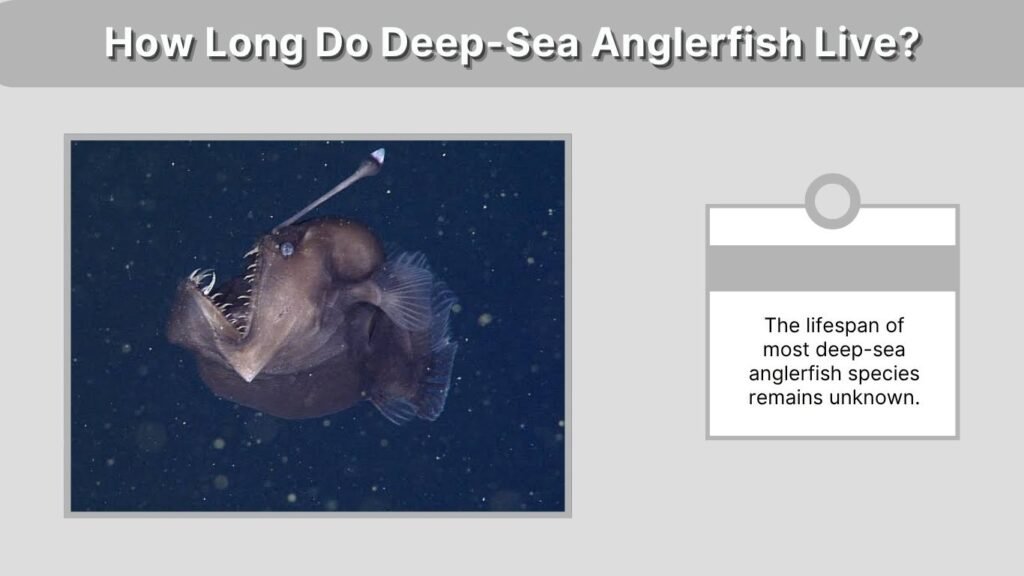
The lifespan of most deep-sea anglerfish species remains unknown. Scientists rarely observe these fish alive, and specimens brought rapidly to the surface are often damaged by changes in pressure and temperature.
Researchers can estimate age in some fish by studying structures such as otoliths, but reliable lifespan information is unavailable for many ceratioids. Claims that every deep-sea anglerfish lives for a specific number of years should therefore be treated cautiously.
Are Deep-Sea Anglerfish Dangerous?
Deep-sea anglerfish are not dangerous to swimmers or divers. Most live far below recreational diving depths, and many are small enough to hold in one hand.
Their teeth are designed for capturing small marine animals, not attacking humans. Even the largest species inhabit environments people cannot enter without specialized submersibles.
Can You Eat Deep-Sea Anglerfish?
The small, pelagic species commonly pictured with glowing lures are not normally harvested as food. They live too deep, occur too unpredictably, and generally have little commercial value.
Monkfish is sometimes sold as “anglerfish” in restaurants and seafood markets, but monkfish belong to a different branch of the anglerfish order. They are large bottom-dwelling fishes harvested for their firm tail meat and should not be confused with black seadevils or other deep-sea ceratioids.
Is the Anglerfish in Finding Nemo Realistic?
The movie’s anglerfish captures several real characteristics, including the glowing lure, sharp teeth, dark habitat, and ambush-feeding behavior. However, its size is heavily exaggerated.
Most deep-sea anglerfish are shorter than 30 centimeters, and some famous black seadevils are only several inches long. A real specimen would be frightening to a tiny fish but would pose no threat to a human.
FAQs
What is the scientific name of the deep-sea anglerfish?
Deep-sea anglerfish do not have one species name. They are generally classified within Ceratioidei. Examples include Melanocetus johnsonii, the black seadevil, and Ceratias holboelli, Krøyer’s deep-sea anglerfish.
How big is a female deep-sea anglerfish?
Size varies greatly. Many females measure less than 30 centimeters, but Krøyer’s deep-sea anglerfish has been reported at up to approximately 1.2 meters. Males are usually dramatically smaller.
Does every male anglerfish attach to a female?
No. Permanent fusion occurs in some deep-sea anglerfish families and species. Others form temporary attachments or mate without becoming lifelong parasites.
Why do deep-sea anglerfish wash up?
Surface sightings are extremely rare. A sick, injured, disoriented, or dead fish may be carried upward by currents or internal gases. Rapid changes in temperature and pressure make prolonged survival near the surface unlikely.
What eats deep-sea anglerfish?
Potential predators include larger deep-sea fish, squid, and other opportunistic hunters. However, direct observations are rare, so the predators of many individual anglerfish species remain poorly documented.