

The Pakistani loach is an active freshwater fish known for its attractive patterns, playful behavior, and habit of exploring the bottom of aquariums. Often called the yoyo loach, this fish is popular among aquarists because of its distinctive markings and ability to eat small aquatic snails. However, Pakistani loaches need more space and social interaction than their small size at pet stores might suggest. Understanding their natural habitat, diet, tank requirements, and behavior is essential for keeping these fascinating fish healthy.
What Is a Pakistani Loach?
The Pakistani loach is a common aquarium name used for several closely related freshwater fish in the genus Botia. It is especially associated with the yoyo loach, commonly identified as Botia almorhae, and the reticulate loach, Botia lohachata.
These fish belong to the family Botiidae and are recognized for their energetic behavior, patterned bodies, and bottom-dwelling habits.
Pakistani Loach Scientific Name
The scientific identification of Pakistani loaches can be confusing. Although aquarium shops frequently sell them as Botia almorhae, some specimens belong to Botia lohachata or other closely related forms.
The name “Pakistani loach” does not necessarily mean a particular fish originated in Pakistan. True Botia almorhae is associated mainly with northern India and possibly Nepal, whereas Botia lohachata has been recorded in Pakistan and neighboring countries.
Pakistani Loach Identification and Appearance
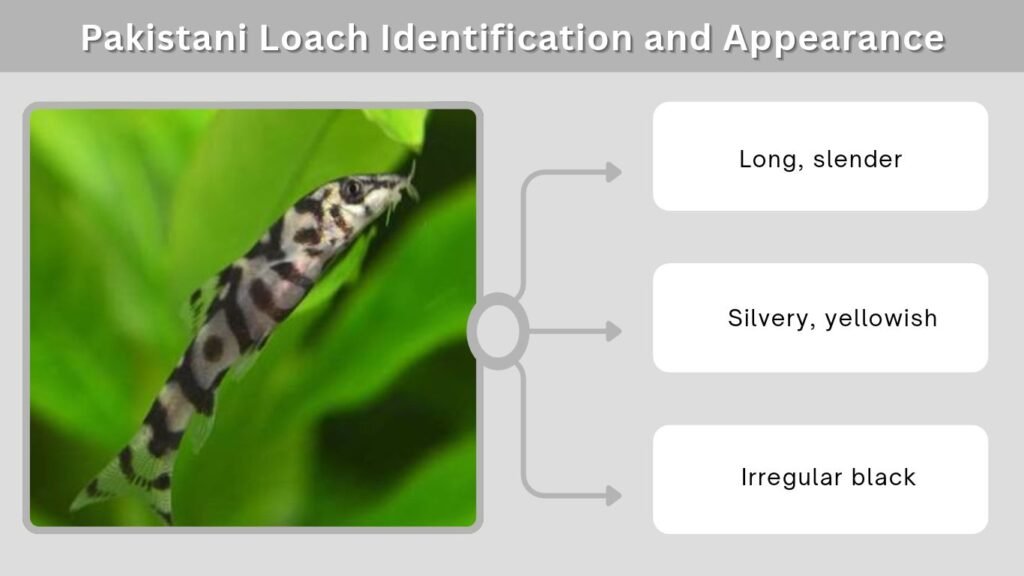
Pakistani loaches have elongated bodies, distinctive dark patterns, and downward-facing mouths adapted for searching the bottom of rivers and aquariums.
Their unusual markings make them relatively easy to recognize, although individual fish can look different as they mature.
Physical Characteristics
Common identification features include:
- Body shape: Long, slender, and slightly compressed.
- Body color: Silvery, yellowish, or pale golden.
- Dark markings: Irregular black or brown bands resembling letters.
- Mouth: Downward-facing with small sensory barbels.
- Fins: Usually transparent or lightly patterned.
- Eyes: Small, positioned toward the upper sides of the head.
- Defensive spines: Sharp, retractable spines beneath the eyes.
Young Pakistani loaches often display patterns resembling the letters Y and O, explaining the popular name “yoyo loach.”
Their markings can become increasingly complex with age.
Pakistani Loach Size
Adult Pakistani loaches commonly reach approximately 4–6 inches (10–15 cm), depending on their species, individual development, and aquarium conditions.
Juveniles sold in aquarium stores are much smaller, sometimes measuring only 2 inches.
Despite their modest size, they are active swimmers that require substantial horizontal space.
Pakistani Loach Habitat and Distribution

Pakistani loaches originate from freshwater river systems in South Asia. Related species occur in Pakistan, India, Nepal, and Bangladesh.
They typically inhabit streams, rocky riverbeds, and pools where they can search for food among stones and other submerged materials.
Natural Habitat
Their preferred environments generally feature:
- Rocky or gravel-covered bottoms
- Fresh, well-oxygenated water
- Moderate water movement
- Natural hiding places
- Aquatic insects and small invertebrates
These environmental characteristics help explain their aquarium requirements.
A successful home aquarium should provide clean water, hiding spaces, and enough room for natural movement.
Pakistani Loach Tank Size and Setup
Pakistani loaches need spacious, established aquariums with suitable water conditions and plenty of hiding places.
Although they spend considerable time near the substrate, they frequently explore other areas of the aquarium.
Recommended Tank Size
A tank with a base measuring at least 48 × 18 inches (120 × 45 cm), approximately 64 US gallons (243 liters), is a sensible starting point for a group of adult yoyo-type loaches.
Larger aquariums provide more room for swimming and reduce competition between individuals.
These fish should not be kept permanently in small tanks simply because they are sold as juveniles.
Aquarium Substrate and Decorations
Fine sand or smooth gravel works well because Pakistani loaches frequently search the substrate for food.
Provide several hiding places using driftwood, smooth stones, caves, and aquarium-safe decorations.
Avoid sharp objects and narrow openings where fish might become trapped.
Hardy plants such as Java fern and Anubias can provide additional shelter.
A secure aquarium lid is important because these loaches occasionally jump.
Pakistani Loach Water Parameters
Stable water conditions are essential for maintaining healthy Pakistani loaches.
| Water Parameter | Recommended Range |
| Temperature | 66–82°F (19–27.5°C) |
| pH | 6.0–7.5 |
| Water hardness | 2–12 dGH |
| Ammonia | 0 ppm |
| Nitrite | 0 ppm |
| Nitrate | As low as practical |
| Water movement | Gentle to moderate |
These ranges are general guidance for the yoyo loach group. Requirements may differ slightly between species.
Maintaining consistent conditions is more important than repeatedly adjusting the water to achieve an exact number.
What Do Pakistani Loaches Eat?

Pakistani loaches are omnivorous fish with a strong preference for animal-based foods.
In nature, they consume aquatic insects, worms, mollusks, and other small invertebrates.
Captive fish generally accept a wide variety of commercial and natural foods.
Best Foods for Pakistani Loaches
A balanced aquarium diet can include:
- High-quality sinking pellets
- Commercial bottom-feeder tablets
- Frozen or live bloodworms
- Brine shrimp
- Small aquatic worms
- Blanched zucchini
- Blanched spinach
- Occasional cucumber pieces
Offer a varied diet instead of relying on one food.
Feed amounts that the fish can finish without leaving substantial waste. Remove uneaten vegetables before they begin decomposing.
Do Pakistani Loaches Eat Snails?
Yes, Pakistani loaches eat small aquatic snails and may help reduce snail populations in freshwater aquariums.
They can investigate snail shells and consume accessible soft tissues.
However, they should not be purchased solely for controlling unwanted snails.
A snail infestation usually indicates excess available food, so correcting feeding habits and removing accumulated debris is also necessary.
Pakistani Loach Behavior and Temperament
Pakistani loaches are curious, intelligent-looking fish that spend considerable time exploring their surroundings.
They may swim through caves, investigate decorations, and interact with other loaches.
Although generally peaceful, their energetic activity can disturb timid aquarium species.
Are Pakistani Loaches Aggressive?
Pakistani loaches are not usually highly aggressive, but they establish social hierarchies.
Occasional chasing and dominance displays are normal, particularly when individuals compete for position within their group.
Keeping too few loaches may increase stress and aggressive behavior.
A group of at least five or six is generally recommended, with larger groups preferable when aquarium space allows.
Pakistani Loach Tank Mates
Suitable companions should tolerate active fish and similar water conditions.
| Suitable Tank Mates | Tank Mates to Avoid |
| Peaceful, appropriately sized rasboras | Long-finned bettas |
| Active schooling barbs | Delicate fancy guppies |
| Compatible danios | Very small, timid fish |
| Selected peaceful catfish | Slow-moving, easily stressed species |
| Other compatible Botia loaches | Aggressive territorial fish |
Compatibility depends on aquarium size, individual temperament, and available hiding places.
Avoid overcrowding the bottom of the aquarium with too many competing species.
Pakistani Loach Lifespan and Health

Pakistani loaches can live for many years when maintained under appropriate aquarium conditions.
With consistent care, individuals may live for 10 years or longer, and some aquarium-care references report potential lifespans of 15–20 years.
Their health depends heavily on water quality, nutrition, and social conditions.
Common Health Problems
Potential warning signs include:
- White spots on the body or fins
- Loss of appetite
- Unusual breathing
- Persistent hiding combined with inactivity
- Damaged fins or skin
- Unexplained weight loss
White spot disease, commonly called ich, is one condition that can affect aquarium loaches.
Because loaches can be sensitive to certain fish medications, treatments must be selected carefully according to the product instructions.
How to Keep Pakistani Loaches Healthy
Maintain effective biological filtration and regularly test aquarium water.
Weekly partial water changes are important. In well-stocked loach aquariums, changes of approximately 30–50% may be appropriate when replacement water is properly conditioned and temperature-matched.
Avoid sudden changes in temperature or water chemistry.
New fish should be quarantined before joining an established aquarium whenever possible.
Pakistani Loach Breeding and Reproduction
Breeding Pakistani loaches in home aquariums is extremely difficult.
In natural river systems, reproduction is associated with seasonal environmental conditions and movement through waterways.
Captive breeding is rarely documented in ordinary home aquariums.
Male and Female Differences
Sexually mature females may develop noticeably fuller bodies than males, particularly when carrying eggs.
However, accurately identifying sex from appearance alone can be difficult.
There are no universally reliable external differences for identifying every juvenile.
Commercial breeding of some related loaches has involved specialized techniques, including hormone-induced reproduction.
For most aquarium keepers, maintaining a healthy group is a more realistic goal than attempting breeding.
FAQs
1. Are Pakistani loaches good for beginners?
Pakistani loaches are better suited to aquarists with some experience. They require spacious aquariums, stable water conditions, and suitable companions. Although they are relatively adaptable once established, their social behavior and long-term care requirements can make them challenging for someone maintaining their first aquarium.
2. Can Pakistani loaches live alone?
Pakistani loaches should not be kept alone. They are social fish that interact with members of their own kind. A solitary loach may become withdrawn or behave aggressively toward other fish. Keeping at least five or six individuals encourages more natural social behavior.
3. Do Pakistani loaches eat shrimp?
Pakistani loaches may eat small shrimp, especially shrimp babies or individuals small enough to fit into their mouths. Their natural diet includes aquatic invertebrates, so ornamental shrimp colonies are not always safe with them. A separate aquarium is preferable when breeding or protecting delicate freshwater shrimp.
4. Are Pakistani loaches nocturnal?
Pakistani loaches may be active during both daytime and nighttime. They often become especially active in dim lighting or around feeding times. Providing shaded areas and hiding places helps them feel secure, allowing them to display natural exploratory behavior throughout the day.
5. How many Pakistani loaches should be kept together?
A group of at least five or six Pakistani loaches is recommended. Larger groups can support more natural interactions when sufficient aquarium space is available. Since adults are active and can reach approximately six inches, a long, spacious tank is essential for maintaining a healthy group.