
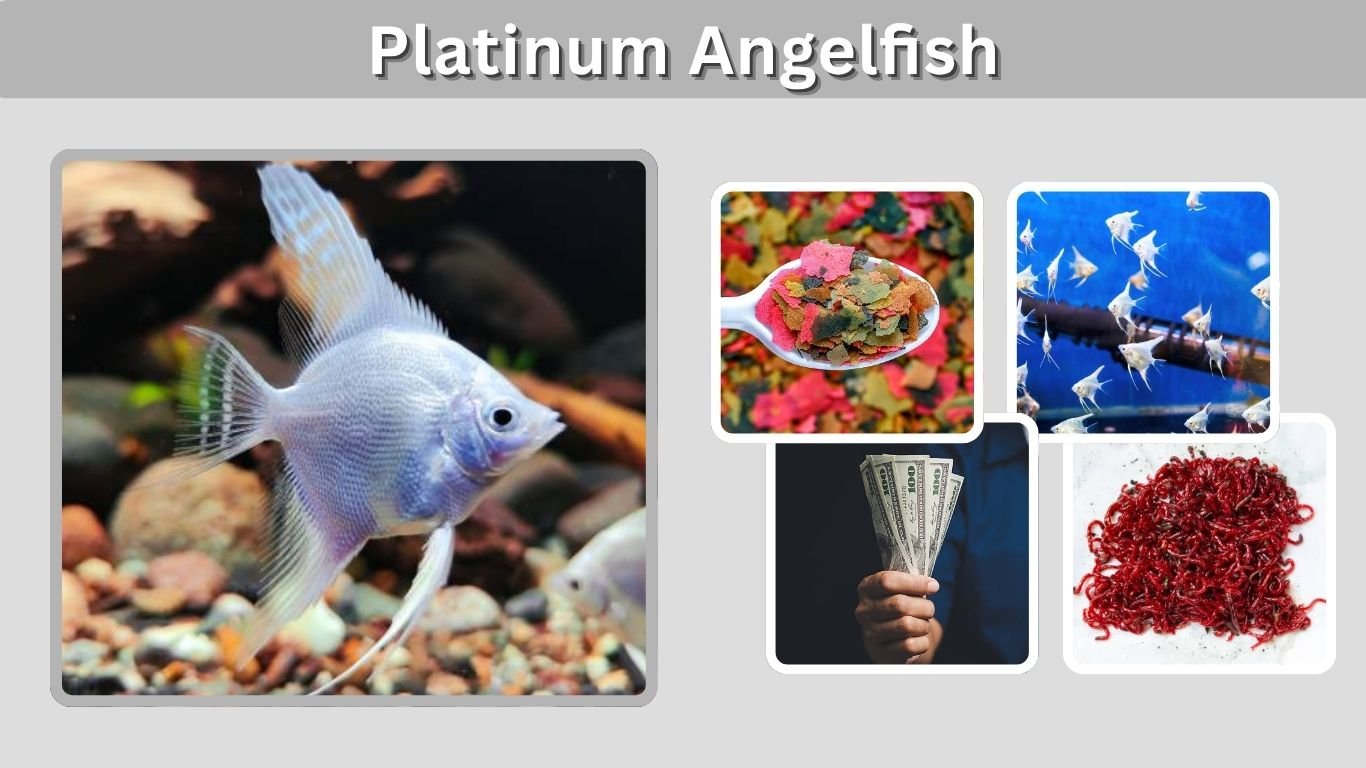
The Platinum Angelfish is a selectively bred freshwater angelfish admired for its luminous white or silver body and subtle blue sheen. It is not a separate wild species; most platinum varieties belong to Pterophyllum scalare, the common freshwater angelfish. Although generally hardy, this elegant cichlid requires warm, clean water, a tall aquarium, suitable companions, and enough space to manage territorial behavior as it matures.
Platinum Angelfish Quick Facts
Platinum Angelfish share the general care needs, body shape, behavior, and adult size of other domesticated Pterophyllum scalare varieties.
| Feature | Description |
| Scientific name | Pterophyllum scalare |
| Family | Cichlidae |
| Type | Selectively bred freshwater angelfish |
| Body length | Up to approximately 6 inches |
| Total height | Up to approximately 8 inches with fins |
| Temperature | Approximately 78–84°F |
| pH | About 6.0–8.0 |
| Diet | Omnivorous |
| Temperament | Peaceful to semi-aggressive |
| Lifespan | Commonly 8–12 years |
| Recommended tank | Tall 55-gallon aquarium for a group |
Wild P. scalare occur across parts of the Amazon basin and nearby South American river systems. They naturally inhabit quiet, vegetation-rich swamps, flooded areas, and slow-moving waters.
What Does a Platinum Angelfish Look Like?
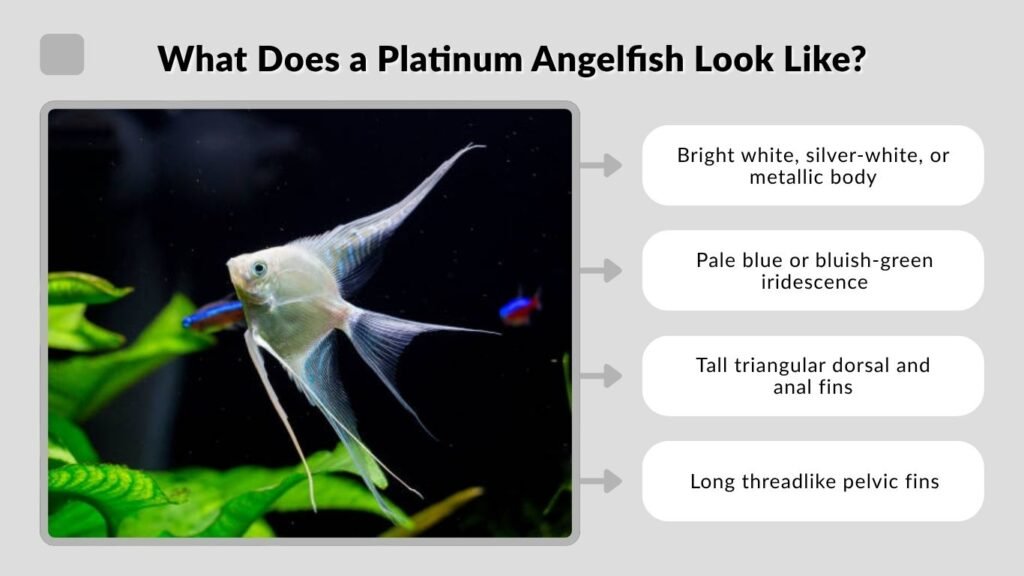
A healthy Platinum Angelfish has a laterally compressed, diamond-shaped body with tall dorsal and anal fins. Two thin pelvic fins extend beneath the body like delicate threads.
Identification Features
- Bright white, silver-white, or metallic body
- Pale blue or bluish-green iridescence
- Tall triangular dorsal and anal fins
- Long threadlike pelvic fins
- Clear, white, or slightly blue fins
- Disc-shaped, laterally compressed body
- Dark eyes in most standard platinum varieties
- Few or no visible vertical body stripes
Young fish may appear plain white or pale silver. Their metallic shine and blue tones often become more noticeable as they grow and develop healthy adult scales.
Platinum Angelfish Genetics
“Platinum” is a domestic color description rather than a separate scientific classification. Breeders combine color, pattern, scale, and fin genes to produce fish sold as platinum, platinum blue, platinum marble, pearlscale platinum, or platinum veil.
The Philippine Blue gene is recessive and produces blue iridescence. When combined with pale or gold-based angelfish, it can create a very light fish commonly described as platinum. However, commercial naming is not completely standardized, so fish sold under the same name may not have identical genetics.
Popular Platinum Varieties
Platinum Blue Angelfish: Usually has an icy white body with stronger blue iridescence.
Pearlscale Platinum Angelfish: Has unusually reflective, textured scales. Pearlscale is a recessive trait that becomes more noticeable under good environmental conditions.
Platinum Veil Angelfish: Carries the veiltail trait, producing longer dorsal, anal, and tail fins.
Platinum Marble Angelfish: Combines a pale base with irregular darker or colored patches.
Platinum Koi or Panda Angelfish: Commercial names describing platinum coloration combined with other patterns. Exact genetics should be confirmed with the breeder.
Platinum vs. Albino Angelfish
Platinum and albino are not automatically the same. Standard platinum fish generally retain dark eyes, while albino-related varieties may have red or pink eyes and reduced dark pigmentation.
Labels such as “albino platinum” or “red-eye platinum” may describe fish carrying multiple traits. Because retailer names vary, buyers interested in breeding should ask for the parents’ genetic information rather than depending only on the sales name.
How Big Do Platinum Angelfish Get?
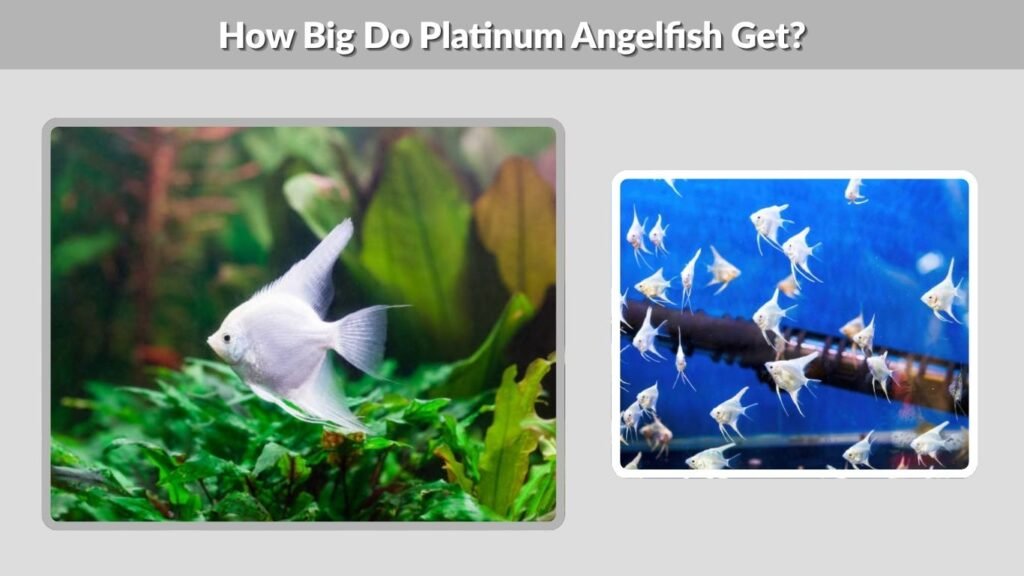
A full-grown Platinum Angelfish may reach around 6 inches in body length. When its tall dorsal and anal fins are included, its overall height can approach 8 inches. Veiltail varieties may appear even larger because of their extended fins.
Angelfish are often sold when they are only one or two inches long. Their small store size can be misleading, so the aquarium should be selected according to adult dimensions rather than juvenile size.
Platinum Angelfish Tank Setup
A good angelfish tank should be tall, warm, gently filtered, and spacious enough to provide territories. Plants and driftwood can create visual barriers that reduce confrontations between fish.
Tank Size
A 55-gallon or larger aquarium is a safe choice for a small adult group or a community containing several angelfish. A single fish or established pair may sometimes be maintained in a tall 29- to 40-gallon aquarium, but larger tanks provide more stable water quality and more room during breeding aggression.
Avoid short aquariums that restrict the fish’s tall fins. A tank with both vertical height and horizontal swimming room is preferable.
Water Conditions
| Water factor | Recommended range |
| Temperature | 78–84°F |
| pH | 6.0–8.0 |
| Hardness | Soft to moderately hard |
| Water movement | Gentle |
| Water changes | Regular partial changes |
Captive-bred angelfish can adapt to different water conditions, but sudden changes are dangerous. Stable temperature, good filtration, regular maintenance, and consistently clean water are more important than attempting to achieve one perfect pH value.
Plants and Decorations
Use tall plants such as Amazon swords, Java fern, Vallisneria, or water sprite. Broad leaves may also provide surfaces for spawning.
Vertical driftwood creates cover and resembles the branches found in the species’ natural environment. Avoid decorations with sharp edges because Platinum Angelfish have delicate fins that can tear easily.
What Do Platinum Angelfish Eat?
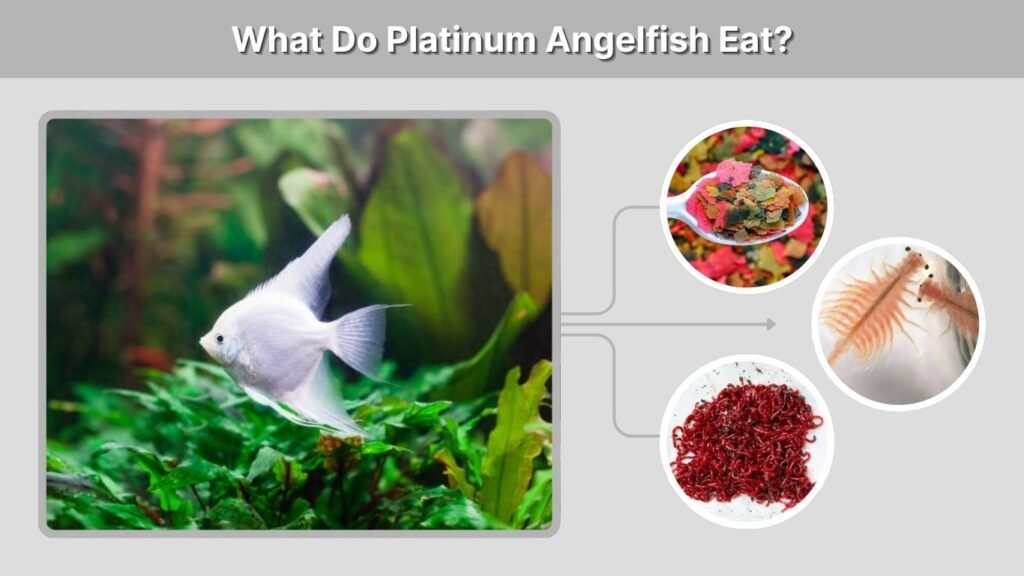
Platinum Angelfish are omnivores and readily accept prepared, frozen, and live foods. A varied diet supports growth, immunity, breeding condition, and strong metallic coloration.
Suitable Foods
- High-quality cichlid flakes
- Small or medium tropical pellets
- Brine shrimp
- Bloodworms
- Daphnia
- Mysis shrimp
- Insect-based foods
- Occasional vegetable-containing flakes
Feed adults once or twice daily, offering only what they can finish within two or three minutes. Rotating several foods is healthier than relying on bloodworms, flakes, or one pellet formula exclusively.
Platinum Angelfish Tank Mates
Platinum Angelfish can live in community aquariums, but they remain cichlids. They may chase companions, establish territories, or defend eggs aggressively.
Suitable companions include larger peaceful tetras, medium rasboras, Corydoras catfish, peaceful gouramis, rainbowfish, and non-aggressive barbs.
Avoid very small fish that could fit inside an adult angelfish’s mouth. Fin-nipping barbs, highly aggressive cichlids, and fast feeders may also cause problems. Dwarf shrimp and tiny fish may eventually be treated as food.
Male and Female Platinum Angelfish
Males and females have almost identical coloration. Head shape, body size, and fin shape are unreliable for sexing young fish.
Sex becomes easiest to confirm during spawning. The female develops a broader breeding tube and lays rows of eggs, while the male follows with a narrower breeding tube to fertilize them. Raising six juveniles together and allowing a natural pair to form is usually more reliable than selecting a supposed male and female at a store.
Breeding Platinum Angelfish
A bonded pair cleans a vertical surface such as a broad leaf, slate, filter pipe, or aquarium wall. The female deposits eggs in organized rows, and the male follows to fertilize them.
Depending on temperature, fertile eggs may hatch within two or three days. The larvae remain attached as “wigglers” before becoming free-swimming several days later. Parents may guard the eggs and fry, although inexperienced pairs sometimes eat their first batches.
Breeding two platinum-looking fish does not always guarantee identical offspring, especially when the parents carry hidden recessive genes or several combined traits.
Buying Platinum Angelfish
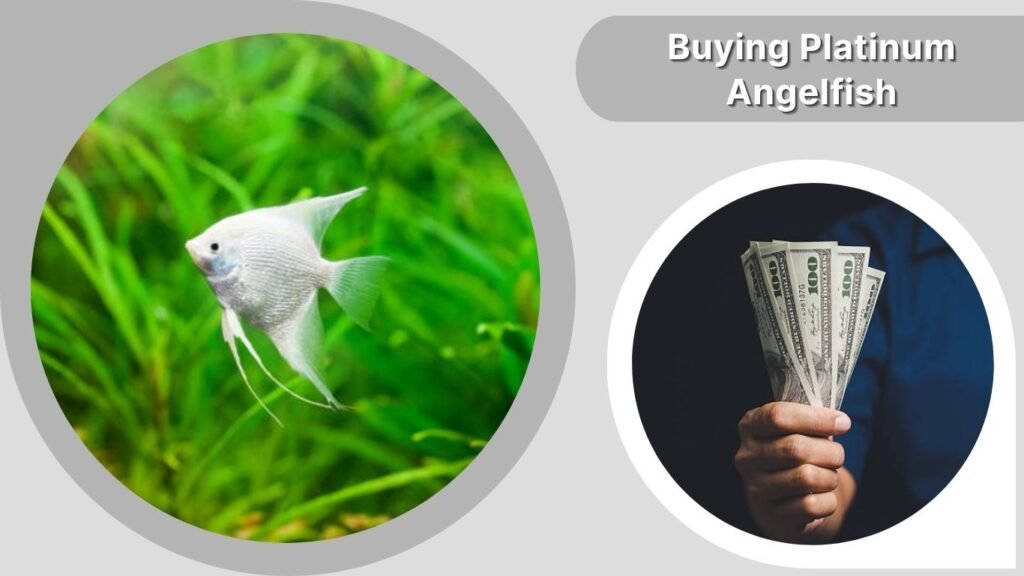
Price varies according to size, fin type, scale pattern, color intensity, breeder reputation, and country. Confirm that the fish is eating, swimming normally, and free from damaged fins, cloudy eyes, white spots, or a severely sunken belly.
For specialty varieties such as platinum blue, platinum pearlscale, or platinum veil, ask the seller whether the label describes a confirmed genetic strain or only the fish’s appearance.
FAQs
Are Platinum Angelfish freshwater fish?
Yes. Platinum Angelfish are domesticated freshwater cichlids, usually belonging to Pterophyllum scalare. They should not be confused with marine angelfish, which belong to a different fish family and require saltwater aquariums.
How long do Platinum Angelfish live?
They commonly live around 8–12 years when provided with clean water, adequate space, a varied diet, and low stress. Some carefully maintained angelfish may live longer, while poor water quality can significantly shorten their lifespan.
Can Platinum Angelfish live alone?
Yes. A single angelfish can live successfully as the centerpiece of a suitable community aquarium. Keeping one fish may also reduce fighting, pairing disputes, and breeding-related territorial behavior.
Are Platinum Angelfish aggressive?
They are usually moderately peaceful but can become territorial toward other angelfish. Aggression becomes more noticeable when adults form pairs, compete for partners, defend spawning surfaces, or protect eggs and fry.
What is the best tank size for Platinum Angelfish?
A tall 55-gallon aquarium is recommended for a group or full community setup. A single fish or compatible bonded pair may live in a smaller tall aquarium, but additional water volume provides better swimming space, stability, and territorial separation.