
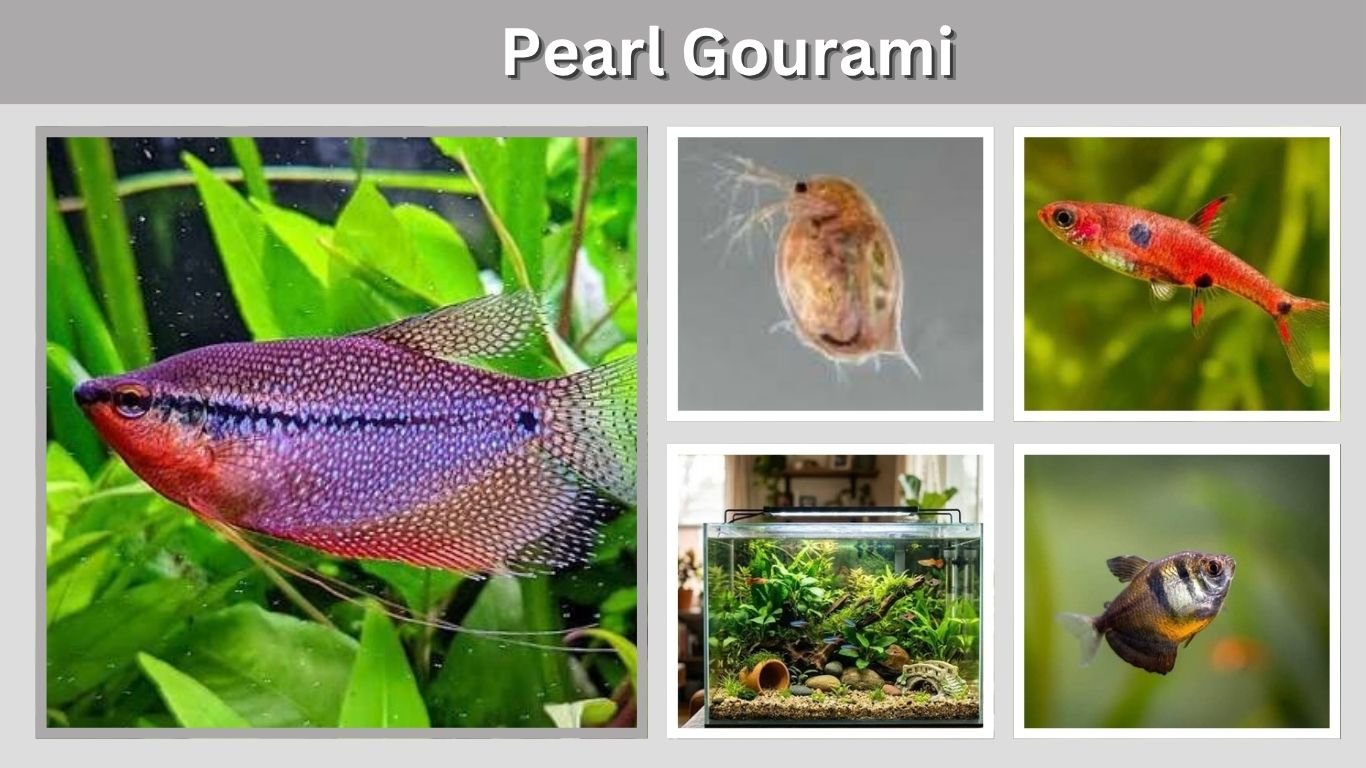
The Pearl Gourami (Trichopodus leerii) is a graceful freshwater fish admired for its shimmering pearl-like spots, peaceful temperament, and flowing fins. Native to slow-moving waters of Southeast Asia, it adapts well to calm community aquariums when given warm water, vegetation, and compatible tank mates. Adults can reach about 4–5 inches, so adequate swimming space is important. This guide covers Pearl Gourami size, tank requirements, male vs female differences, diet, lifespan, temperament, breeding, and suitable companions for a healthy aquarium.
Pearl Gourami Size and Appearance
Pearl Gouramis are medium-sized labyrinth fish with elongated bodies and delicate thread-like pelvic fins. Their bodies are covered with hundreds of pale spots that resemble scattered pearls, while a dark horizontal stripe extends from the mouth toward the tail. Healthy adults develop attractive coloration that becomes particularly noticeable under subdued aquarium lighting and around live plants.
Pearl Gourami Identification
Typical characteristics include:
- Adult size of about 4–5 inches
- Silvery, brownish, or reddish body
- Numerous pearl-white spots
- Dark horizontal stripe along the side
- Long thread-like pelvic fins
- Extended dorsal and anal fins
- Flattened body profile
- Upturned mouth typical of gouramis
The scientific name is Trichopodus leerii, and the fish is sometimes called the Pearl Leeri Gourami.
Full-Grown Pearl Gourami
A full-grown Pearl Gourami usually reaches around 4–5 inches, although individual growth varies with genetics, diet, water quality, and available space.
They are not enormous fish, but their tall bodies and flowing fins require more room than their length alone suggests. A well-maintained aquarium also allows them to develop better coloration and more natural swimming behavior.
Pearl Gourami Tank Size and Setup
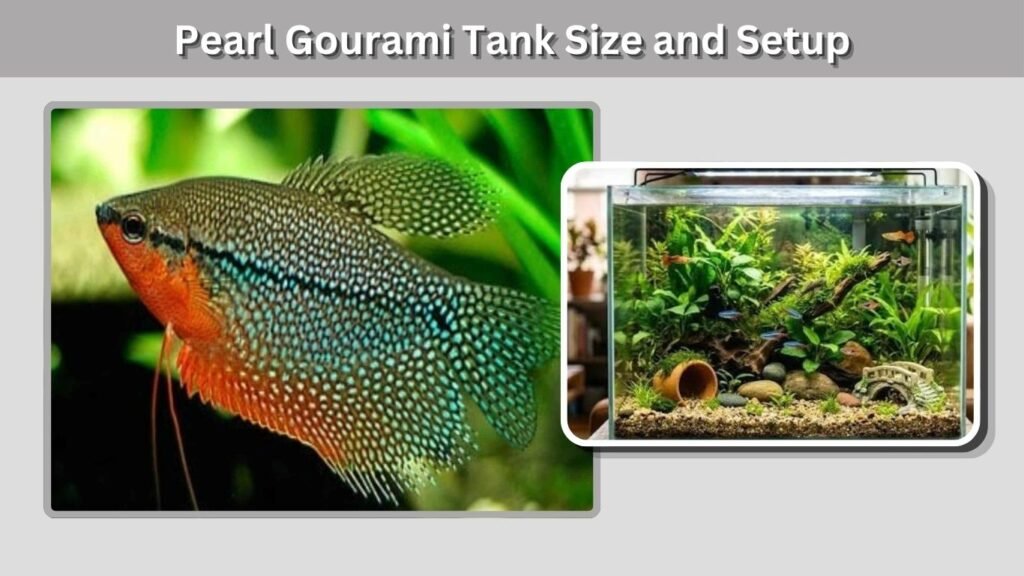
A suitable Pearl Gourami tank size should provide open swimming space alongside heavily planted areas where the fish can retreat. These gouramis come from warm, slow-moving waters containing dense vegetation. They generally dislike strong currents, so the aquarium should provide gentle filtration, stable water conditions, and access to the surface for breathing atmospheric air.
Recommended Tank Conditions
A good Pearl Gourami setup includes:
- Minimum tank around 30 gallons for an adult or pair
- Larger tanks for groups or community setups
- Water temperature around 75–82°F
- Slightly acidic to neutral water
- Gentle water movement
- Live or artificial plants
- Floating plants for surface cover
- Open swimming areas
- Secure aquarium lid
A 20-gallon aquarium may be restrictive for an adult, particularly when other fish are present.
Water Temperature and Parameters
Pearl Gouramis are tropical fish and do best in consistently warm water. Temperatures around 75–82°F are generally suitable.
They tolerate a reasonable range of water chemistry, but stability matters more than constantly adjusting numbers. Avoid sudden temperature or pH changes, and maintain good water quality through regular partial water changes.
Natural Habitat
In nature, Pearl Gouramis occur in Southeast Asia, including areas of Thailand, Malaysia, Indonesia, and surrounding regions. They inhabit swamps, slow streams, floodplains, and heavily vegetated waters.
Their labyrinth organ allows them to breathe atmospheric oxygen at the surface, an adaptation that helps them survive naturally oxygen-poor environments.
Pearl Gourami Male vs Female
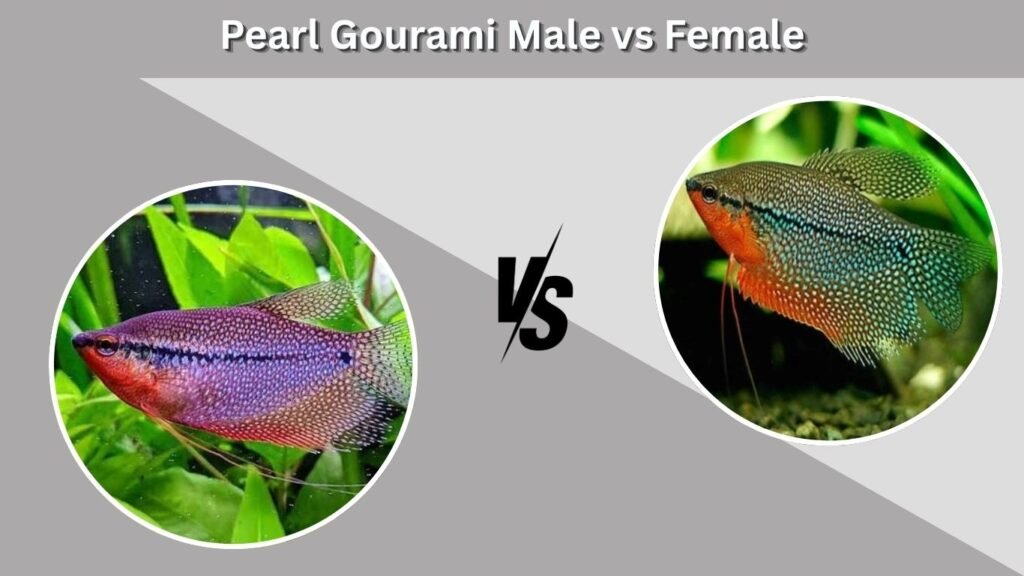
Distinguishing a male vs female Pearl Gourami becomes easier as the fish mature. Both sexes display pearl-like spotting, but adult males usually develop stronger coloration and more elongated fins. Sexing juveniles can be difficult because these differences may not become obvious until the fish approaches maturity.
Male and Female Differences
Look for these characteristics:
- Male: More intense orange-red throat and chest
- Male: Longer and more pointed dorsal fin
- Male: More elaborate fin extensions
- Female: Usually rounder body
- Female: Shorter, more rounded dorsal fin
- Female: Less intense red coloration
- Female: Often slightly fuller through the abdomen
Breeding-condition males generally show the most dramatic color differences.
Male Pearl Gourami
An adult male Pearl Gourami often develops a vivid orange or reddish throat, chest, and belly. His dorsal fin tends to extend farther toward the tail and becomes noticeably pointed.
During breeding, males may become more territorial and spend considerable time near the surface constructing and defending a bubble nest.
Female Pearl Gourami
Females are generally more subdued in color, with a silver-brown body covered in the characteristic pearl pattern. Their dorsal fins tend to be shorter and rounder.
A mature female carrying eggs may appear fuller through the abdomen. Females are often less territorial than breeding males, making several females easier to maintain in larger community aquariums.
Pearl Gourami Tank Mates and Temperament
Pearl Gouramis are generally considered among the more peaceful gouramis, making them excellent candidates for appropriately planned community aquariums. They may be shy when first introduced and appreciate plants or decorations for cover. Problems are more likely when they share cramped conditions with aggressive fish or when multiple adult males compete for territory.
Good Pearl Gourami Tank Mates
Potential companions include:
- Peaceful rasboras
- Larger peaceful tetras
- Corydoras catfish
- Kuhli loaches
- Peaceful barbs
- Small rainbowfish
- Bristlenose plecos
- Other calm community fish
Always consider aquarium size, individual temperament, and water requirements before combining species.
Can Pearl Gouramis Live Alone?
Yes. A Pearl Gourami can live alone without becoming unhealthy simply because another gourami is absent.
However, they can also be maintained as a pair or small group when the aquarium is sufficiently large. If keeping multiple adults, providing plenty of plants and visual barriers helps reduce competition and gives subordinate fish places to retreat.
Pearl Gourami With Angelfish or Bettas
Pearl Gouramis and angelfish can sometimes coexist in spacious aquariums, but success depends strongly on individual temperament. Both species can become territorial.
Combining a Pearl Gourami with a betta is generally less predictable because both are labyrinth fish that may compete near the surface. A calmer community combination is usually easier to manage.
Pearl Gourami Diet and Feeding
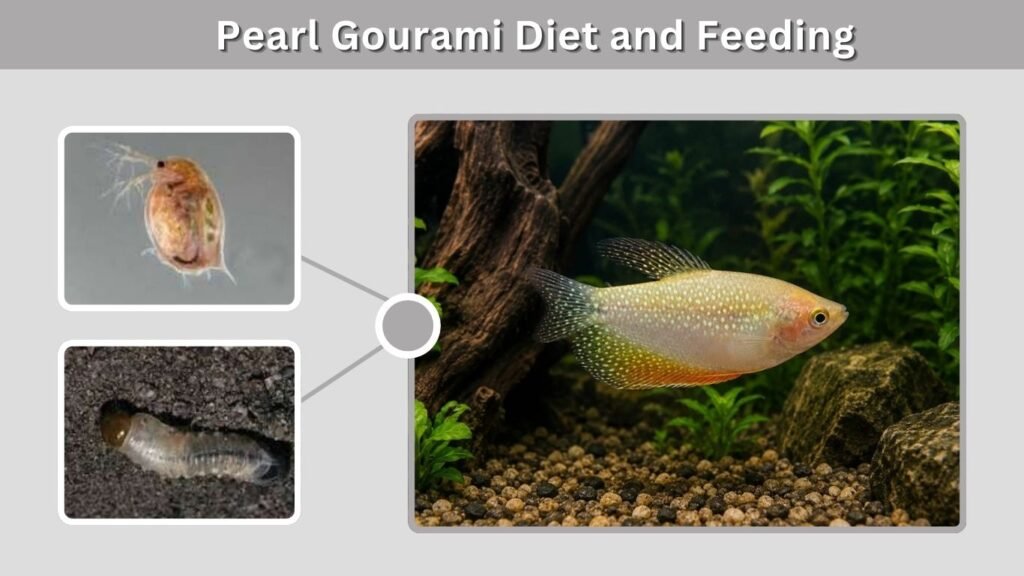
Pearl Gouramis are omnivores and benefit from varied foods rather than relying on a single product. In nature, they consume insects, small aquatic organisms, larvae, and plant material. In an aquarium, balanced prepared foods can form the foundation of their diet, supplemented with frozen or live foods to encourage good condition and stronger coloration.
What to Feed Pearl Gouramis
Suitable foods include:
- High-quality tropical flakes
- Small floating or slow-sinking pellets
- Frozen brine shrimp
- Daphnia
- Bloodworms as occasional food
- Insect larvae
- Appropriate live foods
- Vegetable-containing prepared foods
Offer portions the fish can consume without leaving large amounts of waste in the aquarium.
Feeding Behavior
Pearl Gouramis often feed near the middle and upper portions of the tank. Shy individuals may hesitate to compete with aggressive or extremely fast feeders.
Providing food in more than one location can ensure quieter fish receive enough. A varied diet also supports growth, reproductive condition, immune function, and coloration.
Pearl Gourami Lifespan and Health

A well-maintained Pearl Gourami can live for several years, commonly around 4–6 years, with some individuals potentially living longer under excellent conditions. Water quality, nutrition, genetics, tank stress, and disease prevention all influence longevity. Stable conditions are especially important because chronic stress can weaken the fish and make it more susceptible to infections.
Keeping Pearl Gouramis Healthy
Important care practices include:
- Maintain stable water temperature.
- Perform regular partial water changes.
- Avoid overcrowding.
- Provide hiding places and plants.
- Feed a varied diet.
- Avoid aggressive tank mates.
- Quarantine new fish when practical.
- Watch for damaged fins, unusual spots, or behavioral changes.
Fin rot and other infections may become more likely when water quality deteriorates or fish experience prolonged stress.
Pearl Gourami Breeding and Bubble Nests
Pearl Gouramis are bubble-nest breeders. When ready to reproduce, the male creates a floating nest from bubbles, often incorporating pieces of floating vegetation. Breeding behavior can be fascinating to observe, but a dedicated breeding setup usually provides better control over water conditions and improves the chances of eggs and fry surviving.
Pearl Gourami Breeding Behavior
During breeding, the male becomes more colorful and begins building a bubble nest near the surface. He then courts the female underneath the nest.
After spawning, fertilized eggs float upward and are collected into the bubble nest. The male generally guards the nest and may become territorial toward the female or other fish during this period.
Eggs and Fry
Pearl Gourami eggs hatch relatively quickly under warm conditions. Once the fry become free-swimming, parental protection is no longer necessary and the young require very small foods.
Fry initially need microscopic or extremely fine foods before graduating to larger choices such as newly hatched brine shrimp as they grow.
FAQs
What size tank does a Pearl Gourami need?
A tank of around 30 gallons or larger is a practical starting point for adult Pearl Gouramis, particularly when keeping a pair or community. Larger tanks provide better swimming space, more stable water conditions, and room for plants and hiding areas. Groups require additional space, especially when more than one male is present.
How big does a Pearl Gourami get?
An adult Pearl Gourami usually grows to approximately 4–5 inches long. Genetics, diet, aquarium size, and water quality can influence final size. Their bodies are relatively tall and their fins extend beyond the main body profile, so they need more swimming room than their body length might initially suggest.
Are Pearl Gouramis aggressive?
Pearl Gouramis are generally peaceful compared with many other gouramis. Males can become territorial, particularly during breeding or when housed with competing males in limited space. Providing plants, visual barriers, and sufficient room greatly reduces conflict. They usually perform best with calm community fish that do not nip their long fins.
How can you tell a male Pearl Gourami from a female?
Adult males typically have a stronger orange-red throat and chest, plus a longer, more pointed dorsal fin. Females are generally less colorful, with shorter rounded dorsal fins and fuller bodies. Differences become much clearer as the fish mature, while accurately determining the sex of juveniles can be difficult.
What is the lifespan of a Pearl Gourami?
Pearl Gouramis commonly live around 4–6 years in captivity, although longevity varies between individuals. Providing stable tropical temperatures, clean water, nutritious food, adequate swimming space, and peaceful tank mates gives them the best opportunity for a long life. Chronic stress and poor water conditions can substantially shorten their lifespan.
