
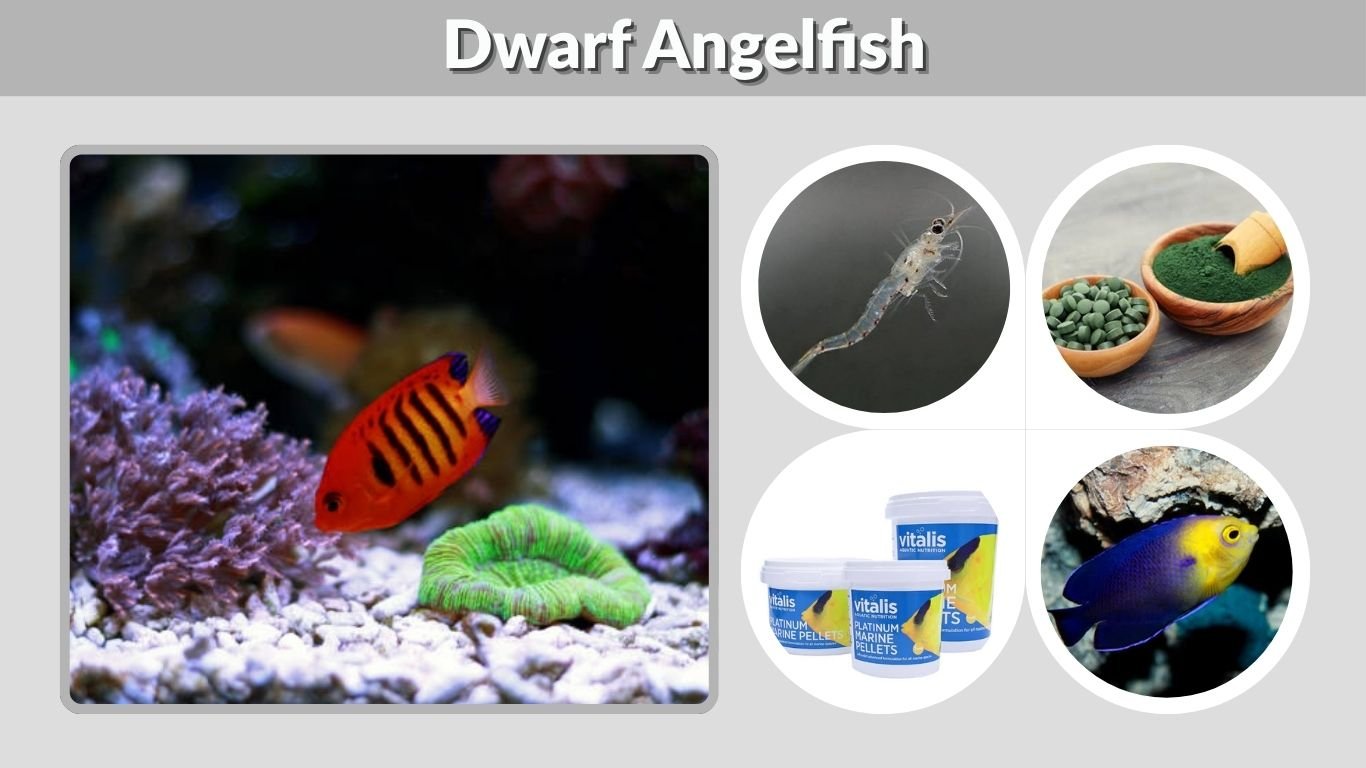
Dwarf angelfish are small, brilliantly colored marine fish commonly kept in saltwater aquariums. Most belong to the genus Centropyge within the angelfish family Pomacanthidae. Popular species include the flame, coral beauty, cherub, lemonpeel, bicolor, golden, and African flameback angelfish. Although smaller than full-sized marine angels, these active, territorial fish still require an established aquarium with stable water quality, ample swimming room, and plenty of rockwork.
Dwarf Angelfish Quick Facts
| Feature | Description |
| Water type | Saltwater |
| Family | Pomacanthidae |
| Main genus | Centropyge |
| Adult size | Approximately 2.5–6 inches, depending on species |
| Temperament | Semi-aggressive and territorial |
| Diet | Algae, sponge material, detritus, and small invertebrates |
| Tank size | Generally 30 gallons or larger |
| Reef safe | With caution |
| Care level | Moderate for most species |
| Lifespan | Potentially many years with proper care |
Most dwarf angelfish inhabit tropical coral reefs, where they spend much of the day grazing and moving between rocky shelters. The cherub angelfish reaches about 8 cm, while larger species such as the bicolor angelfish may approach 15 cm.
What Is a Dwarf Angelfish?
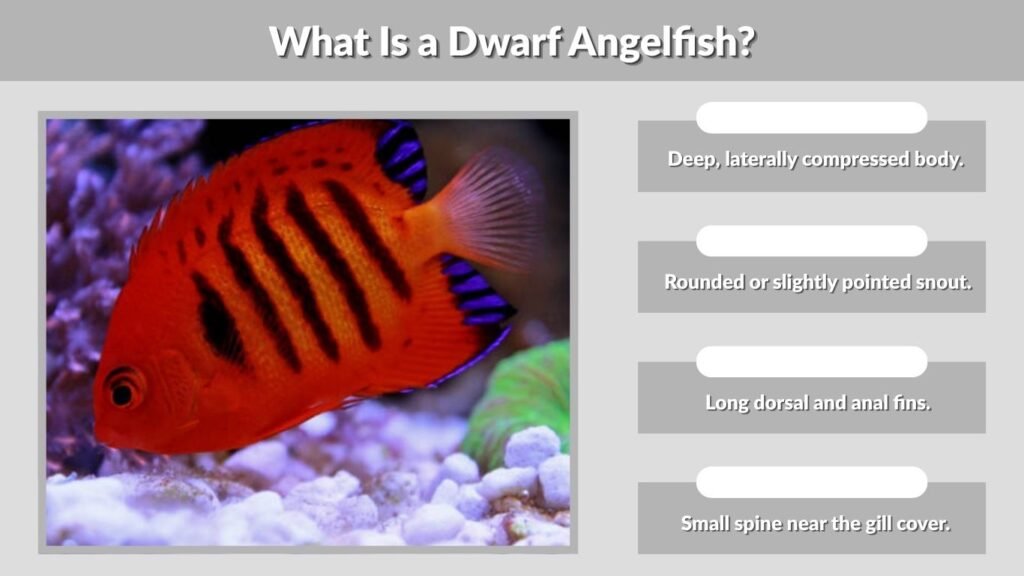
“Dwarf angelfish” is an aquarium-trade term for small marine angelfish, particularly members of Centropyge. Their bodies are deep, flattened from side to side, and covered with vivid combinations of blue, yellow, orange, red, purple, and black.
Despite their compact size, they behave like much larger angelfish. They patrol rockwork, establish territories, chase similar-looking fish, and continuously inspect surfaces for food.
Common Identification Features
- Deep, laterally compressed body
- Rounded or slightly pointed snout
- Long dorsal and anal fins
- Small spine near the gill cover
- Bright contrasting colors
- Strong territorial behavior
- Habit of grazing on rocks
- Quick retreat into crevices when frightened
Are There Freshwater Dwarf Angelfish?
True dwarf angelfish are saltwater fish. There is no widely recognized naturally dwarf freshwater angelfish equivalent to marine Centropyge species.
The familiar freshwater angelfish is Pterophyllum scalare, a South American cichlid from the Amazon basin. Selective breeding has produced different colors, fin shapes, and body types, but varieties sold as “dwarf freshwater angelfish” are generally small individuals, marketing labels, or stunted fish—not a standard dwarf species.
Marine dwarf angelfish cannot live with dwarf gouramis, African dwarf frogs, tetras, or freshwater angelfish because these animals require freshwater. Placing either group in the wrong salinity would be fatal.
Popular Types of Dwarf Angelfish
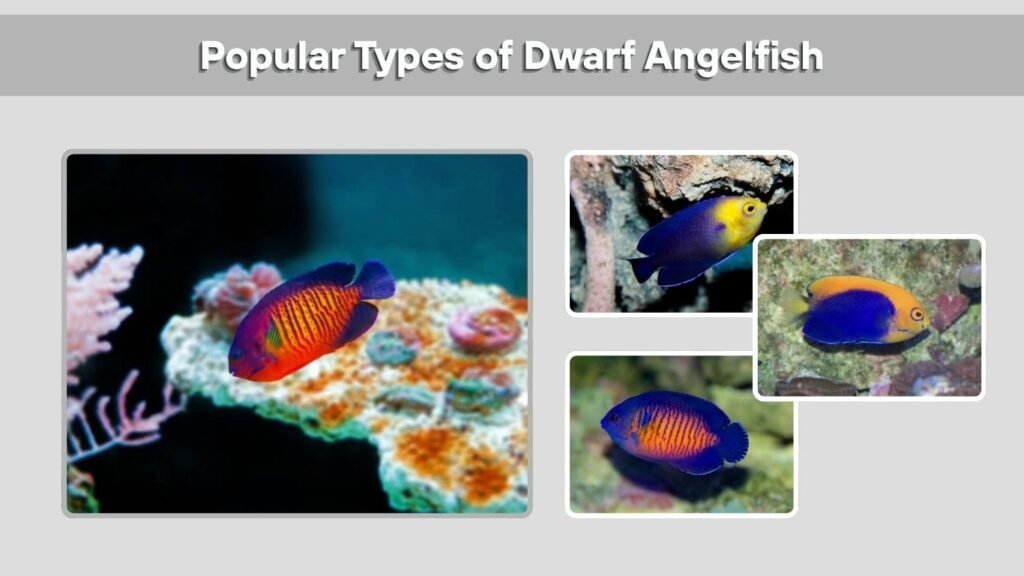
Dwarf angels vary in appearance, adult size, temperament, hardiness, and their tendency to damage corals.
Flame Dwarf Angelfish
The flame angelfish, Centropyge loriculus, has a vivid orange-red body with black vertical bars and blue-edged fins. It is one of the most recognizable marine aquarium fish.
Wild flame angels inhabit tropical Pacific reefs, stay close to shelter, and feed heavily on algae. Although often kept in reef tanks, individuals may nip corals or clam mantles.
Coral Beauty Dwarf Angelfish
The coral beauty, Centropyge bispinosa, displays deep blue or purple fins surrounding an orange-striped body. It is popular because it is colorful, adaptable, and generally hardier than some uncommon dwarf angels.
Coral beauties are semi-aggressive and should have plenty of rockwork. They may behave well in a reef aquarium for months or years, but no individual is guaranteed to ignore corals.
Cherub or Pygmy Angelfish
The cherub angelfish, Centropyge argi, has a dark blue body, orange-yellow face, and bright blue fin edges. It is among the smallest commonly available dwarf angelfish, reaching approximately 8 cm.
Its compact size does not mean it lacks aggression. Cherubs may fiercely defend their chosen caves and grazing areas, particularly in undersized tanks. Wild adults feed on several kinds of algae and retreat into holes when threatened.
Lemonpeel Angelfish
The lemonpeel angelfish, Centropyge flavissima, is bright yellow with blue edging around its eyes and fins. It is sometimes sold as a yellow dwarf angelfish.
This species can be sensitive during acclimation and is known for investigating or nipping corals. It is better suited to an established aquarium maintained by someone with previous marine-fish experience.
Golden Dwarf Angelfish
The golden angelfish, Centropyge aurantia, has a reddish-orange body marked with darker vertical bars. It is naturally secretive and may spend considerable time hidden among rockwork.
Golden angels can be challenging because newly acquired fish may refuse prepared food. A mature aquarium containing natural algae, sponge growth, and numerous hiding places provides the best opportunity for successful acclimation.
African Flameback Angelfish
The African flameback, Centropyge acanthops, has a blue-purple lower body and golden-yellow head, back, and tail. It reaches about 8 cm and naturally inhabits western Indian Ocean reefs at depths of approximately 6–40 metres.
Dwarf Angelfish Tank Setup
A dwarf angelfish needs more space than its body size might suggest. These fish are active, territorial, and accustomed to spending the day moving across a reef.
Tank Size
A general starting point for one of the smaller species is approximately 30 gallons or 120 litres. Larger or more territorial species often do better in tanks of 55–75 gallons.
Tank shape is important. A longer aquarium provides more swimming space, grazing surfaces, and opportunities for territorial fish to avoid one another. The Ornamental Aquatic Trade Association recommends at least 120 litres for a single smaller dwarf angel and a larger aquarium when keeping it with other fish.
Water Parameters
General conditions include:
- Temperature: 24–26°C or 75–79°F
- Specific gravity: 1.020–1.025
- pH: approximately 7.9–8.3
- Ammonia: 0
- Nitrite: 0
- Stable alkalinity and salinity
The aquarium should be fully cycled before the fish is introduced. Rapid changes in temperature, salinity, pH, or nitrogen compounds can cause stress and increase disease susceptibility.
Rockwork and Shelter
Provide substantial live or artificial rockwork arranged with:
- Caves and narrow crevices
- Shaded resting areas
- Open swimming routes
- Algae-covered grazing surfaces
- Several territories rather than one central cave
Secure the rocks carefully so the fish cannot cause unstable pieces to fall while swimming through gaps.
What Do Dwarf Angelfish Eat?
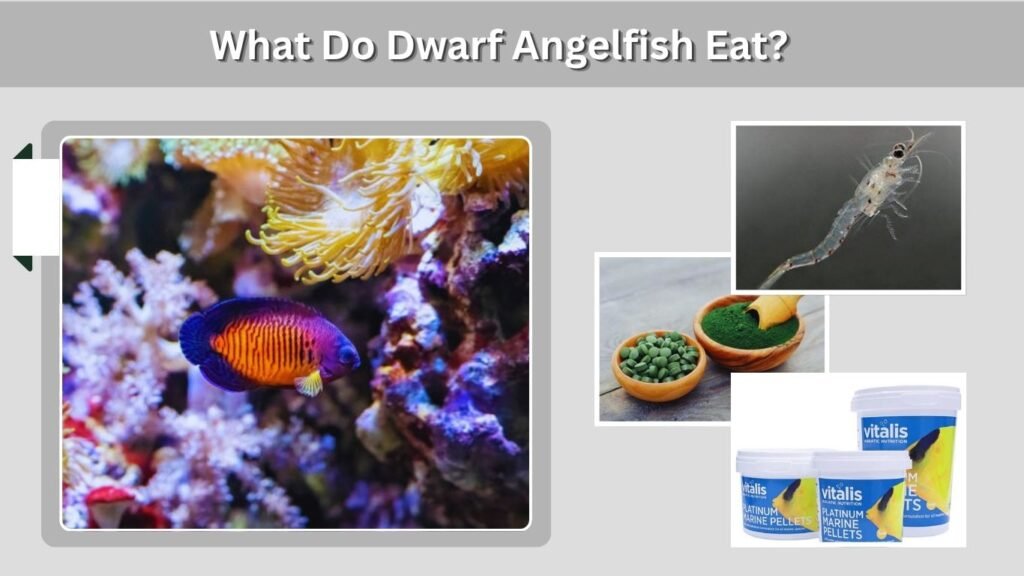
Most dwarf angels are omnivorous grazers. Depending on the species, their natural diet includes algae, detritus, sponge material, and tiny organisms collected from reef surfaces.
A balanced aquarium diet may include:
- Marine algae and spirulina foods
- Angelfish preparations containing sponge
- Mysis shrimp
- Enriched brine shrimp
- Finely chopped marine foods
- Quality marine pellets
- Dried seaweed
- Naturally growing algae on live rock
Offer several small meals rather than one excessive feeding. A varied diet and regular grazing opportunities help maintain body condition, coloration, and natural behavior.
Are Dwarf Angelfish Reef Safe?
Dwarf angelfish are best described as reef safe with caution. Some individuals leave corals untouched, while others repeatedly nip at:
- Large-polyp stony corals
- Soft-coral polyps
- Zoanthids
- Clam mantles
- Sponges
- Other sessile invertebrates
Behavior varies by species and individual. Adequate feeding and natural grazing surfaces may reduce nipping, but they cannot guarantee that a fish will remain harmless. A fish-only aquarium is the safer choice when valuable corals or clams cannot be risked.
Dwarf Angelfish Compatibility
Dwarf angels can live with many clownfish, gobies, wrasses, tangs, and other marine fish when the aquarium is large enough. Avoid extremely timid fish that may be intimidated or prevented from feeding.
Keeping two dwarf angelfish together is risky. They commonly attack their own species and similarly shaped angels. Successful combinations usually require a large aquarium, extensive rockwork, carefully selected species, and introductions planned to prevent one fish from controlling the entire tank. Established pairs may coexist more reliably.
Shrimp and mobile snails are usually less vulnerable than corals or clam mantles, but individual behavior should still be monitored.
Buying and Introducing a Dwarf Angelfish
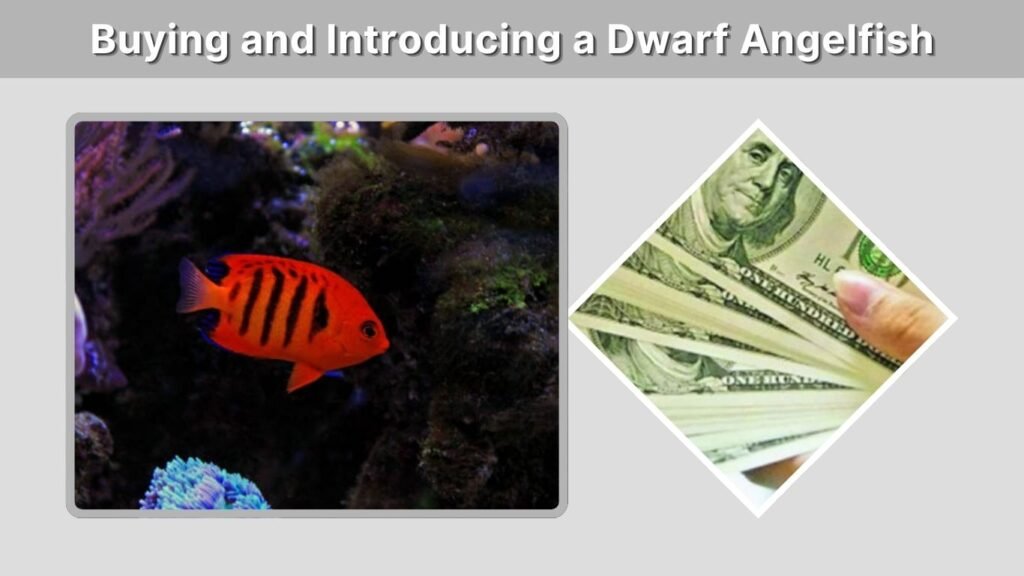
Choose a fish that is alert, actively swimming, and willing to eat. Avoid individuals with rapid breathing, cloudy eyes, torn fins, white spots, hollow abdomens, or repeated scratching against objects.
Quarantine the fish before introducing it to the display tank. During quarantine, confirm that it accepts several foods and watch for marine ich, velvet, flukes, and bacterial problems. Add the dwarf angel after peaceful tank mates when possible because an established angel may become territorial toward later additions.
FAQs
What is the smallest dwarf angelfish?
The cherub angelfish is one of the smallest widely kept species, reaching around 8 cm or roughly 3 inches. Several other pygmy angels reach similar sizes, but even tiny species require adequate swimming and territorial space.
Can a dwarf angelfish live in a 30-gallon tank?
One of the smallest species may live in a well-established 30-gallon aquarium, but larger dwarf angels require more space. A 55-gallon or larger tank generally offers better stability, grazing area, and compatibility options.
Can dwarf angelfish live with clownfish?
Yes, many dwarf angels can live with clownfish. Provide sufficient space and rockwork, and avoid combining particularly aggressive individuals. Monitor both fish during feeding and after the angel establishes a territory.
Can you keep different dwarf angelfish together?
It is possible but risky. Dwarf angels are territorial toward related fish. Mixing them is more likely to succeed in a large aquarium with extensive rockwork, different-looking species, and carefully planned introductions.
Can dwarf gouramis live with dwarf angelfish?
No. Dwarf gouramis are freshwater fish, while dwarf angelfish are marine fish requiring saltwater. A dwarf gourami may sometimes be considered for a freshwater community containing Pterophyllum angelfish, but temperament and tank size must be assessed carefully.